Why Is My Radiator Cold? Causes, Safe Checks and Solutions
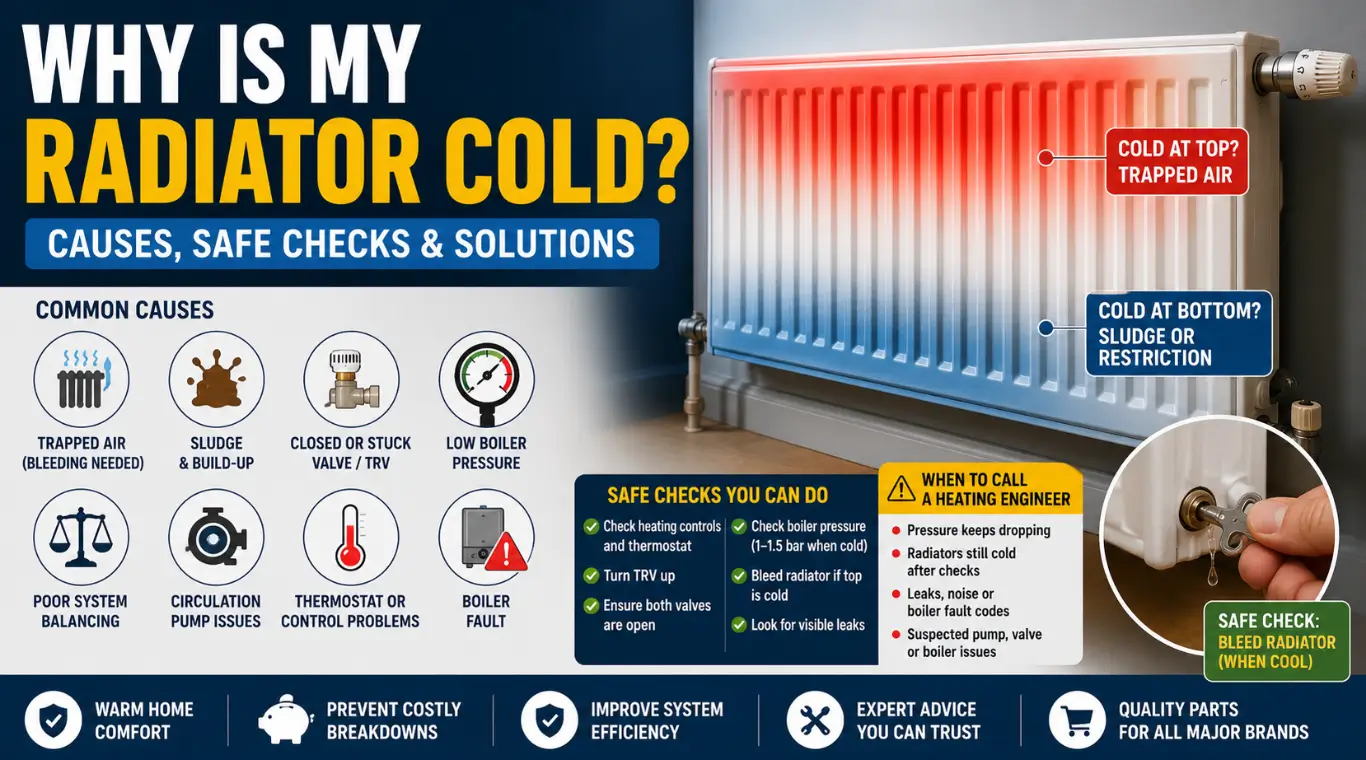
A radiator may remain cold because of trapped air, a closed or stuck valve, sludge, poor system balancing or a wider circulation problem. Where the radiator feels cold provides an important clue: a cold top commonly points to trapped air, while a cold bottom is more often associated with sludge or restricted water flow.
Start by checking whether the problem affects one radiator or the whole house. You can safely check the heating controls, radiator settings and boiler pressure, but valve repairs, system flushing and internal boiler work should be left to a competent heating engineer.
Table of contents
- Why Is My Radiator Cold? Quick Diagnosis
- Is One Radiator Cold or Are All the Radiators Cold?
- Radiator Cold at the Top but Warm at the Bottom
- Radiator Cold at the Bottom but Hot at the Top
- The Entire Radiator Is Cold
- One Radiator Is Cold but All the Others Are Hot
- Why Is the Radiator Hot on One Side but Cold on the Other?
- Why Are Several Radiators Cold?
- Why Are All My Radiators Cold?
- Why Is My Radiator Still Cold After Bleeding?
- Safe Checks a Homeowner Can Carry Out
- Checks for a Heating Engineer
- How to Prevent Cold Radiators
- Need Replacement Central-Heating Parts?
- Frequently Asked Questions
Why Is My Radiator Cold? Quick Diagnosis
| Radiator symptom | Possible cause | Safe first check |
| Cold at the top but warm at the botto | Trapped air | Bleed the radiator after switching the heating off |
| Cold at the bottom but warm at the top | Sludge or restricted circulation | Check whether other radiators have the same problem |
| Completely cold | Closed valve, stuck TRV, blockage or no water flow | Turn the TRV up and check the heating is on |
| One radiator cold while the others are hot | Local valve, air, balancing or blockage problem | Check both radiator valves are open |
| Several radiators cold | Low pressure, poor balancing or circulation problem | Check the boiler pressure and heating controls |
| Every radiator cold | Boiler, thermostat, programmer, pump or zone-control problem | Check for a boiler fault code and confirm heating demand |
| Still cold after bleeding | Air was not the main cause | Stop bleeding and investigate valves and circulation |
The temperature pattern is a useful starting point, but it cannot confirm the failed component on its own.
Is One Radiator Cold or Are All the Radiators Cold?
Before trying to fix the problem, check the rest of the heating system.
When one radiator is cold but the others are hot, the problem is usually local to that radiator. Possible causes include:
- Trapped air
- A closed radiator valve
- A stuck thermostatic radiator valve
- Incorrect balancing
- A blocked valve or radiator
- Restricted flow through the connecting pipework
When several or all radiators are cold, the cause may be elsewhere in the system. Check the thermostat, programmer, boiler pressure and boiler display before concentrating on an individual radiator.
This distinction prevents unnecessary bleeding or valve adjustments when the boiler is not actually supplying heat to the system.
Radiator Cold at the Top but Warm at the Bottom
A radiator that is cold at the top but warm underneath commonly contains trapped air. Air rises to the highest part of the radiator and prevents hot water from filling that section properly. Gurgling or trickling noises can also indicate air in the heating system. (Worcester Bosch)
How to bleed a cold radiator safely
- Switch off the central heating.
- Allow the radiator and system water to cool.
- Place a cloth beneath the bleed valve at the top of the radiator.
- Insert the correct radiator key.
- Slowly turn the key anticlockwise until air begins to escape.
- Close the valve as soon as water starts to appear.
- Wipe away any water and check that the valve is closed securely.
- Check the boiler pressure before turning the heating back on.
Do not remove the bleed valve completely. The escaping water may still be hot if the system has not cooled sufficiently.
Bleeding can cause the pressure in a sealed heating system to fall slightly. Many sealed systems normally operate at approximately 1 to 1.5 bar while cold, but the correct pressure varies, so check the boiler manufacturer’s instructions before repressurising. (British Gas)
Why does air keep returning?
Occasional bleeding can be normal. However, radiators that repeatedly fill with air may indicate:
- A small system leak
- Low system pressure
- Corrosion inside the heating system
- Incorrect pump settings
- Air entering through part of the system
- A problem with an open-vented system or feed-and-expansion arrangement
Repeated bleeding treats the symptom rather than the cause. Arrange an inspection if air quickly returns.
Radiator Cold at the Bottom but Hot at the Top
A radiator that is hot at the top but cold across the bottom is commonly affected by sludge, magnetite or restricted water circulation. Sludge settles in the lower part of the radiator and limits the amount of hot water that can pass through it. (Baxi)
Other possible causes include:
- A radiator that is not correctly balanced
- A partially closed lockshield valve
- A restricted thermostatic valve
- A weak or incorrectly set circulation pump
- Narrow or blocked connecting pipework
- Poor system-water condition
Bleeding is unlikely to resolve a cold bottom because trapped air normally collects at the top. Repeatedly opening the bleed valve may instead reduce the boiler pressure without improving the radiator.
How is radiator sludge treated?
Depending on the severity and condition of the system, an engineer may recommend:
- Removing and flushing an individual radiator
- Adding an approved system cleaner
- Cleaning the wider central-heating system
- Powerflushing where appropriate
- Rebalancing the radiators
- Replacing a heavily restricted radiator
- Adding fresh inhibitor after cleaning
- Installing or servicing a magnetic filter
Removing radiators or adding cleaning chemicals can create leaks or affect the boiler if performed incorrectly. This work is best handled by a competent heating professional.
The Entire Radiator Is Cold
If the radiator is cold from top to bottom, hot water may not be entering it.
Start by checking the thermostatic radiator valve, usually marked with numbers. Make sure it is not set to 0, the frost setting or its lowest position. Turn it to a higher setting and allow time for the system to respond.
Next, check the valve on the opposite side. This is normally the lockshield valve. It may have been closed during previous decorating, maintenance or balancing work.
Possible causes of a completely cold radiator include:
- The TRV is switched off
- The TRV pin is stuck closed
- The lockshield valve is closed
- The valve body is blocked
- The radiator is heavily restricted
- The system is poorly balanced
- No circulating water is reaching that section
A TRV can seize after remaining closed for several months, particularly when the heating has been off during summer. (Viessmann UK)
Do not pull the valve pin with pliers or dismantle the metal valve body. This can damage the valve or release heating water. If turning the TRV does not restore the flow, ask a heating engineer to inspect it.
One Radiator Is Cold but All the Others Are Hot
When only one radiator is affected, use this diagnostic order:
- Confirm the heating is running and the other radiators are warm.
- Turn the affected radiator’s TRV to a higher setting.
- Check that the opposite valve has not been closed.
- Feel whether the radiator is cold at the top, bottom or all over.
- Bleed it only when the top is cold and trapped air is suspected.
- Check whether the pipes leading to the radiator become warm.
- Arrange valve, balancing and blockage checks if it remains cold.
A hot inlet pipe leading to a cold radiator may suggest that water is reaching the valve but is not flowing properly through the radiator. When both connected pipes remain cold, there may be no flow reaching that branch of the system.
Pipe temperatures alone do not confirm which component is faulty, but they can help an engineer narrow down the problem.
Why Is the Radiator Hot on One Side but Cold on the Other?
A small temperature difference between the inlet and outlet sides can be normal because the water cools while passing through the radiator.
A large cold area, however, may suggest:
- Low water flow
- Poor radiator balancing
- A partially restricted valve
- Sludge or debris
- Restricted pipework
- An incorrectly sized or weak circulation pump
If multiple radiators heat unevenly, balancing or a system-wide circulation problem becomes more likely than a fault with one radiator.
Why Are Several Radiators Cold?
Several cold radiators may indicate that hot water is not being distributed evenly around the property.
Possible causes include:
- Poor system balancing
- Low boiler pressure
- Air within several radiators
- Circulation pump problems
- A closed zone valve
- Heating-control problems
- Sludge in the system
- Restrictions in the pipework
- A boiler fault or lockout
Check whether the cold radiators are all upstairs, downstairs or within one heating zone. A clear pattern can help identify a pressure, pump, zone-control or balancing issue.
Why Are All My Radiators Cold?
When every radiator is cold, the individual radiators are unlikely to have failed at the same time.
Check:
- Is the boiler switched on?
- Is central heating selected on the programmer?
- Is the thermostat set above the current room temperature?
- Is a fault code showing?
- Is the boiler pressure within the manufacturer’s recommended range?
- Are the boiler and controls receiving power?
- Is there hot water but no central heating?
- Does the boiler attempt to fire when heating is requested?
Low pressure can prevent some sealed heating systems from operating correctly. British Gas and Worcester Bosch both advise checking the pressure when central heating stops working, while following the instructions for the specific boiler. (Worcester Bosch)
Do not remove the boiler casing or attempt to inspect the pump, wiring, PCB, gas valve or internal controls. Internal boiler diagnosis should be completed by a suitably qualified engineer, with gas-appliance work handled by a Gas Safe registered engineer.
Why Is My Radiator Still Cold After Bleeding?
If the radiator remains cold after air has been released, trapped air was probably not the main problem.
The next areas to investigate are:
- TRV operation
- Lockshield position
- Radiator balancing
- Sludge or internal blockage
- Pipework restrictions
- Boiler pressure
- Pump performance
- Wider circulation problems
Do not keep bleeding the radiator once water flows steadily from the bleed valve. Further bleeding will release system water and may lower the pressure unnecessarily.
Safe Checks a Homeowner Can Carry Out
Homeowners can normally:
- Check the thermostat and programmer
- Confirm that central heating is selected
- Look for a boiler fault code
- Check the boiler pressure against the user manual
- Turn the TRV to a higher setting
- Confirm visible radiator valves are not switched off
- Bleed a cool radiator when the top is cold
- Look for visible water leaks
- Compare the affected radiator with others in the property
Stop if a valve begins leaking, the bleed screw is damaged, the boiler pressure repeatedly falls or you are unsure how the heating system operates.
Checks for a Heating Engineer
A competent heating engineer may investigate:
- Whether the TRV and lockshield valves operate correctly
- Flow and return temperatures
- Radiator balancing
- Pump operation and settings
- Zone valves and heating controls
- System pressure and expansion arrangements
- Sludge and water quality
- Restrictions within valves, radiators and pipework
- Whether cleaning, flushing or replacement is required
Boiler casing removal, combustion checks and repairs involving internal gas-appliance components must be completed by an appropriately qualified Gas Safe registered engineer.
How to Prevent Cold Radiators
Cold spots cannot always be prevented, but good system maintenance can reduce the risk.
Useful measures include:
- Operating TRVs occasionally during warmer months
- Checking for leaks and unexplained pressure loss
- Having the heating system balanced correctly
- Maintaining the correct level of corrosion inhibitor
- Cleaning or servicing the magnetic filter
- Investigating recurring air rather than repeatedly bleeding
- Addressing sludge before it damages pumps and other components
- Arranging appropriate boiler and central-heating maintenance
Sludge can affect radiator output and may also contribute to pump leaks, component contamination and poor heating performance. (Baxi)
Need Replacement Central-Heating Parts?
A cold radiator does not automatically mean the radiator needs replacing. The cause may instead be a thermostatic valve, lockshield valve, circulation pump, heating control or system-water problem.
Heating & Catering Parts supplies a wide range of:
- Thermostatic radiator valves
- Radiator and lockshield valves
- Central-heating pumps
- Heating controls
- Magnetic filters
- Boiler and central-heating components
Check the existing part, connection size and system requirements before ordering. When identifying a boiler-related component, use the boiler model, GC number and the part number printed on the existing component wherever possible.
Frequently Asked Questions
Usually not. A cold bottom with a warm top is more commonly associated with sludge or restricted circulation than trapped air. Bleeding removes air from the top of the radiator and is unlikely to clear sediment from the bottom.
A single cold radiator commonly has a local issue such as trapped air, a closed or stuck valve, poor balancing or a blockage. Check its temperature pattern and valve settings before investigating the wider system.
Yes. Low pressure can reduce or prevent circulation in some sealed heating systems. Check the pressure against the instructions for your boiler rather than relying on one universal pressure figure.
Recurring air can indicate a leak, corrosion, low pressure or another system problem. If air returns regularly, arrange an inspection instead of continuing to bleed the radiator.
No. Many cold-radiator problems are caused by valves, air, balancing, sludge or circulation. Replacement should only be considered after the cause has been properly diagnosed.
Yes. A weak, blocked or failed circulation pump may prevent hot water from reaching some or all radiators. Pump inspection and replacement should be completed by a competent heating engineer.
Key Takeaways
- Radiators may feel cold due to trapped air, closed valves, or sludge, and symptoms can indicate specific issues.
- Check the heating system as a whole before diagnosing a single radiator issue to avoid unnecessary repairs.
- For a radiator cold at the top, bleeding may resolve trapped air; if cold at the bottom, sludge or blockage is likely.
- Homeowners can safely perform basic checks, but complex issues should be handled by a competent heating engineer.
- Regular maintenance and addressing sludge can prevent future cold radiator issues.