What Size Combi Boiler Do I Need? UK kW Guide
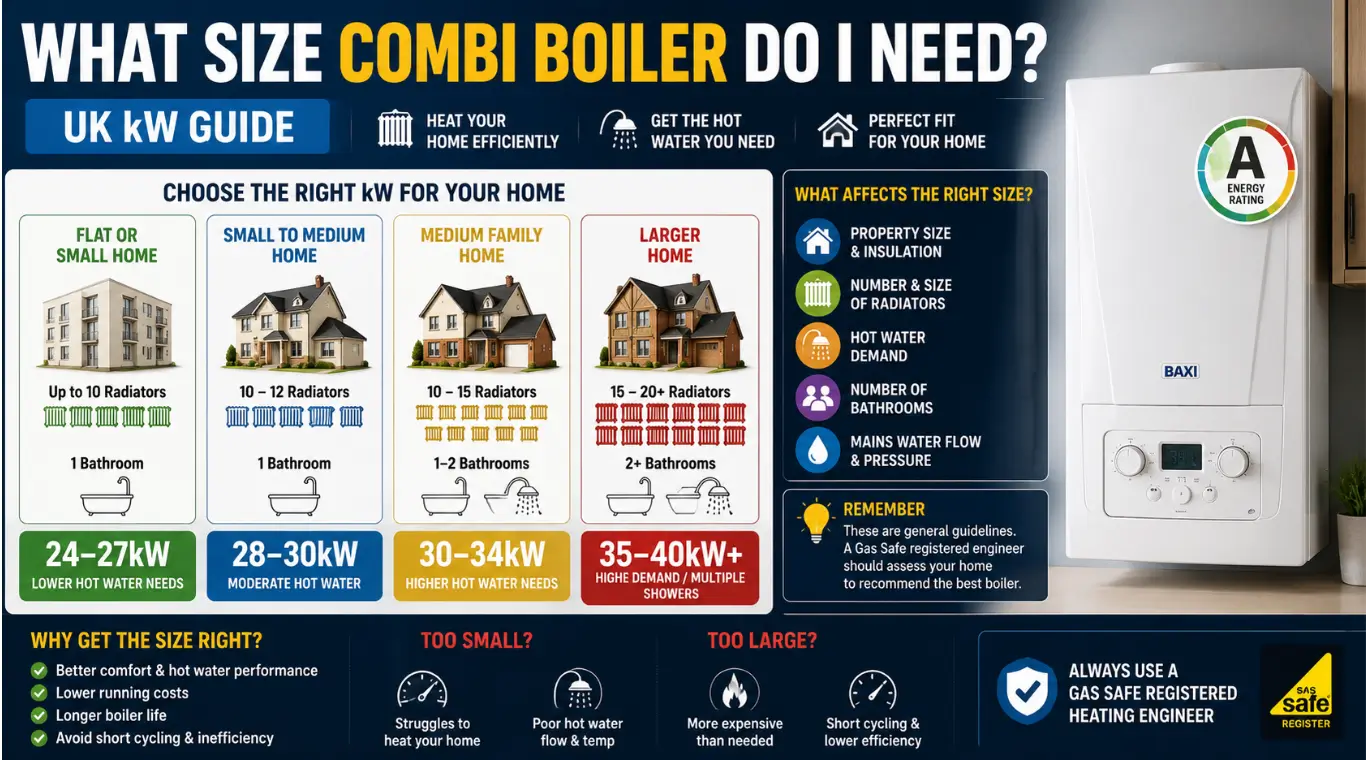
The right combi boiler size depends on two separate demands: how much heat your property needs and how much hot water your household uses. As a starting point, homes with up to 10 radiators and one bathroom often consider a 24–27kW combi. Properties with 10–15 radiators or greater hot-water demand commonly look at approximately 28–34kW, while larger homes may require 35kW or more.
These figures are only general guidelines. Insulation, heat loss, incoming mains-water flow and simultaneous shower use can all change the final recommendation. A Gas Safe registered heating engineer should assess the property before the boiler is selected.
Table of contents
- Quick Combi Boiler Size Guide
- What Does the kW Rating on a Combi Boiler Mean?
- Central Heating and Hot Water Must Be Considered Separately
- What Size Combi Boiler for Up to 10 Radiators?
- What Size Combi Boiler for 10 to 15 Radiators?
- What Size Combi Boiler for 15 to 20 Radiators?
- 24kW vs 30kW vs 35kW Combi Boilers
- Can a Combi Boiler Run Two Showers at Once?
- Why a Heat-Loss Calculation Matters
- What Happens If the Combi Boiler Is Too Small?
- What Happens If the Combi Boiler Is Too Large?
- Questions to Ask Before Choosing a Combi Boiler
- Final Recommendation
- Frequently Asked Questions
Quick Combi Boiler Size Guide
| Typical property | Radiators | Hot-water use | Approximate combi size |
| Flat or small house | Up to 10 | One bathroom with modest demand | 24–27kW |
| Small-to-medium house | Around 10–12 | One bathroom with regular use | 28–30kW |
| Medium family home | Around 10–15 | Bathroom plus occasional ensuite use | 30–34kW |
| Larger home | Around 15–20 | Higher hot-water demand | 35–40kW |
| Multiple bathrooms used together | Varies | Two or more simultaneous showers | A combi may not be the best system |
These ranges broadly reflect current manufacturer and UK heating-industry guidance, but different sources use slightly different property assumptions. For example, Ideal Heating suggests approximately 24–27kW for up to 10 radiators and 28–34kW for 10–15 radiators, while Vaillant also uses bedrooms, bathrooms and radiator numbers as general indicators. (Ideal Heating)
What Does the kW Rating on a Combi Boiler Mean?
A boiler’s output is measured in kilowatts, written as kW. This indicates how much heat the appliance can produce rather than how much electricity it consumes.
However, a combi boiler often has two different maximum outputs:
- Central-heating output for radiators
- Domestic hot-water output for taps and showers
The large number displayed in the model name is commonly linked to its maximum hot-water performance. The maximum central-heating output may be lower.
For example, a boiler sold as a 30kW combi may provide close to 30kW for instant hot water but have a lower or adjustable maximum output for the radiators. The precise figures differ between products, so the technical data should always be checked.
This is why selecting a combi by counting radiators alone can be misleading. In many homes, hot-water demand determines whether a 24kW, 30kW or 35kW model is recommended.
Central Heating and Hot Water Must Be Considered Separately
A combi boiler heats the radiators and produces hot water without requiring a separate hot-water cylinder. It is compact and convenient, but all hot water must be heated instantly when a tap or shower is opened. (Energy Saving Trust)
Your heating requirement depends on factors such as:
- Property size
- Insulation
- Window quality
- External walls
- Ceiling height
- Number and size of radiators
- Local winter conditions
- Desired indoor temperature
Your hot-water requirement depends more on:
- Number of bathrooms
- Type of shower
- Bath-filling expectations
- Number of people in the household
- Whether taps and showers are used together
- Incoming mains-water flow and pressure
A well-insulated three-bedroom house may need relatively little output to heat its rooms but still require a larger combi because the household expects stronger shower and bath performance.
What Size Combi Boiler for Up to 10 Radiators?
A 24–27kW combi boiler is often considered for a flat, apartment or smaller house with:
- Up to approximately 10 average radiators
- One bathroom
- Modest hot-water demand
- One main shower or bath
- No regular need to operate two hot-water outlets together
This output range can be sufficient for many one- or two-bedroom properties and some well-insulated three-bedroom houses.
However, the number of bedrooms is not the deciding factor by itself. A small older property with poor insulation may lose more heat than a larger modern house. Similarly, a compact home with a high-flow shower may need better hot-water performance than the radiator count suggests.
What Size Combi Boiler for 10 to 15 Radiators?
A 28–34kW combi boiler is a common starting range for medium-sized family homes with:
- Around 10–15 radiators
- Three or four bedrooms
- One main bathroom
- An ensuite that is not regularly used at the same time
- Moderate-to-high hot-water demand
A 30kW combi is frequently considered a middle option because it offers stronger hot-water delivery than a typical 24kW model without moving into the largest domestic boiler range.
British Gas provides a rough recommendation of around 30kW for properties with 11–15 radiators and one or two baths or showers. However, it also emphasises that these tables are general rather than a substitute for an individual assessment. (British Gas)
What Size Combi Boiler for 15 to 20 Radiators?
Larger properties with approximately 15–20 radiators may require a 32–40kW combi, depending on heat loss and hot-water demand.
A higher-output model may be considered when the home has:
- Several bedrooms
- Large or double-panel radiators
- Poorer insulation
- High ceilings or large rooms
- A bath and ensuite
- Higher expectations for hot-water flow
Nevertheless, a 40kW combi is not automatically the correct answer for every large house. The central-heating demand may still be much lower than 40kW. The larger rating is often needed to improve instant hot-water production rather than to heat the radiators.
The installer should check whether the chosen boiler can reduce its heating output sufficiently when the property requires less heat.
24kW vs 30kW vs 35kW Combi Boilers
24kW combi boiler
Usually considered for smaller homes with one bathroom and relatively light hot-water use.
It may be suitable when:
- There are up to approximately 10 radiators.
- Only one shower or major hot-water outlet is normally used.
- The incoming water supply is modest.
- The property has reasonable insulation.
30kW combi boiler
A common option for medium-sized homes where improved hot-water performance is required.
It may be suitable when:
- There are approximately 10–15 radiators.
- The home has one bathroom and possibly an ensuite.
- The household wants quicker bath filling or stronger shower performance.
- Hot-water demand is moderate rather than simultaneous.
35kW or larger combi boiler
Usually considered where hot-water demand is higher.
It may be suitable when:
- The property is larger.
- There are approximately 15 or more radiators.
- The home has a bathroom and regularly used ensuite.
- A higher hot-water flow rate is needed.
- The incoming mains supply can support the additional flow.
A larger output cannot create water flow that the property does not already receive. If the incoming mains supply is weak, fitting a more powerful combi may provide little improvement. Vaillant advises that the available options for improving shower performance with a combi are limited by the existing water supply and system conditions. (Vaillant)
Can a Combi Boiler Run Two Showers at Once?
Sometimes, but performance depends on the boiler, shower types and incoming mains supply.
A combi does not store a large quantity of ready-heated water. When two showers run together, the available heated flow must be divided between them. This can cause:
- Reduced flow at both showers
- Temperature changes
- Slower bath filling
- A noticeable drop when another tap is opened
A higher-output combi can improve the total amount of hot water produced, but it cannot overcome inadequate mains flow.
Homes where two or more bathrooms are regularly used at the same time may be better suited to a stored-hot-water arrangement. Although this article focuses on combis, homeowners should not assume that the largest available combi is always the best solution.
Why a Heat-Loss Calculation Matters
Radiator count is convenient, but it does not show how quickly a building loses heat.
A proper assessment considers the property’s:
- Measurements and room volumes
- External walls
- Roof and floor construction
- Insulation
- Windows and doors
- Air leakage
- Desired room temperatures
- Local design temperature
Two properties with 10 radiators can therefore require very different heating outputs.
Worcester Bosch notes that each heating system requires individual design and recommends a home assessment before choosing a boiler. (Worcester Bosch)
The radiator table should therefore be used for understanding quotations, not for independently specifying the final appliance.
What Happens If the Combi Boiler Is Too Small?
An undersized boiler may struggle to meet peak demand.
Possible symptoms include:
- Slow bath filling
- Lower-than-expected shower flow
- Hot-water temperature dropping during high use
- Rooms taking longer to warm up
- Difficulty maintaining temperature in very cold weather
- Poor performance when several outlets are opened
However, slow radiator warm-up does not automatically prove that the boiler is undersized. Poor balancing, sludge, low flow temperature, pump problems or inadequate controls can produce similar symptoms.
The whole system should be assessed before replacing a boiler purely because the home heats slowly.
What Happens If the Combi Boiler Is Too Large?
Modern boilers can modulate, meaning they reduce their burner output when the property needs less heat. This makes a larger appliance more flexible than an older fixed-output boiler.
However, modulation does not make boiler sizing irrelevant.
If the boiler’s minimum heating output is still higher than the property’s demand, it may repeatedly switch on and off. This is known as short cycling. Frequent cycling can reduce efficiency and place unnecessary strain on components. Vaillant’s technical guidance notes that oversizing can cause short cycling and reduce system efficiency. (myVaillant Pro)
An unnecessarily large boiler may also:
- Cost more to purchase
- Provide unused hot-water capacity
- Be less well matched to a small heating load
- Require greater gas-supply capacity
- Operate in shorter heating cycles
When comparing products, look at both the maximum hot-water output and the minimum central-heating output. A wide modulation range can be particularly useful in a well-insulated home.
Questions to Ask Before Choosing a Combi Boiler
Before accepting an installation quotation, ask:
- What is the calculated heat loss of the property?
- What are the boiler’s maximum and minimum heating outputs?
- What hot-water flow rate should I expect?
- Has the incoming mains-water flow been measured?
- Will it support my shower and bath requirements?
- Can two outlets be used together?
- Has the boiler been selected mainly for heating or hot water?
- Will the heating output be correctly commissioned for the property?
- Are any radiator or pipework changes required?
- Is a combi definitely the most suitable system?
The installer should explain why the proposed output suits both the home and the household’s normal usage.
Final Recommendation
For a simple starting point:
- 24–27kW: smaller property, up to around 10 radiators and one bathroom
- 28–34kW: medium property, around 10–15 radiators and moderate hot-water demand
- 35–40kW: larger property or higher hot-water demand
Do not choose a boiler from this table alone. Property heat loss, hot-water habits, mains flow and the boiler’s minimum heating output are equally important.
A new gas boiler must be fitted by an appropriately qualified Gas Safe registered engineer. Gas Safe Register confirms that engineers installing or working on gas boilers must be registered and qualified for that category of work. (gassaferegister.co.uk)
Frequently Asked Questions
It can be, particularly where the property is well insulated, has around 8–10 radiators and only one bathroom. Hot-water demand and heat loss should still be assessed.
A 24–30kW combi is a common starting range. The final choice depends more heavily on bathroom use and mains-water performance than radiator count alone.
Not necessarily. Its larger rating may be required for hot water. However, the minimum central-heating output should be checked to make sure it can operate efficiently at the property’s lower heating demand.
It may heat a greater flow of water, but it cannot improve the incoming mains pressure or flow supplied to the property.
Not always. Radiator size, system balancing, pipework, controls and flow temperature also affect warm-up time. Once the boiler can meet the calculated heat loss, extra maximum output may provide little benefit.
Key Takeaways
- Choosing the right size combi boiler depends on your property’s heat and hot-water demands, typically ranging from 24–27kW for smaller homes to 35kW+ for larger ones.
- General guidelines suggest a 24–27kW combi for homes with up to 10 radiators, 28–34kW for 10–15 radiators, and 35kW or higher for larger properties.
- Always consider factors like insulation, heat loss, and water flow rates when selecting the boiler size.
- Consult a Gas Safe registered heating engineer for an accurate assessment, rather than relying solely on radiator count.
- Balance heating output needs with hot-water demands to find the most suitable combi boiler for your home.