Water Dripping From a Tundish? Causes & What It Means
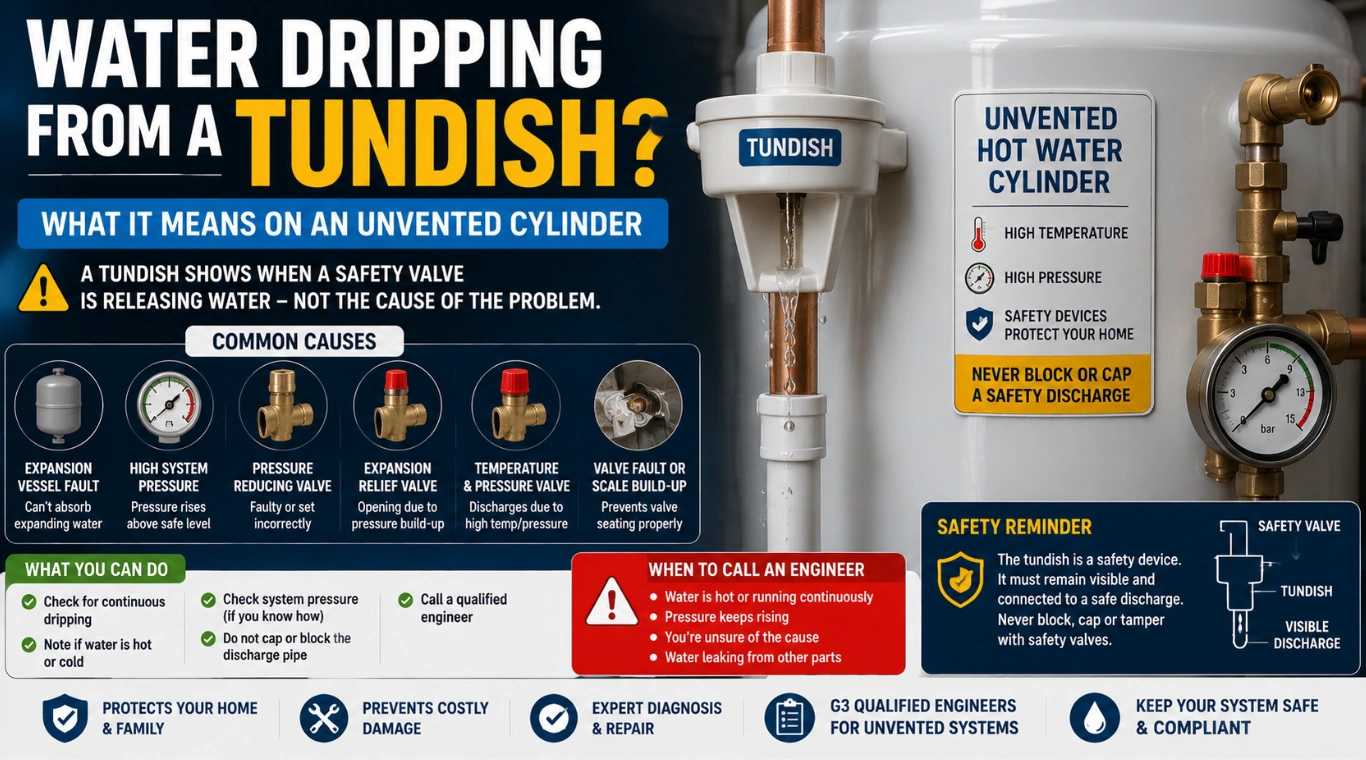
If you can see water dripping through the tundish on an unvented hot water cylinder, it usually means one of the system’s safety or pressure-control devices is discharging water. The tundish itself is normally showing you that there is a problem elsewhere, rather than being the cause of the leak.
Common causes can include an expansion vessel problem, excessive system pressure, a pressure reducing valve fault, an expansion relief valve opening or a temperature and pressure relief valve operating. Persistent discharge should be investigated by a suitably qualified engineer.
Table of contents
- Quick Answer: Why Is My Tundish Dripping?
- What Is a Tundish?
- Is It Normal for a Tundish to Drip?
- Cold Water Dripping From the Tundish
- Hot Water Dripping From the Tundish
- How Does an Unvented Cylinder Control Pressure?
- Common Causes of a Dripping Tundish
- Is the Tundish Itself Leaking?
- Can an Expansion Vessel Cause a Tundish to Drip?
- Can a Pressure Reducing Valve Cause Tundish Discharge?
- Can a T&P Valve Cause the Problem?
- What Can a Homeowner Safely Check?
- What Should You Never Do to a Dripping Tundish?
- Who Can Repair an Unvented Hot Water Cylinder?
- Can You Ignore a Dripping Tundish?
- Parts That May Be Related to Tundish Discharge
- Need Help Finding the Correct Cylinder Part?
- Frequently Asked Questions
Quick Answer: Why Is My Tundish Dripping?
A tundish is designed to provide a visible indication when water is being released from the safety valves on an unvented hot water system. Under normal operation, you would not expect to see continuous water flowing through it.
If your tundish is dripping or running, the important question is why a safety valve is discharging.
Possible reasons include:
- The expansion vessel has lost its charge or is not working correctly
- The system pressure is becoming too high
- The pressure reducing valve is not controlling incoming pressure correctly
- An expansion relief valve is opening
- The cylinder is overheating
- The temperature and pressure relief valve has operated
- A relief valve has become worn, scaled or unable to reseat correctly
The exact cause needs to be diagnosed before any replacement part is ordered.
What Is a Tundish?
A tundish is fitted into the discharge pipework of an unvented hot water cylinder. It creates an air gap and, importantly, allows you to see when a safety device is releasing water.
Approved Document G describes a tundish as part of the safety discharge arrangement and states that discharge should be visible at the tundish.
Manufacturers such as Heatrae Sadia also explain that visible water through the tundish indicates that the system requires attention from a qualified and competent person.
So if you notice water passing through it, don’t assume that replacing the tundish will solve the problem. The tundish is often simply revealing a fault elsewhere in the cylinder or its controls.
Is It Normal for a Tundish to Drip?
Persistent dripping from a tundish should not simply be ignored.
An unvented cylinder contains several controls designed to manage the pressure created as water heats and expands. If pressure or temperature rises outside the intended operating conditions, one of the safety valves may discharge water through the tundish.
Occasional observations need to be assessed in the context of the particular cylinder and installation, but continuous, repeated or substantial discharge should be investigated.
If the water appears very hot or there is a significant continuous flow, arrange professional inspection rather than attempting to alter any of the cylinder’s safety controls.
Cold Water Dripping From the Tundish
If relatively cold water is discharging through the tundish, a pressure or expansion problem may be involved.
The source material identifies common possibilities including a failed pressure reducing valve or an expansion vessel that has lost its charge. Without sufficient space to absorb the expansion of heated water, system pressure can rise until an expansion relief valve opens.
Possible causes include:
- Expansion vessel has lost its air charge
- Expansion vessel diaphragm has failed
- Internal expansion air space has been lost on cylinders that use one
- Incoming water pressure is too high
- Pressure reducing valve is faulty
- Expansion relief valve is opening
- Relief valve is damaged or contaminated with scale or debris
An engineer will normally need to establish which valve is actually discharging and why before deciding whether a component needs replacement.
Hot Water Dripping From the Tundish
Hot water passing through the tundish needs particular attention because it may indicate that a temperature-related safety device is operating.
Unvented cylinders use temperature controls to stop the stored water becoming excessively hot. If normal temperature control fails, additional safety devices are provided to stop the heat source or release dangerously hot water.
The supplied technical material describes the temperature and pressure relief valve, commonly called the T&P valve, as the final mechanical safety device if temperature or pressure reaches an unsafe level.
A T&P valve protects the cylinder by allowing water to discharge when excessive temperature or pressure conditions occur.
Hot discharge does not automatically tell you which component has failed, so the thermostat, high-limit control, T&P valve and other controls need proper investigation.
How Does an Unvented Cylinder Control Pressure?
Water expands when it is heated. In a sealed unvented system, that additional volume must be safely accommodated.
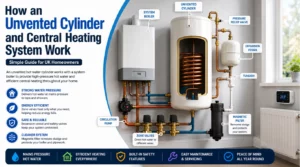
Several components work together to control the cylinder.
Pressure Reducing Valve
Incoming mains water may be at a higher pressure than the cylinder is designed to operate at.
A pressure reducing valve, often incorporated into the inlet control group, regulates the incoming supply to the required pressure.
If this control is not working correctly, excessive pressure may contribute to a relief valve discharging.
Expansion Vessel or Expansion Space
When stored water heats up, it expands.
Depending on the cylinder design, this expansion may be accommodated by:
- An external expansion vessel
- An internal expansion air space
If the available expansion capacity is reduced or lost, system pressure can rise significantly during heating.
Thermostat
The thermostat controls the normal stored-water temperature by switching the heat source off when the required temperature is reached.
High-Limit Safety Cut-Out
A separate high-limit or energy cut-out provides another level of protection if the normal thermostat fails.
This is designed to interrupt the heat source before the cylinder reaches a dangerous temperature.
Temperature and Pressure Relief Valve
The T&P relief valve provides a further safety mechanism.
If excessive temperature or pressure develops, it can open and discharge water into the safety discharge pipework through the tundish.
These controls are why safety valves should never be capped, isolated or prevented from operating.
Common Causes of a Dripping Tundish
| Possible cause | What may be happening |
| Expansion vessel problem | The system cannot adequately absorb the increased water volume as it heats |
| Loss of internal expansion space | Some cylinders rely on an internal air space that may require attention |
| Pressure reducing valve fault | Incoming mains pressure may not be controlled correctly |
| Expansion relief valve operating | System pressure has risen sufficiently for the safety valve to discharge |
| Temperature control fault | Stored water may be heating beyond its intended temperature |
| T&P relief valve operating | Excessive temperature or pressure has activated a safety device |
| Scaled or worn valve | A relief valve may fail to reseat correctly after operating |
| Debris in the valve | Contamination can sometimes prevent a valve from sealing properly |
Importantly, seeing water in the tundish alone is not enough to identify the faulty component.
Is the Tundish Itself Leaking?
Usually, the more important question is not whether the tundish is faulty, but where the water entering it is coming from.
The tundish sits in the discharge route from one or more safety valves. Water appearing inside it therefore often originates from another component.
An engineer may need to determine whether the discharge is coming from:
- An expansion relief valve
- A temperature and pressure relief valve
- Another approved safety device within the installation
Replacing the visible tundish without diagnosing the source of the discharge is unlikely to solve the underlying problem.
Can an Expansion Vessel Cause a Tundish to Drip?
Yes.
The expansion vessel provides space for the additional volume created when water heats up.
If the vessel loses its air charge, its diaphragm fails or it can no longer provide sufficient expansion capacity, pressure can increase as the cylinder heats. A pressure relief device may then open and discharge water through the tundish.
This is one reason a tundish may drip predominantly while the cylinder is heating.
However, the expansion vessel should be properly tested before being replaced. A dripping tundish does not by itself prove that the vessel has failed.
Can a Pressure Reducing Valve Cause Tundish Discharge?
It can.
The pressure reducing valve controls the pressure of water entering the unvented cylinder.
If it allows excessive incoming pressure through, the downstream pressure may rise enough for an expansion or pressure relief valve to operate.
The engineer may therefore check both the incoming water pressure and the performance of the inlet control group when investigating repeated tundish discharge.
Can a T&P Valve Cause the Problem?
A temperature and pressure relief valve can itself develop a problem, but it is important not to assume the valve is faulty simply because it is releasing water.
It may be doing exactly what it was designed to do because another fault has caused excessive temperature or pressure.
Possible scenarios include:
- The valve is correctly responding to an unsafe condition
- Scale or debris is preventing it from resealing
- The valve has deteriorated with age
- Another pressure or temperature control has failed upstream
The underlying cause should therefore be established before replacing a T&P valve.
What Can a Homeowner Safely Check?
There are only a few useful observations a homeowner should make.
You can safely note:
- Whether the dripping is continuous or intermittent
- Whether it mainly happens while the cylinder is heating
- Whether the discharge appears hot or cold, without touching potentially hot water
- Whether the flow is a slow drip or a substantial discharge
- The make and model of the hot water cylinder
- Whether there are any obvious external leaks around the system
You should then provide this information to the engineer.
Do not dismantle the cylinder controls or attempt to test the safety valves yourself unless you are appropriately qualified.
What Should You Never Do to a Dripping Tundish?
Never try to stop the symptom by interfering with the discharge system.
Do not:
- Cap the tundish
- Plug a discharge pipe
- Close off a safety valve
- Remove the T&P valve
- Alter the discharge pipework
- Adjust safety controls to prevent them operating
Approved Document G requires the discharge arrangement to safely carry released water to an appropriate termination, and discharge must be visible at the tundish.
Preventing a safety valve from discharging can remove an important protection from the unvented cylinder.
Who Can Repair an Unvented Hot Water Cylinder?
Work on an unvented hot water cylinder should be carried out by someone with the appropriate competence and qualification for unvented hot water systems.
This is commonly referred to as G3 unvented hot water qualification or competence, referring to the requirements associated with Approved Document G.
Manufacturer guidance also states that installers working on unvented systems must hold the appropriate qualification.
Gas Safe registration may also be relevant where work involves a gas boiler or gas appliance, but Gas Safe registration and unvented-cylinder competence are not the same qualification.
Can You Ignore a Dripping Tundish?
It is not a good idea.
Even where the immediate cause is relatively straightforward, such as an expansion issue, ongoing discharge means the system is not operating normally.
Leaving it unresolved can lead to:
- Continued water wastage
- Scale deposits around valves and discharge pipework
- Further deterioration of safety components
- Increasing pressure-control problems
- Damage around the discharge termination
- A more serious temperature or pressure fault going unnoticed
The safest approach is to identify the reason the valve is opening.
Parts That May Be Related to Tundish Discharge
Depending on the diagnosis, related components may include:
- Expansion vessels
- Pressure reducing valves
- Inlet control groups
- Expansion relief valves
- Temperature and pressure relief valves
- Cylinder thermostats
- High-limit thermostats or energy cut-outs
- Tundishes and approved discharge components
A dripping tundish does not confirm which of these parts needs replacing.
Before ordering, check the cylinder manufacturer, model and existing component details. Part specifications and pressure ratings can vary between cylinder systems.
Need Help Finding the Correct Cylinder Part?
Heating & Catering Parts stocks a wide range of heating and hot water system components.
If an engineer has identified the faulty part, check the manufacturer, cylinder model and existing part number before ordering.
If you are unsure which replacement component is required, send us a clear photo of the cylinder data label and existing component and we can help you identify the correct part.
Frequently Asked Questions
Water passing through the tundish usually means a safety or pressure relief valve is discharging. Possible causes include excessive pressure, inadequate expansion capacity, temperature-control problems or a fault with one of the relief valves.
During normal operation you would not generally expect persistent visible discharge through the tundish. Repeated or continuous dripping should be investigated.
This can happen when system pressure increases as the stored water expands. An expansion vessel or expansion provision problem is one possible cause, but proper diagnosis is required.
It depends on why it is dripping. The discharge may simply indicate a pressure-control problem, but it can also occur when an important temperature or pressure safety device has operated. Persistent discharge should therefore not be ignored.
Hot discharge may indicate that a temperature-related safety device has operated. Avoid touching the discharged water and arrange professional inspection.
Key Takeaways
- A dripping tundish indicates a safety or pressure relief valve is discharging, signalling a potential issue in the hot water system.
- Common causes of discharge include problems with the expansion vessel, high system pressure, or faults with the pressure reducing valve.
- Persistent dripping should not be ignored; it can lead to water wastage and further system damage if left unresolved.
- The source of the water should be diagnosed by a qualified engineer, rather than assuming the tundish itself is faulty.
- Homeowners can observe conditions but should avoid attempting repairs; certified professionals should handle complex issues.