Combi Boiler Hot Water Going Hot and Cold? Causes Explained
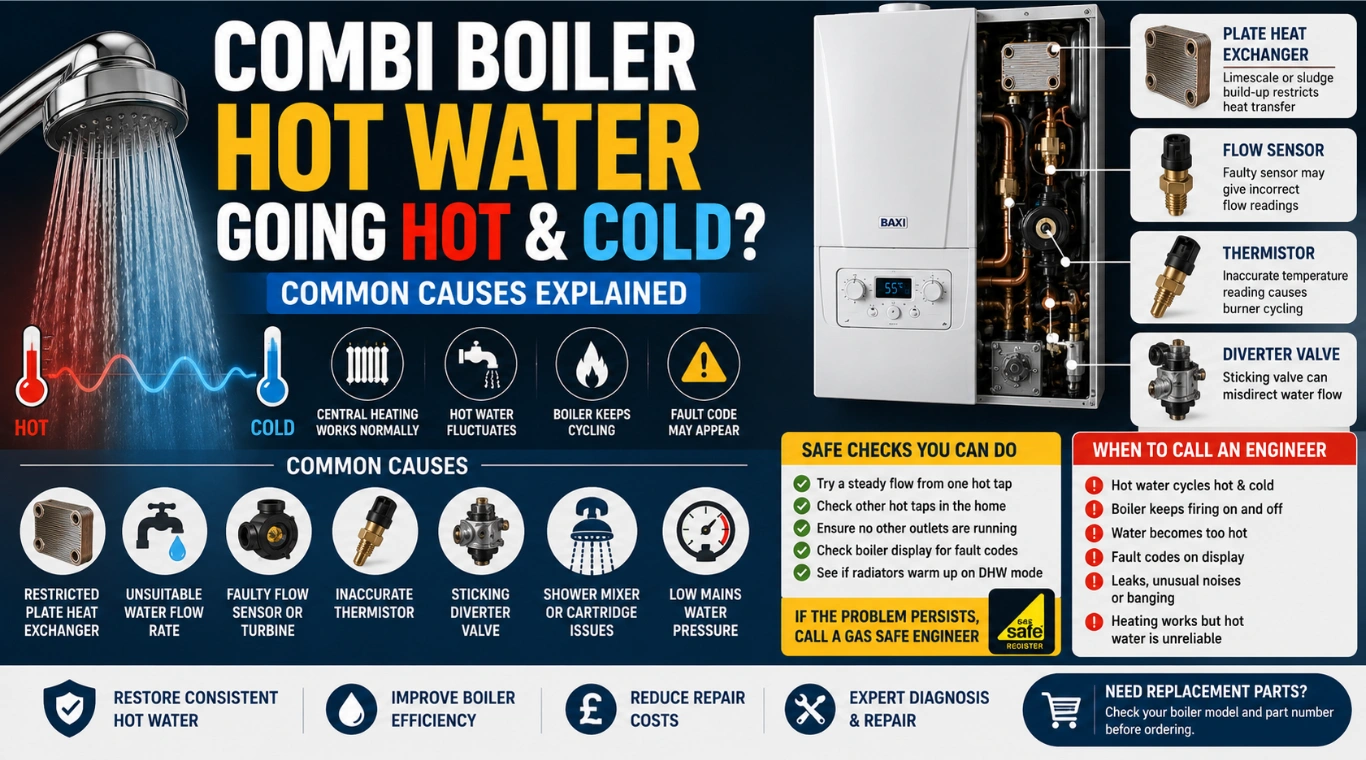
If your combi boiler’s hot water keeps changing from hot to cold, the problem may be caused by a restricted plate heat exchanger, an unsuitable water-flow rate, a faulty flow sensor, an inaccurate thermistor or a diverter-valve problem.
A blocked plate heat exchanger is a common possibility, particularly when the central heating works normally but the hot water repeatedly heats up, turns cold and then becomes hot again. However, the symptom alone does not confirm which component has failed.
Internal testing and boiler repairs should be completed by a suitably qualified Gas Safe registered engineer.
Table of contents
- Quick answer
- What does fluctuating hot water look like?
- 1. A restricted plate heat exchanger
- 2. The water flow is too low
- 3. The water flow is too high
- 4. A faulty flow sensor or turbine
- 5. An inaccurate hot-water thermistor
- 6. A sticking diverter valve
- 7. A problem with the shower rather than the boiler
- Safe checks a homeowner can make
- How an engineer diagnoses fluctuating hot water
- Can a plate heat exchanger be cleaned?
- When should you call an engineer?
- Need the correct replacement boiler part?
- Frequently Asked Questions
Quick answer
When combi-boiler hot water goes hot and cold, first check whether the problem affects every hot tap or only one shower.
- Every hot outlet is affected: the fault is more likely to be associated with the boiler, water flow or mains supply.
- Only one shower is affected: the shower’s thermostatic mixer or cartridge may need investigating.
- Hot water repeatedly heats and cools in a cycle: the boiler may be switching its burner on and off because of restricted flow or inaccurate temperature information.
- Central heating works but hot water is unreliable: possible causes include the plate heat exchanger, flow sensor, thermistor or diverter valve.
Combi boilers heat mains water when a tap or shower is opened, rather than storing a cylinder of hot water. Consistent performance therefore depends on adequate mains flow and the boiler correctly detecting, heating and controlling that flow.
What does fluctuating hot water look like?
The exact pattern can provide useful clues.
| What happens | Possible area to investigate |
| Water cycles from very hot to cold and back again | Restricted heat transfer, low flow or burner cycling |
| Water stays warm but never becomes properly hot | High tap flow, reduced boiler output or restricted heat exchanger |
| Hot water stops when the tap is turned down | Flow rate may be below the boiler’s minimum operating requirement |
| Boiler does not react when a tap opens | Flow sensor, turbine or flow switch |
| Hot water is unreliable but heating works normally | Domestic-hot-water components |
| Radiators become warm when a hot tap is running | Diverter valve may not be moving correctly |
| Only the shower fluctuates | Shower mixer, cartridge or local flow issue |
| Every hot tap fluctuates | Boiler or incoming water-supply issue |
1. A restricted plate heat exchanger
The domestic-hot-water plate heat exchanger transfers heat from the boiler’s sealed primary circuit to the mains water travelling towards the taps. The two water supplies pass through separate internal channels and should not mix.
Over time, these narrow channels can become restricted by deposits. Depending on which side is affected, this may include limescale from the incoming water or magnetite and debris from the heating circuit.
When heat cannot pass through the plate heat exchanger effectively, the boiler’s internal temperature may rise quickly. The burner then reduces its output or switches off. Once the temperature falls, it may fire again. This repeated cycle can make the water alternate between hot and cold. This is the central mechanism explained in the supplied technical script.
Other signs that may support this diagnosis include:
- Reduced hot-water flow
- Hot water that becomes less reliable as the tap runs
- Central heating working better than the hot-water supply
- The boiler repeatedly firing and stopping during one continuous demand
- Overheating or circulation-related fault codes
- Kettling or unusual internal noises
HCP’s plate heat-exchanger listings also associate restricted units with reduced flow, lukewarm water and fluctuating temperatures.
These symptoms do not prove that the plate heat exchanger needs replacing. An engineer should confirm the restriction and rule out the controls that regulate water flow and temperature.
2. The water flow is too low
A combi boiler needs a minimum water flow before it recognises a hot-water demand and keeps the burner operating.
When a tap or shower is turned down too far, the flow may fall below that threshold. The boiler stops heating, the water turns cold, and then the boiler may restart when the flow changes again.
Worcester Bosch technical guidance confirms that very low flow rates can cause certain combi boilers to cycle on and off, producing fluctuations at the outlet. This can be more noticeable when the incoming water is relatively warm and the boiler’s hot-water setting is low.
Possible reasons for low flow include:
- A tap that is only partly open
- A restricted shower head
- Blocked filters
- A partially closed isolation valve
- Low incoming mains pressure
- Simultaneous water use elsewhere in the property
- A restricted plate heat exchanger
Try opening the hot tap to a steady, moderate flow. If the temperature immediately becomes more stable, record this for the engineer.
3. The water flow is too high
A different problem can occur when water travels through the boiler faster than the appliance can heat it.
The result may be warm or lukewarm water rather than a clear hot-cold cycle. The effect can be more noticeable during winter because the incoming mains water starts at a lower temperature.
Manufacturer operating guidance commonly advises reducing the tap flow when domestic hot water is not reaching the required temperature.
A higher-output combi boiler can normally provide a greater hot-water flow, but every model has a limit. Running several outlets simultaneously can exceed the boiler’s available domestic-hot-water output.
4. A faulty flow sensor or turbine
The boiler must know that a hot tap has been opened. Depending on the model, it may use a flow sensor, turbine, flow switch or Hall-effect sensor to detect moving water.
A sticking, restricted or electrically faulty sensor can send an intermittent signal to the PCB. The boiler may then behave as though the tap is repeatedly being opened and closed.
Possible symptoms include:
- Delayed ignition after opening a tap
- Hot water starting and stopping unpredictably
- The tap symbol disappearing from the boiler display
- No hot water despite normal central heating
- Hot water working better at some flow rates than others
The engineer may inspect the turbine, filter, wiring and sensor readings before replacing the component. HCP carries model-specific boiler flow sensors, so compatibility must be checked using the boiler model, GC number and existing part number.
5. An inaccurate hot-water thermistor
A thermistor is an electronic temperature sensor. It reports the temperature of the boiler water to the PCB, allowing the boiler to adjust the flame and protect itself against overheating.
If the sensor provides an inaccurate or unstable reading, the boiler may:
- Reduce the flame too early
- Switch the burner off unnecessarily
- Allow the water to become excessively hot
- Restart repeatedly
- Display a temperature-sensor fault code
An engineer can compare the sensor’s resistance or diagnostic reading with the manufacturer’s temperature data. The correct values vary between boilers, so generic resistance figures should not be used across different brands and models.
HCP’s existing NTC sensor guide covers thermistor symptoms and engineer testing in more detail.
6. A sticking diverter valve
Inside a combi boiler, the diverter valve directs heat either towards the radiators or towards the domestic-hot-water circuit.
If it sticks between positions, some heat may continue travelling into the central-heating circuit when a tap is opened. This can reduce hot-water performance.
Signs may include:
- Radiators warming while only hot water is being used
- Hot water working only when the heating is switched on
- Water remaining lukewarm
- Heating working normally but hot-water performance being inconsistent
A diverter-valve fault is less likely to create a precise hot-cold cycle than a flow or temperature-control problem, but it should still be considered when the symptoms match.
7. A problem with the shower rather than the boiler
When the kitchen and bathroom taps remain stable but one shower goes hot and cold, the boiler may not be responsible.
A thermostatic shower valve mixes hot and cold water and adjusts the mixture when supply pressure or temperature changes. A restricted or failing shower cartridge may therefore produce unstable shower temperatures even when the boiler is delivering consistent hot water.
Testing another hot outlet helps separate a boiler-wide fault from a local shower problem.
Safe checks a homeowner can make
You can collect useful information without opening the boiler:
1. Test more than one outlet.
Check a hot tap in the kitchen and bathroom as well as the shower.
2. Use a steady flow.
Open one hot tap at a moderate rate and avoid changing it repeatedly.
3. Check for competing demand.
Make sure no washing machine, dishwasher, shower or second tap is using water simultaneously.
4. Watch the boiler display.
Note whether the flame or tap symbol disappears when the water turns cold.
5. Record any fault code.
Do not assume that the same fault code has the same meaning across every boiler model.
6. Check whether the radiators warm up.
This may help identify a diverter-valve issue.
7. Note whether central heating works normally.
This helps the engineer narrow the fault to the domestic-hot-water circuit.
Do not remove an integral boiler casing or attempt to clean, test or replace internal components. Gas Safe guidance distinguishes a removable decorative panel from an integral case that forms part of the combustion circuit; an integral casing should not be removed by an unregistered person.
How an engineer diagnoses fluctuating hot water
A professional diagnosis may include:
- Confirming the boiler’s model and domestic-hot-water specification
- Measuring flow and temperature at different outlets
- Observing whether the burner is cycling
- Reading live temperature and flow data
- Checking the domestic-hot-water sensor or turbine
- Comparing thermistor readings with manufacturer data
- Testing whether the diverter valve moves fully
- Checking primary circulation through the plate heat exchanger
- Inspecting the exchanger for restriction, leakage or internal failure
The engineer should follow the correct manufacturer instructions rather than replacing parts based on the symptom alone.
Can a plate heat exchanger be cleaned?
A restricted plate heat exchanger may sometimes be professionally cleaned if it is structurally sound and the blockage can be removed safely.
Replacement is normally more appropriate when:
- The internal plates are damaged or corroded
- The unit has developed an internal pinhole
- Primary and mains water are mixing
- Cleaning does not restore adequate flow
- The manufacturer specifies replacement
- The labour involved makes cleaning uneconomical
The original script includes detailed acid-cleaning instructions. I have deliberately excluded those instructions because they involve hazardous chemicals and internal boiler work.
The engineer should also investigate why the restriction developed. Replacing the component without addressing magnetite, contaminated system water or scale conditions may allow the problem to return.
When should you call an engineer?
Arrange professional inspection when:
- Every hot outlet fluctuates
- The boiler repeatedly fires and stops
- Water becomes dangerously hot
- A fault code appears
- The boiler makes kettling or banging noises
- There is water leaking beneath the boiler
- The heating works but hot water remains unreliable
- The problem is becoming more frequent
Anyone employed to repair a domestic gas boiler must be Gas Safe registered and competent for that work.
Need the correct replacement boiler part?
Once the fault has been professionally diagnosed, check the boiler model, GC number and existing component number before ordering a replacement.
Heating & Catering Parts stocks model-specific:
- Plate heat exchangers
- Flow sensors and turbines
- Thermistors
- Diverter valves
- Boiler pumps
- Associated seals and repair kits
Do not order a plate heat exchanger based only on the boiler brand or hot-water symptom. Two boilers from the same manufacturer can use different parts.Frequently asked questions.
Frequently Asked Questions
The cause may be low water flow, a shower mixer problem, a faulty flow sensor, an inaccurate thermistor or restricted heat transfer through the plate heat exchanger. Test the hot taps as well as the shower to determine whether the problem affects the entire property.
Not automatically. It is a strong possibility when every hot outlet is affected, the central heating works normally and the boiler repeatedly fires and stops. An engineer should still test the flow sensor, thermistors, diverter valve and water flow before replacing it.
No. Accessing and removing it involves internal boiler work, draining and resealing. Cleaning may also involve hazardous chemicals. The work should be completed by an appropriately qualified engineer.
The boiler may be reaching the limit of how much incoming water it can heat. Reducing the flow gives the water more time to absorb heat. However, unusually poor performance still needs investigation.
The outlets may have different flow rates or local restrictions. When only one shower is affected, its thermostatic mixer, filter or cartridge may be responsible rather than the boiler.
Key Takeaways
- Fluctuating hot water in a combi boiler can arise from various issues, such as a restricted plate heat exchanger, low flow rate, or faulty components.
- Common signs include water cycling from hot to cold, inconsistent temperatures, and low pressure affecting boiler performance.
- Homeowners can perform checks like testing multiple taps, ensuring steady flow, and monitoring the boiler display for clues before calling an engineer.
- Professional diagnosis is crucial; it may involve inspecting flow sensors, checking thermistors, and assessing the heat exchanger’s condition.
- Always consult a Gas Safe registered engineer for repairs and use the correct replacement parts after proper diagnosis.