Boiler Pump Not Working? Signs, Causes and What to Do
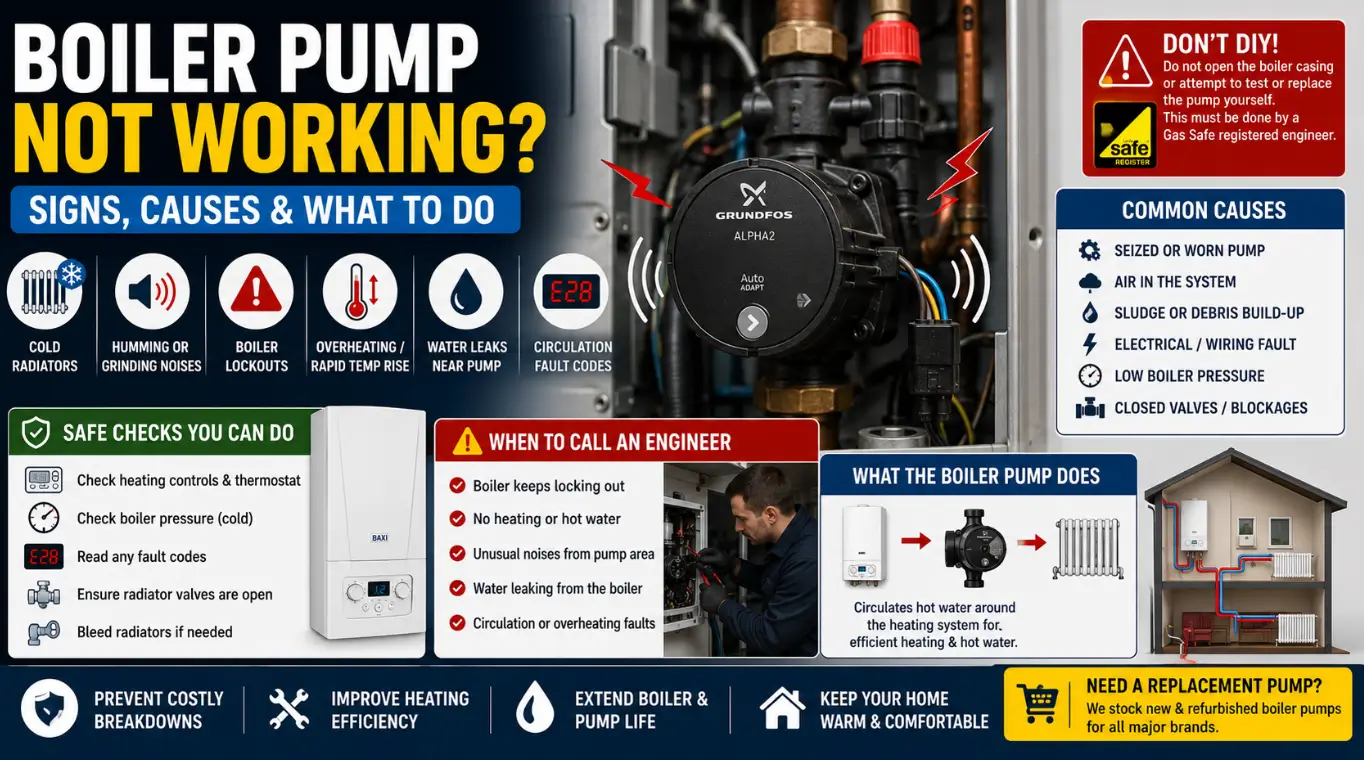
A boiler pump not working can prevent heated water from circulating through the boiler, radiators and heating system. Possible signs include cold radiators, slow heating, unusual humming or grinding noises, repeated boiler lockouts and circulation or overheating fault codes.
However, these symptoms do not automatically prove that the pump has failed. Low pressure, trapped air, sludge, closed valves, a blocked heating system, faulty wiring or a temperature-sensor problem can produce similar symptoms. Check the boiler controls, pressure and displayed fault code first. Internal pump testing and replacement should be left to a suitably qualified Gas Safe registered engineer.
Table of contents
- Quick Answer
- What Does a Boiler Pump Do?
- Signs That a Boiler Pump May Not Be Working
- Safe Checks Before Calling an Engineer
- What Causes a Boiler Pump to Stop Working?
- How Does an Engineer Diagnose a Faulty Boiler Pump?
- Can a Seized Boiler Pump Be Freed?
- Does the Boiler Pump Always Need Replacing?
- Choosing the Correct Replacement Boiler Pump
- Find a Replacement Boiler Pump
- Frequently Asked Questions
Quick Answer
A faulty or seized boiler pump may cause:
- No heating or, on some combi boilers, no heating and no hot water
- Radiators that remain cold or take longer to heat
- Humming, buzzing, grinding or rattling from the boiler
- Rapid temperature rises followed by a boiler lockout
- Circulation, no-flow or overheating fault codes
- Water leaking from the pump area
Do not remove the boiler casing or attempt to turn, test or replace an internal pump yourself. A heating engineer must first determine whether the pump itself has failed or another system problem is preventing circulation.
What Does a Boiler Pump Do?
A boiler circulation pump moves heated water through the boiler and around the central-heating system.
During a heating demand, the pump helps move hot water from the boiler towards the radiators. Cooler water then returns to the boiler to be reheated.
Many combi boilers also depend on primary water circulation while producing domestic hot water. Therefore, a significant pump failure can sometimes affect both the heating and hot water.
Without sufficient circulation, heat can build rapidly inside the boiler. Modern boilers monitor water temperature and circulation conditions and may reduce their output or lock out to protect the appliance.
For example, Baxi lists temporary and permanent “no water circulation” faults on some current boiler ranges. Ideal also associates its L1 fault with flow-temperature overheating or no water flow. The exact fault code and meaning depend on the boiler model.
Signs That a Boiler Pump May Not Be Working
A circulation-pump fault can appear in several different ways. None of the following symptoms should be treated as a diagnosis on its own.
| Symptom | What it may indicate | Who should investigate |
| All radiators remain cold | The pump may not be circulating water, but controls, pressure and system valves must also be checked | Homeowner can check controls and pressure; engineer for further diagnosis |
| Heating takes much longer than normal | Weak circulation, trapped air, sludge, an incorrect pump setting or a worn pump | Heating engineer |
| Boiler hums but does not heat | A pump or another motorised component may be powered but unable to operate correctly | Gas Safe engineer |
| Boiler heats briefly and shuts down | Restricted circulation may be causing a rapid temperature rise | Gas Safe engineer |
| Boiler displays a circulation fault | Pump failure, blockage, closed valve or another flow-related problem may be present | Check the manual, then arrange diagnosis |
| Water appears beneath the boiler | An internal pump, seal, joint or another boiler component may be leaking | Turn the boiler off and contact an engineer |
| Some radiators remain cold | Air, sludge, balancing or radiator-valve problems may be more likely than total pump failure | Safe radiator checks first; engineer if widespread |
No Heating or Hot Water
A failed pump can cause no heating and no hot water on certain combi boilers because the appliance cannot establish the required primary circulation.
However, other problems can create the same complaint, including:
- Low boiler pressure
- Incorrect controls or timer settings
- A flow sensor or diverter-valve problem
- Ignition failure
- A blocked condensate route
- A PCB or electrical fault
Baxi’s homeowner guidance recommends checking fault codes, boiler pressure and controls when there is no hot water before assuming an internal part has failed.
Cold or Slowly Heating Radiators
A weak pump may struggle to distribute hot water throughout the property. Radiators furthest from the boiler or on upper floors may take longer to heat.
Nevertheless, one cold radiator usually points towards a local problem such as trapped air, a closed valve, a stuck thermostatic radiator valve or internal radiator sludge. A pump problem becomes more likely when poor circulation affects most or all of the system.
Humming or Buzzing From the Boiler
A humming noise can indicate that a pump motor is receiving an electrical supply but is not rotating or circulating water correctly.
Possible reasons include:
- A seized rotor
- Debris around the pump impeller
- Air trapped within the pump or system
- A worn motor
- An electrical or control problem
Humming can also come from a boiler fan, transformer, gas valve or another electrical component. The location and cause must therefore be confirmed before a replacement pump is ordered.
Repeated Overheating or Circulation Faults
When water does not move through the heat exchanger quickly enough, the flow temperature can rise unusually fast. The boiler may then stop operating and display an overheating or circulation-related fault.
A faulty pump is one possible cause, but the engineer must also consider:
- Closed system valves
- Trapped air
- A blocked filter or heat exchanger
- Sludge in the heating circuit
- A bypass problem
- Incorrect temperature readings
- Restricted pipework
Safe Checks Before Calling an Engineer
Homeowners should only complete checks that do not involve removing the boiler casing or working on internal parts.
1. Check the Heating Controls
Confirm that:
- The boiler is switched on
- Heating mode is enabled
- The programmer is within an active period
- The room thermostat is requesting heat
- The thermostat temperature is set above the current room temperature
If the boiler works for hot water but not for heating, the problem may be related to the controls or heating circuit rather than the pump.
2. Read the Fault Code
Look at the boiler display and record the complete fault code before resetting anything.
Check the user manual for the exact model because fault meanings vary between manufacturers and boiler ranges. A circulation code does not necessarily name the failed component; it may identify the stage of operation where the problem was detected.
3. Check the Boiler Pressure
Check the pressure while the system is cool.
Many sealed domestic systems operate at approximately 1 to 1.5 bar when cold, but the correct pressure must be confirmed in the boiler’s user instructions. If pressure is too low, follow the manufacturer’s approved filling procedure.
Do not continually repressurise a boiler that keeps losing pressure. Repeated pressure loss indicates another problem that needs investigating. Ideal’s guidance for some no-flow and overheating faults includes checking that system pressure is within the recommended range.
4. Check the Radiator Valves
Make sure the radiator valves have not all been closed.
If every thermostatic radiator valve is turned off, the heating system may have limited circulation depending on its design. Do not adjust internal bypass valves or boiler components.
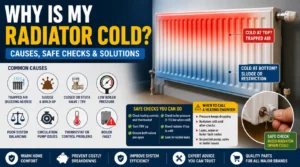
5. Look for a Wider Radiator Problem
Consider how many radiators are affected:
- One radiator: Check its valves and whether it needs bleeding.
- Cold at the top: Trapped air may be present.
- Cold at the bottom: Sludge or restricted flow may be present.
- All radiators cold: Check the controls, pressure and boiler display.
Our guide to why a radiator is cold explains these differences in greater detail.
6. Reset the Boiler Once
After completing the safe checks, follow the reset instructions for your exact boiler.
Only reset it once. If the same circulation or overheating fault returns, stop resetting the appliance and arrange an engineer visit. Baxi advises that frequent lockouts indicate a fault requiring professional attention.
What Causes a Boiler Pump to Stop Working?
Seized Rotor or Impeller
A seized boiler pump is one where the motor or rotating assembly cannot move correctly.
Deposits, contamination or a mechanical problem may prevent the rotor or impeller from turning. Some modern pumps can attempt an automatic restart when they detect a blockage, while certain models also provide a manufacturer-defined manual restart procedure for trained installers. These procedures are model-specific and are not homeowner repairs.
Sludge or Debris
Heating-system corrosion can create dark magnetic deposits commonly called sludge. Debris may restrict the pump, filter, heat exchanger or connecting waterways.
Simply fitting another pump without addressing heavy system contamination can leave the original cause unresolved.
Wilo’s technical fault guidance identifies silted or clogged pump components, foreign bodies and air within the pump as possible causes of poor pump operation.
Air Trapped in the System
Air can prevent a pump from moving water effectively and may produce gurgling, rattling or inconsistent circulation.
An engineer may need to vent the appliance correctly and investigate why air repeatedly enters the system.
Electrical Supply or Wiring Fault
A pump cannot operate if it is not receiving the correct electrical supply or control signal.
Possible causes include:
- Loose or damaged wiring
- A failed electrical connector
- A PCB output problem
- A damaged speed-control cable
- A fault within the pump electronics
Modern pumps may use additional control or communication wiring, so diagnosis should follow the appliance wiring diagram rather than assuming that every pump operates in the same way. Worcester Bosch, for example, identifies pump-control wiring and PCB problems among the possible causes of abnormal pump operation on certain Greenstar boilers.
Mechanical Wear
Pump bearings, motors and internal rotating parts can wear over time.
A worn pump may become noisy, run intermittently or provide insufficient circulation before stopping completely.
Water Leakage or Corrosion
A leak may develop around:
- Pump seals
- Hydraulic connections
- The pump body
- Nearby boiler components
Water near electrical parts requires prompt professional attention. Turn the boiler off and do not remove the casing to locate the leak.
How Does an Engineer Diagnose a Faulty Boiler Pump?
An engineer should diagnose the heating system methodically rather than fitting a pump based only on a noise or fault code.
The process may include:
- Confirming the exact boiler model and fault history
- Checking system pressure, controls and heating demand
- Examining the displayed fault code and manufacturer instructions
- Checking whether valves, filters or waterways are restricting circulation
- Comparing flow and return temperature behaviour
- Checking for air, sludge and system contamination
- Confirming whether the pump is being instructed to operate
- Completing the manufacturer-specified electrical checks
- Assessing whether the pump is rotating and producing circulation
- Ruling out sensors, wiring, PCB outputs and other system components
The uploaded case study correctly highlights the importance of proving the electrical command before condemning a pump. However, bypassing or manually operating a boiler safety device is not included in this public guide.
Gas Safe Register advises homeowners never to attempt work on a gas appliance themselves and to use a registered engineer who is qualified for the required appliance and work category.
Can a Seized Boiler Pump Be Freed?
In some cases, a competent engineer may be able to restore movement to a recently blocked pump by following the exact pump or boiler manufacturer’s procedure.
That does not necessarily provide a permanent repair. A pump that repeatedly seizes may have:
- Internal wear
- Heavy contamination
- Motor damage
- Damaged electronics
- An underlying system-sludge problem
The engineer should decide whether the pump can be safely restored or needs replacing.
Homeowners should not remove the boiler casing, loosen pump screws, turn the rotor with a screwdriver or release water from an internal pump.
Does the Boiler Pump Always Need Replacing?
No. Symptoms that resemble pump failure can be caused by:
- No electrical supply to the pump
- Damaged wiring
- A PCB control problem
- Low boiler pressure
- Trapped air
- Closed valves
- System sludge
- A blocked filter
- A faulty sensor
- Restricted pipework
Replacing a working pump will not resolve these faults. The failed component or circulation restriction must be identified first.
Choosing the Correct Replacement Boiler Pump
Boiler pumps are not universally interchangeable.
Before ordering, check:
- Boiler manufacturer
- Exact boiler model and output
- Appliance GC number
- Existing pump manufacturer and part number
- Any superseded manufacturer numbers
- Electrical connector and control arrangement
- Whether the complete pump, pump head or hydraulic assembly is required
Do not choose a replacement from appearance alone. Similar-looking pumps may use different housings, outputs, connectors or control systems.
Find a Replacement Boiler Pump
Heating & Catering Parts stocks new and refurbished boiler pumps for a wide range of UK boiler brands.
Before ordering:
- Compare the existing part number with the product listing.
- Check the boiler model and GC number.
- Review all compatibility information carefully.
- Ask a qualified engineer to confirm the diagnosis.
Need help identifying the correct pump? Send Heating & Catering Parts a clear photograph of the boiler data plate and the part number shown on the existing pump.
Frequently Asked Questions
Yes, a pump fault can stop hot-water production on some combi boilers because the appliance requires primary circulation during a hot-water demand. However, a diverter valve, flow sensor, pressure problem, ignition fault or other component may produce the same symptom.
The pump may be receiving power but unable to rotate because of a seized rotor, debris, air or internal wear. Humming can also come from other boiler components, so an engineer must confirm the source.
Yes. Insufficient water circulation can cause the boiler temperature to rise rapidly. The boiler may reduce its output, shut down or display a no-flow or overheating fault.
No. Replacing an internal boiler pump involves electrical components, boiler water connections and opening the appliance. The repair should be completed by a suitably qualified Gas Safe registered engineer.
No. A circulation fault may be caused by the pump, trapped air, low pressure, a closed valve, sludge, blocked waterways, faulty wiring or incorrect sensor information.
No. Carry out one reset using the manufacturer’s instructions. If the same fault returns, stop resetting the boiler and arrange a professional inspection.
Key Takeaways
- A faulty boiler pump can cause no heating or hot water, cold radiators, and unusual noises.
- Symptoms resembling pump failure can be due to various issues like low pressure, trapped air, or sludge.
- Do not attempt to diagnose or replace an internal pump yourself; always consult a qualified Gas Safe engineer.
- Homeowners can perform safe checks like checking heating controls and reading fault codes before calling an engineer.
- Choose the correct replacement boiler pump by verifying the model, manufacturer, and specifications to ensure compatibility.