Baxi E25 Fault Code: Causes, Fixes & Reset Guide
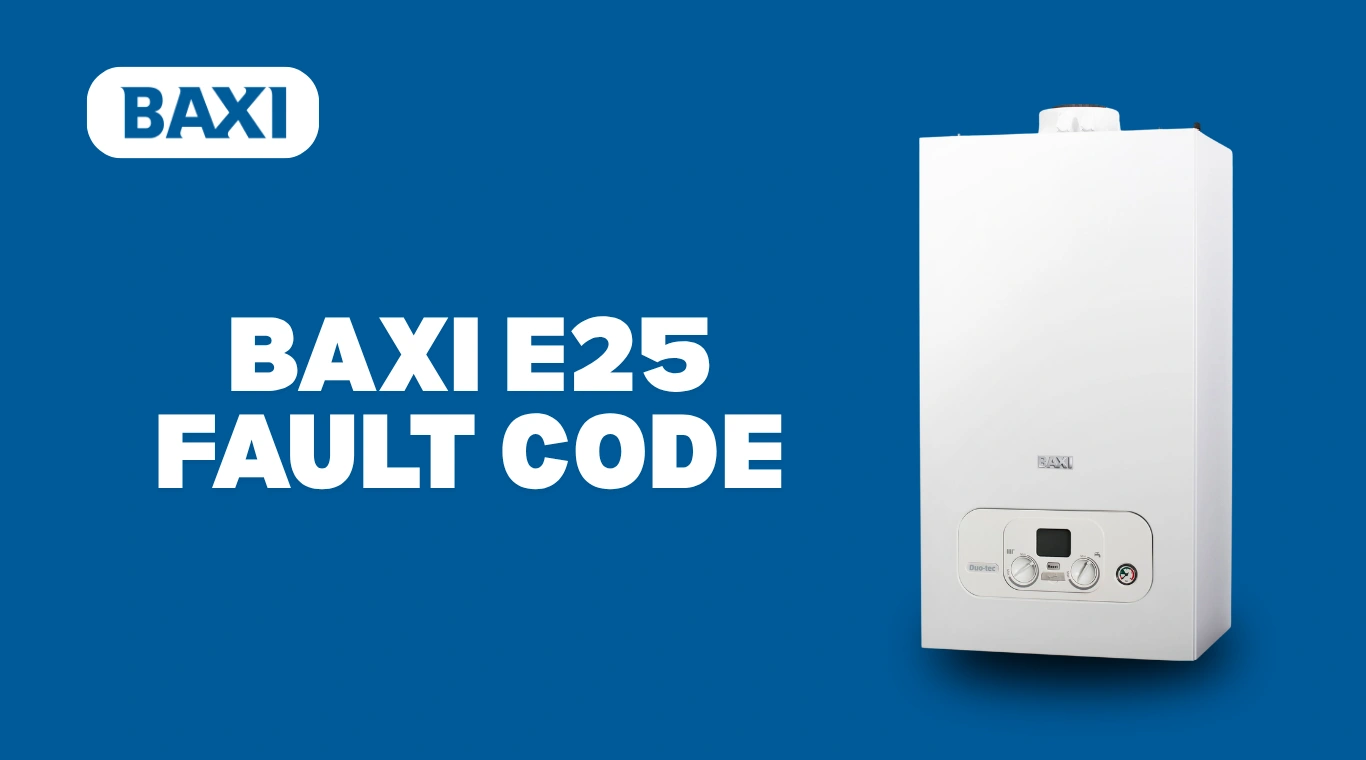
A Baxi E25 fault code generally indicates a circulation problem that has caused the boiler temperature to rise too quickly. The boiler detects inadequate water movement and shuts down to help prevent overheating.
The exact meaning of E25 can vary between Baxi model ranges, so the boiler’s specific installation and servicing instructions should always take priority.
Common causes include a faulty or seized circulation pump, closed valves, trapped air, system blockages, sludge, low system pressure, a faulty NTC temperature sensor or, in some cases, a PCB or electrical fault.
Important: Internal boiler diagnosis and repairs should be carried out by a suitably qualified Gas Safe registered engineer. Homeowners should not remove the boiler casing or work on internal electrical, gas or water components.
Table of contents
- What Does the Baxi E25 Fault Code Mean?
- Common Causes of Baxi E25 Fault Code
- Baxi E25 Fault Code: Safe Checks for Homeowners
- How Does an Engineer Diagnose Baxi E25 Fault Code?
- Can You Fix Baxi E25 Yourself?
- Does Baxi E25 Always Mean the Pump Has Failed?
- When Should You Call a Heating Engineer?
- When Does the Baxi Pump Need Replacing?
- Need a Replacement Baxi Boiler Pump ?
- Conclusion
- Frequently Asked Questions
What Does the Baxi E25 Fault Code Mean?
The Baxi E25 fault code is associated with a circulation or overheating condition on applicable Baxi boiler models.
During normal operation, the circulation pump moves heated water away from the heat exchanger and around the central-heating system. If the water cannot circulate correctly, the temperature inside the boiler can increase rapidly.
The boiler monitors temperature using sensors. If the temperature rises beyond the expected operating conditions, the control system can stop the appliance and display E25.
The underlying problem may therefore be:
- Pump failure
- Seized circulation pump
- Pump electrical fault
- Closed heating valves
- Air trapped in the system
- Sludge or debris restricting circulation
- Low system pressure
- Blocked heat exchanger
- Faulty NTC temperature sensor
- Wiring or PCB problem
An E25 code should therefore be treated as a symptom requiring diagnosis, rather than proof that the pump itself has failed.
Common Causes of Baxi E25 Fault Code
1. Faulty or Seized Circulation Pump
The circulation pump is one of the first components an engineer will investigate.
If the pump stops operating, hot water can remain inside the boiler instead of circulating through the heating system. This can cause the heat exchanger temperature to rise rapidly.
A pump may fail because of:
- Electrical failure
- Seized motor
- Internal wear
- Debris or sludge
- Air inside the pump
- Damaged bearings
- PCB or wiring problems
Possible symptoms
You may notice:
- Radiators remain cold
- Boiler becomes very hot
- Pump makes unusual noises
- Boiler repeatedly locks out
- Heating works intermittently
- E25 returns after resetting
A humming noise does not automatically prove that the pump has failed. A pump can receive power and make a noise while still failing to circulate enough water.
2. Closed Isolation or Heating Valves
Restricted circulation can occur when a valve underneath the boiler or elsewhere in the heating system has been closed.
This can happen after:
- Boiler servicing
- Plumbing work
- Radiator replacement
- Heating-system maintenance
- Boiler installation
A homeowner can visually check accessible valves without dismantling the boiler.
Do not force a stiff valve or remove components to investigate it.
3. Airlock in the Heating System
Air can interfere with water circulation.
An airlock may cause:
- Gurgling noises
- Cold radiators
- Uneven radiator temperatures
- Poor circulation
- Pump noise
- Repeated overheating symptoms
If only one radiator has air, bleeding may help. However, repeatedly bleeding radiators when the problem keeps returning can indicate another underlying issue.
4. Sludge or System Blockage
Central-heating water can accumulate:
- Magnetite
- Sludge
- Corrosion debris
- Scale
- Other deposits
These materials can restrict narrow waterways and affect circulation through the boiler and heating system.
A heavily contaminated system may also place additional strain on the circulation pump.
An engineer may check system condition, filters, pump performance and temperature differences before deciding whether cleaning or flushing is appropriate.
5. Low Boiler Pressure
Low pressure can contribute to circulation problems on sealed heating systems.
Check the boiler pressure using the boiler’s display or pressure gauge and compare it with the manufacturer’s recommended operating range.
Many sealed systems operate around 1–1.5 bar when cold, but this is not universal.
Do not repeatedly repressurise the boiler simply to clear E25. If pressure keeps falling, the underlying reason needs investigation.
6. Faulty NTC Temperature Sensor
The NTC thermistor monitors temperature and sends information to the PCB.
If the sensor provides an incorrect reading, the boiler may incorrectly interpret the temperature inside the appliance.
A faulty NTC can potentially cause:
- Incorrect temperature readings
- Premature burner shutdown
- Overheating protection
- Temperature-related fault codes
- Unstable boiler operation
An engineer can test the sensor against the manufacturer’s resistance and temperature data.
A generic resistance value should not be used because NTC specifications differ between boiler models.
7. Blocked Heat Exchanger
A restricted heat exchanger can reduce water movement and cause the boiler temperature to rise too quickly.
The restriction may result from:
- Sludge
- Magnetite
- Scale
- Debris
- Poor system-water condition
The correct repair depends on the condition and design of the heat exchanger.
Cleaning or replacing an internal boiler heat exchanger should be undertaken by a suitably qualified engineer.
8. Electrical, Wiring or PCB Fault
The pump itself may be working correctly while its electrical supply or control signal has failed.
An engineer may therefore investigate:
- Pump supply voltage
- Wiring connections
- PCB output
- Connectors
- Relays
- Sensor circuits
- Control signals
This is important because replacing a pump will not resolve an E25 fault caused by a PCB or wiring problem.
Baxi E25 Fault Code: Safe Checks for Homeowners
Time needed: 5 minutes
There are several observations you can make without opening the boiler.
- Record the E25 Code
Take a photograph of the display and note when the fault occurs.
For example:
When heating starts
After several minutes
When hot water is requested
When the boiler becomes hot
After the system has been unused
This information can help the engineer diagnose the fault. - Check the Boiler Pressure
Look at the pressure gauge or digital pressure display.
Compare the reading with the manufacturer’s instructions.
If the pressure is very low, follow the boiler’s user instructions for repressurising if you are confident doing so.
If the pressure repeatedly falls, arrange professional inspection. - Check the Heating Controls
Confirm that:
The boiler has power
Central heating is selected
The thermostat is requesting heat
The programmer is correctly configured
If E25 appears despite normal heating demand, further diagnosis may be required. - Check Accessible Heating Valves
Look at the visible valves beneath the boiler and around the heating system.
Do not force valves that are stuck.
Do not remove boiler components. - Check the Radiators
After the heating has been running, compare the radiators.
Are they:
Completely cold?
Warm at the top but cold at the bottom?
Warm on some radiators but not others?
All heating normally before E25 appears?
Cold radiators combined with E25 can support a circulation problem, but they do not identify the failed component by themselves. - Try the Boiler Reset Once
If the manufacturer’s user instructions permit a reset, you can try resetting the boiler once.
If the E25 code immediately returns, or the boiler repeatedly locks out, do not continue resetting it.
Repeated resets can mask the underlying problem and do not repair a failed pump, blockage or sensor.
How Does an Engineer Diagnose Baxi E25 Fault Code?
A professional diagnosis normally begins with the boiler’s exact model and fault history.
The engineer may then carry out several checks.
1. Check the Pump
The engineer can establish whether the pump:
- Receives the correct electrical supply
- Starts when required
- Runs at the expected speed
- Produces abnormal noise
- Is mechanically seized
- Circulates water correctly
2. Check Pump Electrical Resistance
Where applicable, an engineer can use appropriate electrical testing equipment to investigate the pump motor.
The measured result must be interpreted against the pump manufacturer’s specifications.
3. Check Flow and Return Temperatures
Temperature measurements can provide valuable information about water circulation.
An unusually large temperature difference may indicate restricted flow, pump problems or another circulation issue.
However, temperature measurements alone do not prove that one particular component has failed.
4. Check System Pressure
The engineer can investigate whether system pressure is suitable and whether pressure loss is occurring.
5. Check for Air
The heating system and pump can be assessed for trapped air or air-related circulation problems.
6. Check for Blockages
The engineer may investigate:
- Pump inlet
- Filters
- Heat exchanger
- Pipework
- Radiator circuit
- Magnetic filter
- System-water condition
7. Test the NTC Sensors
The engineer can compare sensor readings with the manufacturer’s technical information.
If the sensor reading is incorrect, the sensor or its wiring may require attention.
8. Investigate the PCB
If the pump, sensors and hydraulic system test correctly, the engineer may investigate the boiler PCB and associated control circuits.
Can You Fix Baxi E25 Yourself?
Only basic external checks should be attempted by a homeowner.
You can normally:
- Check the displayed fault code
- Check system pressure
- Check heating controls
- Observe radiator temperatures
- Look for visible leaks
- Follow the manufacturer’s reset procedure
You should not:
- Remove the boiler casing
- Disconnect internal wiring
- Test live electrical components
- Remove the circulation pump
- Open the heat exchanger
- Drain internal boiler components
- Replace an NTC sensor
- Replace a PCB
- Work on gas components
Internal boiler work should be completed by a suitably qualified engineer.
Does Baxi E25 Always Mean the Pump Has Failed?
No.
The circulation pump is an important possibility, but E25 can have several underlying causes.
A simplified diagnostic sequence is:
E25 appears → check pressure and external conditions → investigate circulation → test pump → check for blockages and air → test sensors → investigate wiring and PCB if required.
This approach helps prevent unnecessary replacement of expensive components.
When Should You Call a Heating Engineer?
Arrange professional diagnosis if:
- E25 repeatedly returns
- The boiler repeatedly overheats
- Radiators remain cold
- The circulation pump makes unusual noises
- The boiler repeatedly locks out
- System pressure keeps falling
- There is a water leak
- You suspect a pump or PCB fault
- The boiler requires internal inspection
If the boiler shows signs of overheating or another safety-related fault, avoid repeatedly operating it until it has been checked.
When Does the Baxi Pump Need Replacing?
A pump may need replacement when testing confirms that it:
- Has failed electrically
- Has seized mechanically
- Cannot achieve the required circulation
- Has damaged internal components
- Has excessive bearing wear
- Cannot operate at the required speed
The replacement must match the exact boiler and pump specification.
Do not order a pump based solely on the Baxi brand. Check the full boiler model, GC number, pump part number and existing component wherever possible.
Need a Replacement Baxi Boiler Pump?
Heating & Catering Parts supplies replacement boiler pumps and circulation components for many Baxi boiler models.
Before ordering, check:
- Baxi boiler model
- Model variant
- GC number
- Existing pump part number
- Pump manufacturer
- Connection configuration
- Boiler serial number where required
A pump that fits one Baxi model may not automatically fit another model in the same range.
Conclusion
The Baxi E25 fault code is generally associated with a circulation or overheating condition on applicable Baxi boilers. The circulation pump is one of the main components to investigate, but it is not the only possible cause.
Closed valves, trapped air, low pressure, sludge, restricted heat exchangers, faulty NTC sensors, wiring faults and PCB problems can produce similar symptoms.
The safest approach is to start with the checks available to the homeowner, such as the boiler pressure, controls and fault display. If E25 returns after a reset, professional diagnosis is required.
An engineer should test the pump, water circulation, temperatures, sensors and electrical controls before replacing any component. This avoids replacing a working pump when the real problem lies elsewhere.
Frequently Asked Questions
On applicable Baxi models, E25 indicates a circulation-related overheating condition. The boiler detects that water temperature is rising too quickly or that circulation is inadequate.
Not necessarily. A faulty or seized pump is a common possibility, but blocked waterways, air, low pressure, valves, sensors, wiring and PCB faults can also cause circulation problems.
Low pressure can contribute to circulation problems on sealed heating systems. However, the exact cause should be confirmed before replacing components.
You can normally follow the reset procedure in the boiler’s user instructions. If E25 returns, avoid repeatedly resetting the boiler and arrange professional diagnosis.
An engineer can check the pump’s electrical supply, control signal, operation, mechanical condition and water circulation. They may also compare flow and return temperatures and investigate blockages.
Key Takeaways
- The Baxi E25 fault code indicates a circulation problem, causing the boiler to overheat and shut down.
- Common causes include a faulty circulation pump, closed valves, airlocks, low pressure, sludge, and faulty sensors.
- Homeowners can check the pressure, controls, and visible valves, but should not attempt internal repairs themselves.
- Professional diagnosis is essential when the E25 code persists or if the boiler exhibits overheating symptoms.
- Replacing the pump may be necessary if tests confirm it has failed electrically or mechanically, but underlying issues should be identified first.