Boiler Replacement Cost UK: What Affects the Price in 2026?
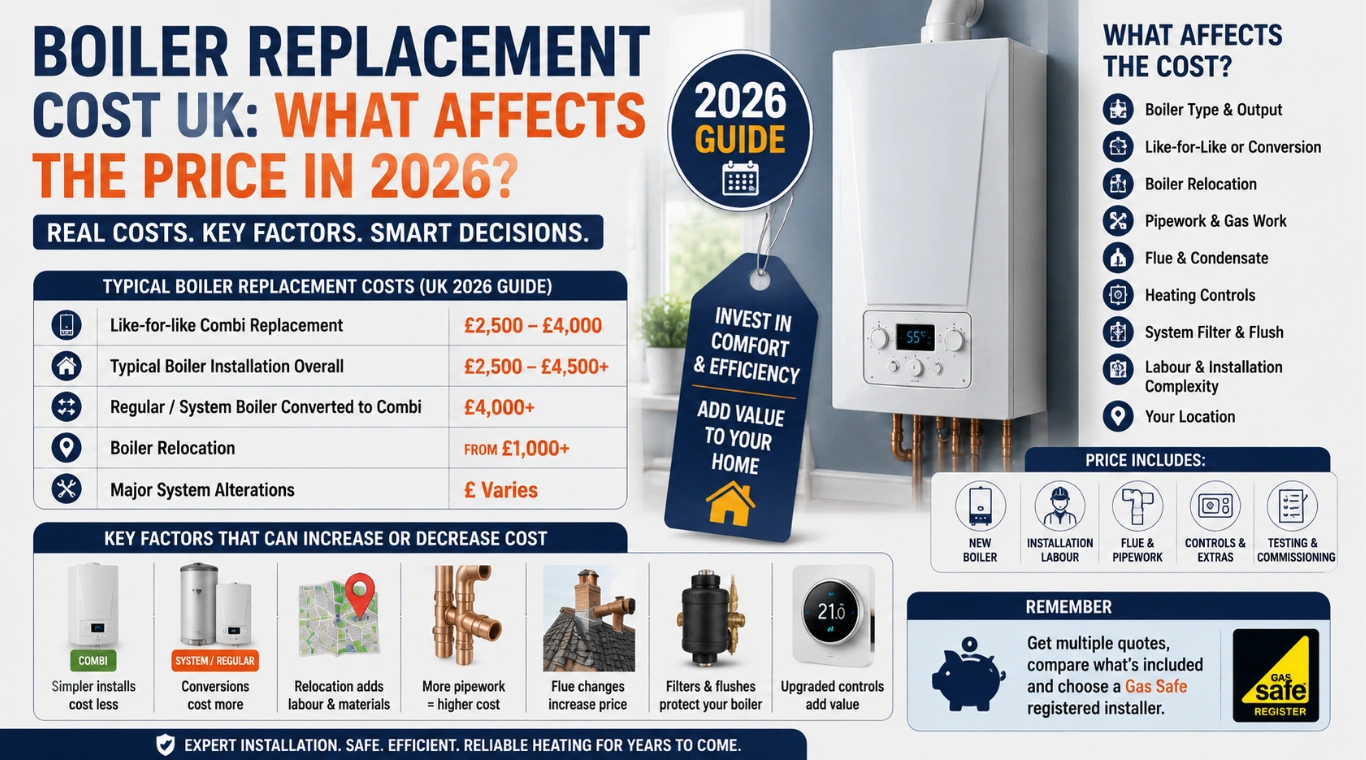
The Boiler Replacement Cost UK can range from a straightforward like-for-like installation to several thousand pounds for a more complex conversion. As a broad 2026 guide, a like-for-like combi boiler replacement typically costs around £2,500 to £4,000 supplied and installed. However, the final price depends on the boiler, installation location, pipework and any additional work required.
The important point is that you are not only paying for the new boiler. Installation complexity can have just as much impact on the final quotation as the appliance itself. The original source highlights boiler type, property size, relocation, system conversions, pipework, flue work and heating controls as major cost factors.
Table of contents
- Quick Answer: How Much Does It Cost to Replace a Boiler in the UK?
- What Makes Up the Cost of a Boiler Replacement?
- 1. The Type of Boiler You Choose
- 2. Like-for-Like Replacement or Boiler Conversion?
- 3. Moving the Boiler to a New Location
- 4. Property Size and Hot Water Demand
- 5. Boiler Brand and Output
- 6. Gas Pipework Alterations
- 7. Flue Requirements
- 8. Condensate Pipework
- 9. Heating Controls
- 10. Magnetic Filter
- 11. Does the Heating System Need Flushing?
- 12. Labour and Installation Complexity
- What Should Be Included in a Boiler Replacement Quote?
- Why Online Boiler Cost Calculators Are Only Estimates
- Boiler Repair or Replacement: Which Makes More Sense?
- When Might Repair Be Worth Considering?
- When Might Boiler Replacement Make More Sense?
- Do You Need a New Boiler Because of a Fault Code?
- How to Keep Boiler Repair Costs Under Control
- Need a Replacement Boiler Part?
- Frequently Asked Questions
Quick Answer: How Much Does It Cost to Replace a Boiler in the UK?
For a typical UK home in 2026:
| Boiler replacement scenario | Rough UK guide |
| Like-for-like combi replacement | £2,500 to £4,000 |
| Typical boiler installation overall | £2,500 to £4,500+ |
| Regular/system boiler converted to combi | Around £4,000 or more |
| Boiler relocation | Additional cost depending on complexity |
| Major system alterations | Can increase the price significantly |
These figures are budgeting guides, not fixed quotations. Recent UK cost data shows installation prices varying considerably depending on boiler type, the amount of labour involved and any additional system work.
A professional survey and quotation are the best way to establish the actual price for your property.
What Makes Up the Cost of a Boiler Replacement?
The total boiler replacement cost can usually be divided into several areas:
- The new boiler itself
- Labour
- Flue components
- Pipework and fittings
- Heating controls
- System protection
- Removal of the old boiler
- Any required system alterations
- Additional work needed to meet current installation requirements
This explains why two homes installing apparently similar boilers can receive quite different quotations.
1. The Type of Boiler You Choose
The first major factor is the boiler type.
Most UK homes use one of three main types:
Combi boiler
A combination boiler provides central heating and domestic hot water directly from one appliance.
There is normally no separate hot water cylinder.
Combi boilers are common in smaller and medium-sized UK homes and can make for a relatively straightforward replacement where an existing combi is being swapped for another in the same location.
System boiler
A system boiler provides central heating and works with a separate hot water cylinder.
They are often used where a property has higher hot water demand or multiple bathrooms.
Replacing one system boiler with another may be relatively straightforward, but converting the property to a different boiler type adds additional work.
Regular boiler
Regular boilers are also called conventional or heat-only boilers.
They are commonly found in older heating systems and may operate alongside:
- A hot water cylinder
- Cold water storage
- Additional system components
Moving from a traditional regular boiler system to a combi can require considerably more alteration than simply replacing the existing boiler.
2. Like-for-Like Replacement or Boiler Conversion?
This is one of the biggest influences on boiler replacement cost.
A like-for-like replacement generally means:
Existing combi → new combi in approximately the same location.
Or:
Existing system boiler → new system boiler.
Where much of the existing installation remains suitable, the work can be relatively straightforward.
The original source correctly identifies these replacements as generally less expensive than changing boiler type or redesigning the heating arrangement.
Current UK cost guides put a typical same-location combi replacement at around £2,500 to £4,000, while conversions commonly cost more because of the additional plumbing and labour involved.
Why does a conversion cost more?
Changing from a regular or system boiler to a combi may involve:
- Removing an existing hot water cylinder
- Altering heating pipework
- Adding new hot and cold water connections
- Changing gas pipework where required
- Modifying the flue
- Changing controls
- Removing redundant tanks or components
- Additional testing and commissioning
That means the installer is doing much more than simply changing the appliance.
3. Moving the Boiler to a New Location
Keeping a replacement boiler in the same position will usually be cheaper than relocating it.
Moving the boiler may require changes to:
- Gas supply pipework
- Heating flow and return pipes
- Hot and cold water pipework
- Condensate drainage
- Electrical supplies
- Flue position
The greater the distance between the old and new locations, the more work may be required.
Current installers quote significant additional costs for relocation. BOXT, for example, currently shows boiler-location changes adding roughly £1,000 to £1,400 depending on where the new boiler is placed.
That does not mean every relocation will cost that amount, but it shows why moving a boiler can materially change a quotation.
4. Property Size and Hot Water Demand
The number of bedrooms can give a rough indication of heating demand, but it should not be used alone to choose a boiler.
An engineer may consider:
- Number and size of radiators
- Property heat loss
- Insulation
- Number of bathrooms
- Number of showers
- Simultaneous hot water demand
- Existing system design
A two-bedroom flat with one bathroom has very different requirements from a four-bedroom house with multiple bathrooms.
The uploaded source also makes the useful point that property size is only part of the calculation. The condition and design of the existing heating system can influence the installation cost more than bedroom count alone.
5. Boiler Brand and Output
Boiler purchase prices vary between manufacturers, product ranges and outputs.
A larger or premium boiler can increase the upfront cost, while warranties and included controls may also differ between models.
However, bigger is not automatically better.
An oversized boiler can cycle unnecessarily, while an undersized appliance may struggle to meet demand.
The correct output should therefore be selected around the property’s heating requirements and, particularly with combi boilers, expected hot water demand.
6. Gas Pipework Alterations
Sometimes the existing gas supply pipework is not suitable for the replacement appliance or installation.
An engineer may need to assess:
- Existing pipe size
- Pipe route
- Appliance requirements
- Available gas pressure
- Other gas appliances in the property
If new or larger gas pipework is required, labour and materials can increase the installation price.
This is another reason an online boiler calculator cannot always predict the final cost accurately.
7. Flue Requirements
A gas boiler must safely discharge combustion products through an appropriate flue system.
A replacement may sometimes reuse a similar route, but a new installation can require:
- New standard flue
- Flue extensions
- Vertical flue
- Additional bends
- Different termination position
- Roof work
The original source identifies flue alterations as one of the installation extras capable of increasing cost.
A boiler relocation can therefore become considerably more complicated if the new position also requires a completely different flue arrangement.
8. Condensate Pipework
Modern condensing boilers produce condensate that needs to be safely drained away.
The existing condensate arrangement may require modification when a new boiler is installed.
This can depend on:
- Boiler location
- Position of suitable drainage
- Length of external condensate pipework
- Protection against freezing
Even relatively small alterations add labour and materials to the job.
9. Heating Controls
A new boiler installation may also involve updating the heating controls.
Examples include:
- Room thermostat
- Programmable thermostat
- Smart heating controls
- Weather compensation
- Load compensation
- Thermostatic radiator valves where appropriate
Controls can increase the initial installation price but also have an important role in how effectively the heating system is operated.
Current UK cost guides show smart and Wi-Fi-enabled controls among common additional boiler-installation costs.
10. Magnetic Filter
A magnetic filter is installed in the heating circuit to capture magnetite and other circulating debris.
Protecting a replacement boiler from dirty system water can be important because contamination can contribute to problems with:
- Pumps
- Heat exchangers
- Valves
- Sensors
- Narrow waterways
Whether a particular installation requires a new filter depends on the existing system and manufacturer’s installation requirements.
11. Does the Heating System Need Flushing?
The condition of the existing central heating system also matters.
Older systems may contain:
- Magnetite
- Sludge
- Corrosion debris
- Contaminated system water
An installer may recommend cleaning or flushing where appropriate before commissioning the new boiler.
This should not simply be treated as an automatic extra. The reason and appropriate cleaning method should be based on the actual condition of the heating system.
The source similarly lists system flushing as a possible installation extra rather than something every property automatically requires.
12. Labour and Installation Complexity
A straightforward replacement can sometimes be completed within a working day.
A major conversion may require substantially longer.
Current UK estimates suggest:
- Like-for-like replacement: often around 4 to 6 hours
- Regular-to-combi conversion: potentially 1.5 to 2 days
- More complicated conversions and relocation: longer depending on the work required
Labour therefore becomes a significant part of the difference between a simple £2,500-style installation and a substantially more expensive project.
What Should Be Included in a Boiler Replacement Quote?
When comparing quotations, do not look at the headline price alone.
Check what is actually included.
A quotation may need to cover:
- Boiler
- Installation labour
- Flue
- Controls
- System filter
- Required pipework alterations
- Condensate work
- System cleaning where required
- Disposal of the old boiler
- Testing and commissioning
- Manufacturer warranty registration where applicable
A cheaper quotation is not necessarily cheaper if several essential items are later added separately.
Why Online Boiler Cost Calculators Are Only Estimates
Online calculators can be useful for establishing a starting budget.
They normally ask questions such as:
- Current boiler type
- Required boiler type
- Number of bedrooms
- Number of bathrooms
- Current boiler location
- Proposed location
That can give a useful approximation.
But it cannot always assess:
- Actual pipework condition
- Gas supply requirements
- System contamination
- Existing flue arrangement
- Hidden access problems
- System design
- Installation-specific requirements
This is why the original source repeatedly distinguishes between an online estimate and a proper fixed quotation.
Boiler Repair or Replacement: Which Makes More Sense?
A boiler developing a fault does not automatically mean it needs replacing.
Many faults can be resolved by identifying and replacing the affected component.
Current UK repair estimates put many boiler repairs around £120 to £750, with an average of roughly £300 depending on the problem, labour and parts required.
That can be significantly less than replacing the entire boiler.
Common replacement components include:
- Boiler pumps
- Fans
- PCBs
- Diverter valves
- Gas valves
- Expansion vessels
- Sensors
- Electrodes
- Plate heat exchangers
- Main heat exchangers
However, repair is not always the most economical choice.
When Might Repair Be Worth Considering?
Repair may make sense where:
- The boiler is otherwise in good condition
- The fault has been clearly diagnosed
- The required part is available
- The boiler has not suffered repeated major failures
- Repair cost is reasonable compared with replacement
- The appliance remains suitable for the property
A single failed pump or sensor, for example, does not necessarily justify replacing an otherwise serviceable boiler.
When Might Boiler Replacement Make More Sense?
Replacement may deserve consideration where:
- The boiler is particularly old
- Major components have failed
- Repairs are becoming frequent
- Several components require attention
- Replacement parts are obsolete or difficult to source
- The boiler is unsuitable for current household demand
- The wider heating system is being redesigned
Many boilers can operate for around 10 to 15 years, although service life varies considerably according to model, installation quality, maintenance and system condition.
Age alone should therefore not be used as the only reason to condemn a boiler.
Do You Need a New Boiler Because of a Fault Code?
Not necessarily.
A fault code usually tells an engineer that the boiler has detected a particular condition. It does not necessarily mean that the complete boiler has failed.
Depending on the model, a fault may relate to areas such as:
- Ignition
- Water pressure
- Circulation
- Temperature sensing
- Fan operation
- Flame detection
- PCB communication
The fault should first be diagnosed correctly.
Replacing parts based purely on the displayed code can become expensive and may fail to solve the underlying problem.
How to Keep Boiler Repair Costs Under Control
If your existing boiler develops a problem:
- Note the exact fault code.
- Record the full boiler make and model.
- Have the boiler properly diagnosed.
- Ask which component has failed.
- Get the manufacturer’s part number where possible.
- Compare the repair cost with the cost and condition of the existing boiler.
- Only then decide whether repair or replacement offers better value.
For internal gas, combustion and sealed-case work, use a Gas Safe registered engineer.
Need a Replacement Boiler Part?
Heating & Catering Parts stocks replacement boiler components across many major UK boiler brands, including parts such as:
- Pumps
- Fans
- PCBs
- Gas valves
- Diverter valves
- Expansion vessels
- Heat exchangers
- Sensors
- Electrodes
- Controls
If an engineer has diagnosed your boiler fault, always confirm compatibility before ordering.
Useful information includes:
- Boiler manufacturer
- Full model
- GC number where available
- Existing manufacturer part number
- Photograph of the boiler data plate
- Photograph of the existing component
This can help ensure the correct replacement part is identified before purchase.
Frequently Asked Questions
A straightforward like-for-like combi boiler replacement commonly falls around £2,500 to £4,000, although prices vary significantly according to boiler choice and installation requirements.
Usually, yes. Keeping the new boiler in the existing position can reduce the amount of new pipework, condensate work and flue alteration required.
A conversion can require removal of existing hot water equipment, new pipework and considerable changes to the heating and hot water system.
The cost depends on the distance and complexity involved. Current installer pricing shows boiler relocation can add around £1,000 or more in some circumstances.
Not necessarily the same type of flush. The heating system should be assessed and appropriately cleaned or treated according to its condition and manufacturer requirements.
Key Takeaways
- Replacing a boiler in the UK can cost between £2,500 and £4,000 for a like-for-like installation, depending on various factors.
- Key cost factors include boiler type, installation complexity, pipework changes, and additional work needed.
- Moving a boiler to a new location may add £1,000 to £1,400 based on complexity and distance.
- Consult a professional for an accurate quotation, as online calculators provide only rough estimates.
- Consider whether repair or replacement makes more sense based on the boiler’s condition and repair costs.