Radiator Balancing vs Powerflushing: What Is the Difference?
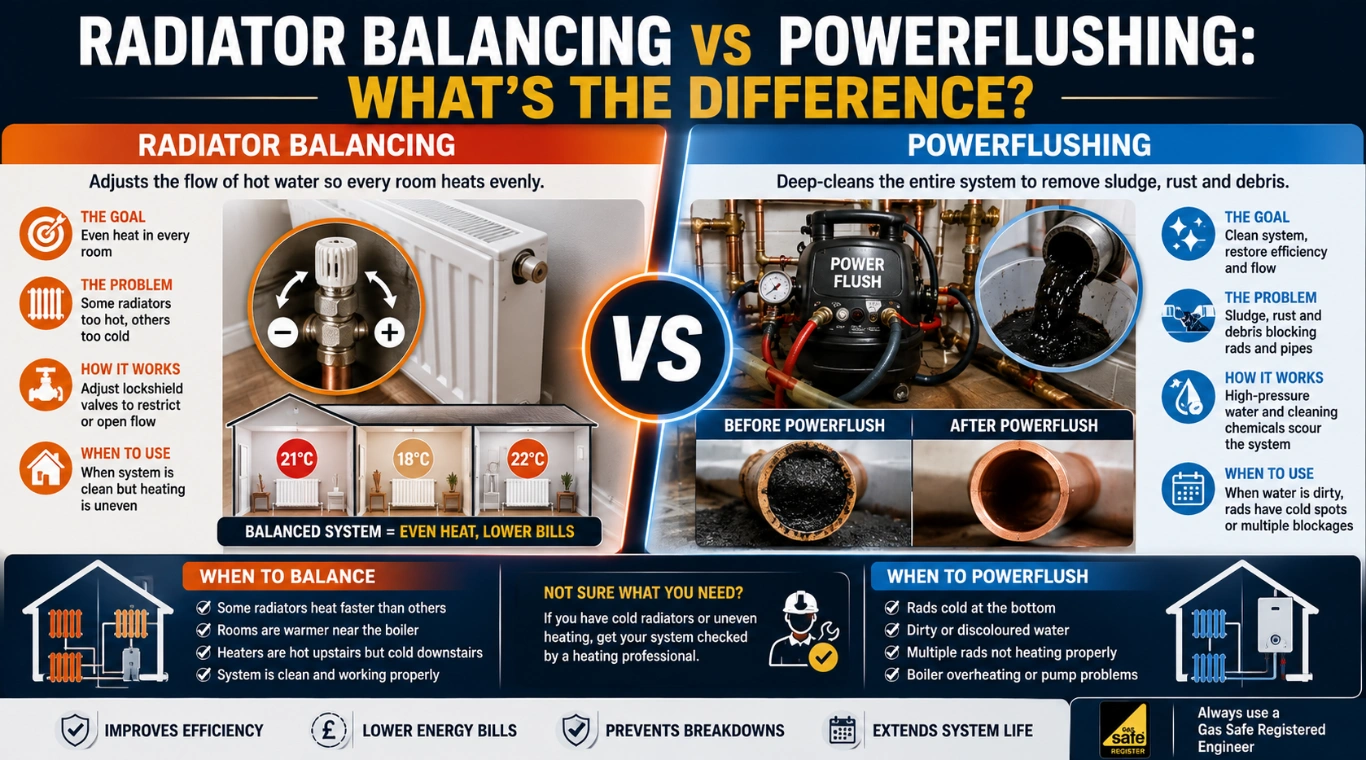
Radiator Balancing vs Powerflushing can both improve central-heating performance, but they solve very different problems. Radiator balancing controls how heating water flows through individual radiators, while powerflushing cleans sludge, magnetite, rust and debris from the wider heating system.
Choosing the wrong treatment can waste money. A system that simply needs balancing does not necessarily need a powerflush, while a heavily contaminated system may not improve significantly through valve adjustments alone.
The correct solution depends on the symptoms, system condition and results of proper diagnosis.
Table of contents
- What Is Radiator Balancing?
- What Problem Does Radiator Balancing Fix?
- What Is Powerflushing?
- What Problems Can Powerflushing Fix?
- Radiator Balancing vs Powerflushing: Which Do You Need?
- Cold at the Bottom of the Radiator: Balancing or Powerflush?
- Step-by-Step: How Radiator Balancing Works
- Step-by-Step: How Powerflushing Works
- Step 1: Assess the heating system
- Step 2: Determine whether cleaning is appropriate
- Step 3: Connect specialist flushing equipment
- Step 4: Circulate cleaning chemicals
- Step 5: Flush contaminated water from the system
- Step 6: Clean affected components
- Step 7: Refill and treat the system
- Step 8: Check system operation
- Step 9: Rebalance where necessary
- Can You Balance Radiators Instead of Powerflushing?
- Can Powerflushing Replace Radiator Balancing?
- What Causes Sludge in a Central-Heating System?
- What Causes Uneven Radiator Heating?
- What Should You Check Before Paying for a Powerflush?
- Can a Powerflush Damage a Heating System?
- What Happens If You Do Not Balance Your Radiators?
- What Happens If Sludge Is Not Removed?
- Safe Checks Homeowners Can Make
- When Should You Call a Heating Engineer?
- Radiator Balancing vs Powerflushing: Which Is Cheaper?
- Conclusion
- Frequently Asked Questions
What Is Radiator Balancing?
Radiator balancing is the process of adjusting the flow of heating water through individual radiators.
A central-heating system does not naturally distribute hot water equally. Radiators closer to the boiler may receive more flow because they offer an easier route for the circulating water.
As a result, you may notice:
- Radiators near the boiler becoming hot quickly.
- Radiators farther away taking much longer to heat.
- Upstairs rooms becoming too warm.
- Downstairs rooms remaining cold.
- Some radiators reaching high temperatures while others stay lukewarm.
Balancing adjusts the lockshield valves to restrict or increase flow through individual radiators.
The aim is to distribute heat more evenly around the property.
What Problem Does Radiator Balancing Fix?
Balancing is primarily useful when the heating system is clean and functioning correctly but the heat distribution is uneven.
For example:
Radiator A: Very close to the boiler and heats extremely quickly.
Radiator B: Farther away and remains lukewarm.
The problem may not be sludge or a failed component. The system may simply be allowing too much water through the easier route.
Adjusting the lockshield valves can redistribute the available flow.
Common signs that balancing may help
- Some radiators heat much faster than others.
- One area of the house stays colder.
- Radiators near the boiler become excessively hot.
- Distant radiators remain lukewarm.
- The heating system works but feels uneven.
- Radiators heat at noticeably different rates.
What Is Powerflushing?
Powerflushing is a specialist cleaning process designed to remove accumulated contamination from a central-heating system.
A specialist flushing machine circulates water and cleaning chemicals through the heating circuit at a high flow rate.
Depending on the system condition, this can help remove:
- Magnetite
- Black iron oxide sludge
- Rust
- Corrosion debris
- Scale
- Other deposits and contaminants
The process can involve cleaning radiators, pipework and other parts of the heating circuit.
A powerflush is therefore fundamentally different from radiator balancing.
Balancing changes water distribution. Powerflushing attempts to restore circulation by removing contamination.
What Problems Can Powerflushing Fix?
Powerflushing may be considered when contamination is restricting circulation.
Typical symptoms can include:
- Radiators cold across the bottom.
- Several radiators failing to heat correctly.
- Cold spots on radiators.
- Dirty or discoloured heating water.
- Repeated circulation problems.
- Boiler overheating caused by restricted flow.
- Pump problems associated with debris.
- Repeated blockages.
- Poor heating performance despite correctly positioned valves.
However, these symptoms do not automatically prove that a powerflush is required.
A cold radiator, for example, could also have:
- A faulty TRV.
- A closed lockshield valve.
- Trapped air.
- Poor balancing.
- A circulation pump problem.
- A blocked radiator.
- A wider heating-control problem.
Proper diagnosis should come before expensive cleaning work.
Radiator Balancing vs Powerflushing: Which Do You Need?
The easiest way to distinguish the two is to consider what the system is doing.
Choose balancing when:
- Radiators heat unevenly.
- Some radiators are much hotter than others.
- The system otherwise appears clean.
- The problem relates to heat distribution.
- Distant radiators receive insufficient flow.
- There are no strong signs of sludge contamination.
Consider powerflushing when:
- Multiple radiators have cold areas.
- Radiators remain cold at the bottom.
- System water is heavily contaminated.
- Sludge or magnetite is suspected.
- Circulation is restricted.
- Cleaning is recommended following a system assessment.
- The heating system has significant contamination.
The two treatments can also be used at different stages. A contaminated system may require cleaning first, followed by balancing to distribute heat correctly.
Cold at the Bottom of the Radiator: Balancing or Powerflush?
A radiator that is hot at the top but cold across the bottom often points towards sludge or restricted circulation.
This differs from a radiator that is cold at the top but warm underneath.
Cold at the top
Commonly associated with:
Trapped air
Bleeding may help if air is confirmed.
Cold at the bottom
More commonly associated with:
Sludge, magnetite or restricted circulation
Bleeding is unlikely to remove deposits from the bottom of the radiator.
If several radiators show the same pattern, the condition of the wider heating system may need investigation.
Step-by-Step: How Radiator Balancing Works
Time needed: 5 minutes
Radiator balancing should be carried out carefully because changing one valve affects the overall system flow.
- Allow the heating system to cool
The system should be assessed from a suitable starting condition.
- Check all radiator valves
Confirm that the thermostatic radiator valves and lockshield valves are operating correctly.
- Turn on the heating
Allow the system to begin heating.
- Identify temperature differences
The engineer assesses how quickly each radiator heats and compares the system’s flow and return temperatures.
- Adjust the lockshield valves
The lockshield valve can be adjusted to restrict or increase flow through individual radiators.
- Recheck the system
After adjustments, the radiators are allowed to heat again.
- Fine-tune the system
Further adjustments may be required until the heating distribution is more consistent.
The exact balancing procedure depends on the system design and should not be reduced to simply opening every valve fully.
Step-by-Step: How Powerflushing Works
Powerflushing requires specialist equipment and should be performed by a competent heating professional.
Step 1: Assess the heating system
The engineer identifies the system type, boiler, radiators, pumps and controls.
Step 2: Determine whether cleaning is appropriate
A powerflush should not be recommended solely because one radiator is cold.
The engineer should establish whether contamination is actually contributing to the problem.
Step 3: Connect specialist flushing equipment
A high-flow flushing machine is connected to the central-heating system.
Step 4: Circulate cleaning chemicals
Appropriate cleaning chemicals may be circulated to loosen deposits and contamination.
Step 5: Flush contaminated water from the system
The system is repeatedly flushed until the water condition improves.
Step 6: Clean affected components
Depending on the installation, individual radiators and other components may require additional attention.
Step 7: Refill and treat the system
The system is refilled according to the manufacturer’s requirements and appropriate water-treatment procedures.
Step 8: Check system operation
The engineer checks circulation, heating performance and system operation.
Step 9: Rebalance where necessary
Once the system has been cleaned, radiator balancing may still be required to achieve even heat distribution.
Can You Balance Radiators Instead of Powerflushing?
Sometimes.
If the system is fundamentally clean and the main issue is uneven distribution, balancing may solve the problem without requiring a powerflush.
For example, if:
- Radiators near the boiler heat very quickly.
- Distant radiators remain cooler.
- The boiler operates normally.
- The system water is reasonably clean.
- There are no significant sludge symptoms.
Then balancing may be the more appropriate starting point.
However, balancing cannot remove sludge.
If a radiator is restricted by accumulated debris, adjusting its lockshield valve does not physically clean the blockage.
Can Powerflushing Replace Radiator Balancing?
Not necessarily.
Powerflushing removes contamination, but it does not automatically establish the correct flow distribution through every radiator.
After cleaning, the system may still require balancing.
This is particularly relevant where some radiators previously received significantly more flow than others.
Therefore:
Powerflush = clean the system.
Balance = distribute the flow.
They address different aspects of central-heating performance.
What Causes Sludge in a Central-Heating System?
Sludge develops mainly from corrosion and contamination within the heating system.
It can contain materials such as:
- Magnetite
- Iron oxide
- Rust particles
- Corrosion debris
- Scale
- General system contamination
Poor water quality and inadequate system protection can increase contamination.
A magnetic filter can also help capture magnetic debris circulating through the system, although the correct system-treatment strategy depends on the installation.
What Causes Uneven Radiator Heating?
Uneven heating does not always mean sludge.
Potential causes include:
- Incorrect radiator balancing.
- Closed lockshield valve.
- Faulty thermostatic radiator valve.
- Trapped air.
- Restricted radiator.
- Pipework restriction.
- Weak circulation pump.
- Low system pressure.
- Heating-control problems.
- Sludge or magnetite.
This is why replacing parts or paying for a powerflush without diagnosis can be unnecessar
What Should You Check Before Paying for a Powerflush?
Before agreeing to a powerflush, ask the heating professional:
- What evidence shows the system contains sludge?
- Are several radiators affected?
- Is the cold area consistent with sludge?
- Has the system water been assessed?
- Could the problem be balancing?
- Have the radiator valves been checked?
- Is the circulation pump operating correctly?
- Is the boiler pressure correct?
- Are there any other circulation restrictions?
- Is a powerflush appropriate for this particular system?
A good diagnosis should identify the reason for the recommended treatment.
Can a Powerflush Damage a Heating System?
A powerflush is not automatically suitable for every old or poorly maintained heating system.
An engineer should assess the condition of the system before carrying out high-flow cleaning.
Older components may already have corrosion or weakened seals. Disturbing heavily contaminated systems can sometimes expose existing weaknesses.
Therefore, the engineer should consider:
- Boiler age and condition.
- Radiator condition.
- Pipework condition.
- Existing leaks.
- Pump condition.
- Valve condition.
- Overall system design.
The correct cleaning method should be selected according to the system rather than treating every heating problem with the same procedure.
What Happens If You Do Not Balance Your Radiators?
An unbalanced system may continue to operate, but heat distribution can remain uneven.
Possible consequences include:
- Some rooms overheating.
- Other rooms remaining cold.
- Longer heating times.
- Poor comfort.
- Uneven radiator temperatures.
- Potentially inefficient system operation.
Balancing can therefore be useful even when the boiler itself has no fault.
What Happens If Sludge Is Not Removed?
Heavy contamination can restrict circulation and affect heating performance.
Over time, sludge and magnetite may contribute to:
- Cold radiator areas.
- Restricted waterways.
- Pump problems.
- Poor heat transfer.
- Reduced heating performance.
- Boiler circulation faults.
The appropriate solution depends on the severity and location of the contamination.
Safe Checks Homeowners Can Make
You can perform several basic observations without opening the boiler.
Check 1: Compare radiators
See whether one radiator is affected or several.
Check 2: Feel the temperature pattern
After the heating has operated, identify whether the radiator is:
- Cold at the top.
- Cold at the bottom.
- Cold everywhere.
- Hot on one side and cooler on the other.
- Check 3: Check radiator valves
Make sure visible valves have not accidentally been turned off.
Check 4: Check boiler pressure
Compare the pressure with the boiler manufacturer’s recommended range.
Check 5: Listen for unusual noises
Humming, grinding, kettling or unusual pump noises can provide useful information.
Check 6: Look for leaks
Visible water around radiators, valves or pipework should be investigated.
Do not dismantle valves, open the boiler casing or attempt internal boiler repairs.
When Should You Call a Heating Engineer?
Professional assistance is appropriate when:
- Several radiators remain cold.
- Radiators repeatedly develop cold spots.
- The boiler repeatedly overheats.
- System pressure keeps falling.
- The pump makes unusual noises.
- There is a water leak.
- A radiator valve is leaking.
- Powerflushing has been recommended.
- You suspect an internal boiler circulation fault.
- The heating problem remains after basic checks.
Gas boiler work should be handled by an appropriately qualified Gas Safe registered engineer.
Radiator Balancing vs Powerflushing: Which Is Cheaper?
The cost depends on the property, system design and work required.
Radiator balancing is generally a less intensive procedure because it involves adjusting radiator flow rather than cleaning the entire heating system with specialist flushing equipment.
Powerflushing requires specialist machinery, cleaning chemicals, labour and system preparation.
Therefore, powerflushing should not be chosen simply because a radiator is cold.
A less expensive balancing adjustment may be sufficient when the system is clean and the issue is uneven flow.
Conclusion
Radiator balancing and powerflushing are not the same treatment.
Radiator balancing adjusts the flow through individual radiators to distribute heat more evenly around the property. It is particularly useful when some radiators become hot quickly while others remain cooler.
Powerflushing is a specialist cleaning process designed to remove accumulated sludge, magnetite, rust and other contamination that can restrict circulation and reduce heating performance.
If your radiators heat unevenly but the system appears clean, balancing may be appropriate. If multiple radiators have cold bottoms, the heating water is heavily contaminated or circulation appears restricted, the system may require professional investigation and potentially cleaning.
The most important step is accurate diagnosis before paying for treatment. A cold radiator does not automatically mean that the system needs a powerflush.
Frequently Asked Questions
Radiator balancing adjusts the flow of heating water through individual radiators. Powerflushing cleans the central-heating system to remove sludge, magnetite, rust and other debris.
Not necessarily. Cold radiators can result from trapped air, closed valves, poor balancing, pump problems, low pressure or sludge. The cause should be diagnosed before arranging a powerflush.
No. Balancing changes water flow through radiator valves. It does not clean sludge or magnetite from radiators and pipework.
It can help when cold radiators result from sludge or restricted circulation. However, a faulty valve, pump, airlock or balancing problem requires a different solution.
They may need balancing after cleaning. Powerflushing addresses contamination, while balancing ensures heating water is distributed appropriately around the system.
Key Takeaways
- Radiator balancing adjusts water flow in radiators for even heating, while powerflushing cleans contamination from the entire heating system.
- Choose balancing when radiators heat unevenly but the system is clean; choose powerflushing for heavily contaminated systems with cold spots.
- Proper diagnosis is critical before treatment; cold radiators don’t always mean a powerflush is needed.
- Balancing resolves distribution issues, while powerflushing addresses sludge and other debris for improved circulation and performance.