Boiler Pump Failure Symptoms: Signs, Causes & Diagnosis
A faulty boiler circulation pump can cause cold radiators, uneven heating, unusual pump noises, boiler overheating, fault codes and repeated lockouts. The pump is responsible for circulating heated water through the central-heating system, so a weak, seized or electrically faulty pump can quickly affect boiler performance.
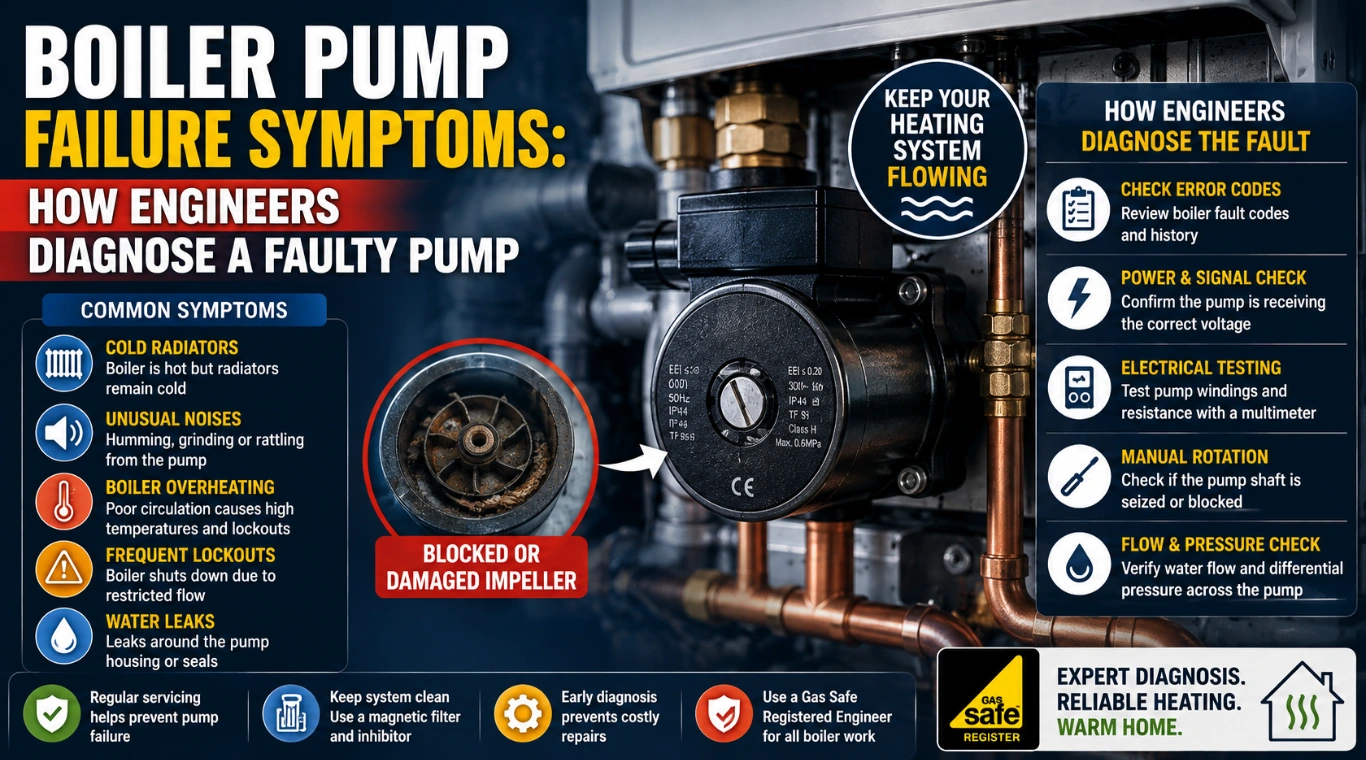
Engineers diagnose a suspected boiler pump fault by checking the boiler fault history, electrical supply, pump operation, system pressure, temperature differences and water circulation. They may also test the pump electrically and inspect it for blockages, seized components or signs of mechanical failure.
A pump fault should not be diagnosed from symptoms alone. Airlocks, sludge, blocked heat exchangers, closed valves, low system pressure and PCB faults can produce similar symptoms.
Safety: Boiler pump testing and internal boiler repairs should be carried out by a suitably qualified heating engineer. Do not remove an integral boiler casing or attempt electrical testing yourself.
Table of contents
- Quick Answer: What Are the Signs of a Failing Boiler Pump?
- What Does a Boiler Circulation Pump Do?
- 10 Common Boiler Pump Failure Symptoms
- 1. Radiators Stay Cold
- 2. Radiators Heat Very Slowly
- 3. The Boiler Gets Hot but the Radiators Do Not
- 4. Boiler Overheating or Locking Out
- 5. Boiler Pump Making a Humming Noise
- 6. Grinding, Rattling or Mechanical Noise
- 7. Pump Runs but There Is Little or No Circulation
- 8. Some Radiators Are Hot and Others Stay Cold
- 9. Boiler Works Intermittently
- 10. Water Leaking Around the Pump
- How Do Engineers Diagnose a Faulty Boiler Pump?
- Does a Multimeter Test Prove a Boiler Pump Has Failed?
- Safe Checks for Homeowners
- Can You Free a Stuck Boiler Pump Yourself?
- When Should You Call a Gas Safe Engineer?
- How to Prevent Boiler Pump Problems
- Conclusion
- Frequently Asked Questions
Quick Answer: What Are the Signs of a Failing Boiler Pump?
The most common boiler circulation pump failure symptoms include:
- Radiators remain cold or heat very slowly.
- Some radiators heat while others stay cold.
- The boiler becomes hot but heat does not circulate properly.
- The boiler repeatedly overheats or locks out.
- The pump makes humming, buzzing, grinding or rattling noises.
- The pump appears to run but water circulation remains poor.
- The boiler displays a circulation or overheating fault code.
- The heating works intermittently.
- The boiler pressure or temperature behaves abnormally.
- Water leaks from around the pump or associated connections.
These symptoms do not automatically prove that the pump has failed. An engineer should test the pump and rule out other circulation problems before replacing it.
What Does a Boiler Circulation Pump Do?
The boiler circulation pump moves heated water around the central-heating system.
When the boiler fires for central heating, the pump circulates water through the heating circuit. Hot water travels towards the radiators, transfers heat into the rooms and then returns to the boiler to be reheated.
A simplified heating cycle is:
Boiler → Pump → Radiators → Return Pipe → Boiler
If the pump cannot circulate water effectively, the boiler may generate heat without being able to transfer that heat around the system.
This can cause the boiler’s internal temperature to rise quickly. Depending on the appliance design, its controls may reduce the burner output or shut the boiler down to protect the appliance.
10 Common Boiler Pump Failure Symptoms
1. Radiators Stay Cold
Cold radiators are one of the most obvious signs of a circulation problem.
If the boiler fires and becomes hot but the radiators remain cold, an engineer may investigate:
- Circulation pump operation
- Airlocks
- Closed radiator valves
- Zone valves
- Low system pressure
- Sludge
- Blocked pipework
- Poor system balancing
- PCB or electrical faults
If every radiator is cold, the engineer should investigate the wider heating system rather than immediately replacing the pump.
If only one radiator is cold, a local valve, balancing or blockage problem becomes more likely.
2. Radiators Heat Very Slowly
A failing pump does not always stop completely.
A worn or restricted pump may continue operating while producing insufficient circulation. This can result in:
- Slow radiator warm-up
- Uneven radiator temperatures
- Some radiators becoming hot while others remain cool
- Longer heating times
- Poor heat distribution
Modern electronically controlled pumps can also change their operating speed according to system demand. Therefore, an engineer needs to determine whether the pump is actually responding correctly rather than simply listening for a noise.
3. The Boiler Gets Hot but the Radiators Do Not
This symptom can provide an important diagnostic clue.
If the boiler quickly becomes hot while the heating system remains cool, inadequate circulation may be preventing heat from leaving the boiler efficiently.
Possible causes include:
- Failed circulation pump
- Weak pump
- Airlock
- Closed valve
- Blocked heat exchanger
- Sludge
- Restricted pipework
- Incorrect pump setting
- Electrical control fault
An engineer may compare flow and return temperatures to determine whether heated water is circulating correctly.
4. Boiler Overheating or Locking Out
A circulation problem can cause the boiler’s internal temperature to rise rapidly.
Modern boilers have safety controls that monitor operating conditions. If the boiler detects excessive temperature or inadequate circulation, it may shut down and display a fault code.
Possible symptoms include:
Boiler fires → temperature rises quickly → burner stops → fault or lockout → boiler resets → problem returns
A circulation fault code does not automatically mean that the pump itself has failed.
The engineer may also need to check:
- Pump operation
- Pump electrical supply
- Flow and return sensors
- Heat exchanger condition
- System pressure
- Air in the system
- Blockages
- PCB controls
This distinction is important because replacing a pump will not resolve a fault caused by a blocked heat exchanger or failed sensor.
5. Boiler Pump Making a Humming Noise
A humming boiler pump can indicate several different conditions.
Possible causes include:
- Pump motor problems
- Air within the pump
- A partially seized pump
- Incorrect pump speed
- Electrical problems
- Debris affecting the impeller
A low humming noise does not necessarily mean that the pump has failed.
However, if the humming is accompanied by poor heating performance or repeated boiler lockouts, the pump should be investigated.
6. Grinding, Rattling or Mechanical Noise
Grinding or rattling sounds may indicate a mechanical problem.
An engineer may investigate whether:
- The pump bearings have worn.
- The impeller is damaged.
- Debris has entered the pump.
- The pump is partially seized.
- Air is passing through the system.
- The pump is operating incorrectly.
The exact noise matters, but sound alone cannot confirm the failed component.
7. Pump Runs but There Is Little or No Circulation
One particularly confusing pump fault occurs when the pump appears to operate but the heating system still has poor circulation.
The motor may be running while the hydraulic performance remains inadequate.
Potential causes include:
- Damaged impeller
- Internal pump wear
- Airlock
- Sludge or debris
- Incorrect pump setting
- System restriction
- Closed valve
- Blocked heat exchanger
This is why an engineer should assess actual circulation, rather than assuming that a pump is healthy simply because it makes a noise or vibrates.
8. Some Radiators Are Hot and Others Stay Cold
Uneven heating does not necessarily mean the pump has failed.
Possible causes include:
- Poor system balancing
- Partially closed lockshield valves
- Stuck TRVs
- Air
- Sludge
- Restricted pipework
- Pump performance problems
- Incorrect pump settings
If several radiators throughout the property are affected, circulation becomes more important to investigate.
A heating engineer can compare radiator temperatures and system flow to determine whether the problem is local or system-wide.
9. Boiler Works Intermittently
A pump can develop an intermittent fault rather than failing completely.
The heating may work normally at one time and then stop circulating correctly later.
This can occur because of:
- Electrical connection problems
- Pump control faults
- A motor that intermittently struggles to start
- Internal mechanical wear
- Air or debris
- A failing electronic pump module
Intermittent faults can be particularly difficult to diagnose because the pump may appear normal when the engineer first arrives.
Recording when the fault occurs and any boiler fault codes can provide useful information.
10. Water Leaking Around the Pump
Water around a boiler pump or heating pump should not be ignored.
Potential causes include:
- Failed seals
- Loose connections
- Corrosion
- Damaged pump components
- Leakage from nearby heating components
A leak can also cause system pressure to fall.
If boiler pressure repeatedly drops, the engineer should investigate the entire heating system rather than assuming that the pump is responsible.
How Do Engineers Diagnose a Faulty Boiler Pump?
Time needed: 5 minutes
Professional pump diagnosis normally involves several checks rather than replacing the component immediately.
- Check the Boiler Fault Code
The engineer first checks the boiler display and fault history.
The code can indicate areas such as:
Circulation
Overheating
Temperature sensing
Water pressure
Pump control
However, fault-code meanings vary between boiler manufacturers and models.
The exact appliance manual and technical documentation should therefore be used. - Check the System Pressure
Low pressure can interfere with heating-system operation and may produce symptoms that resemble a circulation problem.
The engineer checks the pressure against the manufacturer’s specified operating range.
If the pressure is repeatedly falling, they may investigate:
Heating-system leaks
Pressure relief valve discharge
Expansion vessel problems
Radiator leaks
Internal boiler leaks
Pressure should therefore be considered alongside pump performance. - Check Whether the Pump Receives Electrical Power
An electrically faulty pump cannot operate correctly.
An engineer can check whether the appropriate electrical supply and control signal reach the pump.
This can help distinguish between:
Pump failure
and
Pump control failure
For example, if the pump itself is electrically and mechanically healthy but the required control signal is absent, replacing the pump may not solve the problem.
Electrical testing should be performed by a suitably competent professional. - Test the Pump Electrically
Depending on the pump design, an engineer may use appropriate electrical test equipment to investigate:
Electrical continuity
Resistance
Supply voltage
Control signals
Motor condition
Resistance measurements can help identify certain winding or electrical faults, but there is no universal resistance value that applies to every boiler pump.
The engineer should use the manufacturer’s technical specifications for the exact pump. - Check Pump Operation
The engineer may assess whether the pump:
Starts correctly
Changes speed when required
Runs continuously when commanded
Produces abnormal noise
Vibrates excessively
Responds to the boiler’s control system
Modern modulating pumps can behave differently from older fixed-speed pumps, so simply listening for a running motor is not enough. - Check Water Flow and Temperature Difference
An important part of circulation diagnosis is determining whether heated water is actually moving through the system.
An engineer can assess flow and return temperatures and compare them with the boiler’s operating conditions.
A significant abnormal temperature difference can point towards:
Poor circulation
Pump problems
System restrictions
Incorrect balancing
Heat exchanger restrictions
Temperature measurements should be interpreted alongside the boiler’s specifications and operating conditions. - Check for Airlocks and System Restrictions
Air can interfere with circulation.
Sludge and magnetite can also restrict water flow through:
Pumps
Radiators
Valves
Heat exchangers
Narrow pipework
An engineer may therefore inspect the wider system rather than replacing the pump immediately.
Does a Multimeter Test Prove a Boiler Pump Has Failed?
Not necessarily.
Electrical measurements can identify certain faults, but they do not always prove that a pump is capable of producing the required hydraulic performance.
A complete diagnosis should consider both:
Electrical operation
and
Hydraulic circulation
This distinction is important because a pump can receive power and still fail to circulate water adequately.
Safe Checks for Homeowners
There are some useful checks you can perform without opening the boiler.
Check the boiler display
Record any fault code shown.
Check system pressure
Compare the displayed pressure with the boiler manufacturer’s recommended range.
Check heating controls
Confirm that:
- Central heating is selected.
- The programmer is calling for heat.
- The thermostat is set above the current room temperature.
Compare radiators
Check whether:
- All radiators are cold.
- Some radiators are warm.
- One radiator remains cold.
- Radiators heat slowly.
Listen for unusual noises
Note any humming, grinding, rattling or gurgling.
Do not remove the boiler casing or attempt to access the pump’s internal electrical components.
Can You Free a Stuck Boiler Pump Yourself?
A stuck pump can sometimes be caused by debris or mechanical seizure.
However, accessing and manually freeing a pump inside a boiler can involve electrical and heating-system hazards.
For an integral boiler pump, diagnosis and repair should be carried out by a suitably qualified engineer.
Do not remove the boiler casing or disconnect internal wiring yourself.
When Should You Call a Gas Safe Engineer?
Arrange professional diagnosis when:
- The boiler repeatedly locks out.
- The boiler overheats.
- Radiators remain cold despite a heating demand.
- The pump makes severe grinding or rattling noises.
- The boiler repeatedly loses pressure.
- Water is leaking from the boiler.
- The pump does not operate.
- Heating performance has deteriorated significantly.
- You suspect an internal boiler component has failed.
Gas-related boiler work and internal combustion-appliance work should be completed by an appropriately qualified Gas Safe registered engineer.
How to Prevent Boiler Pump Problems
You cannot prevent every pump failure, but good heating-system maintenance can reduce the risk of circulation problems.
Useful measures include:
- Maintain the system at the correct pressure.
- Investigate recurring pressure loss.
- Address system leaks promptly.
- Keep heating-system water in good condition.
- Maintain the magnetic filter where fitted.
- Have the boiler serviced according to the manufacturer’s requirements.
- Investigate unusual pump noises early.
- Do not repeatedly reset a boiler that continues to lock out.
- Ensure radiators and valves remain correctly maintained.
Dirty system water is particularly important because sludge and magnetite can affect pumps and other hydraulic components.
Conclusion
Boiler pump failure symptoms can range from cold radiators and unusual noises to overheating and repeated boiler lockouts. However, these symptoms can also result from airlocks, sludge, low pressure, blocked heat exchangers, electrical faults and control problems.
The most reliable diagnosis involves checking the fault history, system pressure, pump electrical supply, pump operation, water flow and temperature difference. An engineer may also inspect the pump mechanically and compare test results with the manufacturer’s technical information.
A pump should therefore not be replaced simply because the boiler is overheating or the radiators are cold. Correct diagnosis helps identify whether the pump itself has failed or whether another part of the heating system is causing the circulation problem.
Frequently Asked Questions
Common symptoms include cold radiators, boiler overheating, repeated lockouts, humming or grinding noises, slow heating and poor water circulation. A pump may also leak if its seals or housing have deteriorated.
Yes. A failed or weak circulation pump can prevent heated water from reaching the radiators. However, trapped air, sludge, closed valves, low pressure and balancing problems can cause similar symptoms.
An engineer may check fault codes, system pressure, electrical supply, pump operation, resistance where applicable, water flow, temperature differences and differential pressure. The exact tests depend on the pump and boiler design.
Yes. A pump can appear to run while producing insufficient circulation. A damaged impeller, mechanical wear, air, system restriction or incorrect pump operation can reduce its performance.
No. The problem may actually be caused by air, wiring, controls, system contamination or another restriction. If the pump itself has mechanically or electrically failed, replacement may then be necessary.
Key Takeaways
- A faulty boiler circulation pump causes cold radiators, overheating, and unusual noises; engineers diagnose issues by checking multiple factors, not just symptoms.
- Common boiler pump failure signs include cold or slowly heating radiators, overheating boilers, and water leaks; engineers investigate further to confirm pump issues.
- Diagnosing a boiler pump requires checking fault codes, system pressure, electrical supply, and pump operation; this prevents unnecessary replacements.
- Homeowners can perform checks such as monitoring boiler display, checking system pressure, and comparing radiator temperatures; do not attempt internal repairs yourself.
- Regular maintenance and prompt troubleshooting can help prevent boiler pump problems, ensuring better heating system performance.