Boiler Expansion Vessel Problems: Symptoms & How to Fix Them
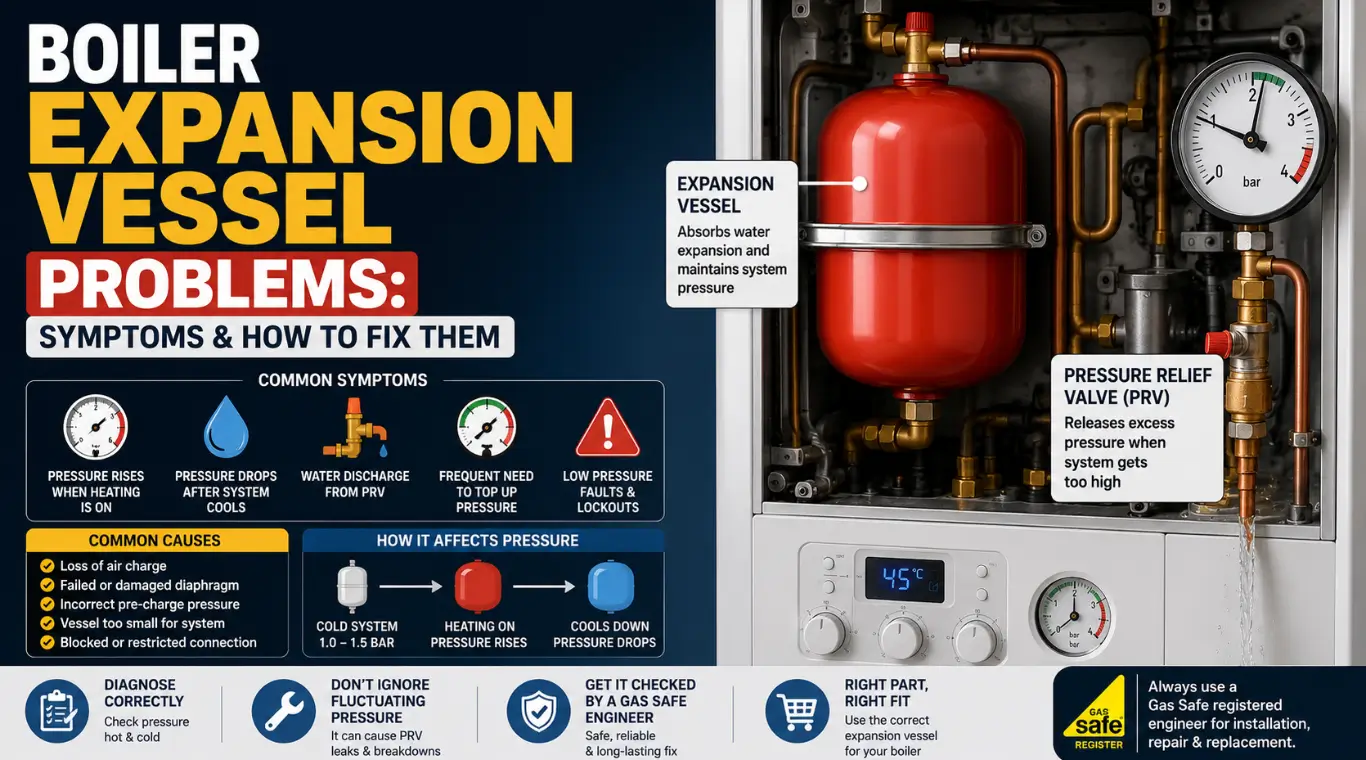
Boiler expansion vessel problems commonly cause pressure to rise sharply when the heating is running and then fall again after the system cools. In some cases, the pressure relief valve releases water outside, leaving the boiler with insufficient pressure once it has cooled.
However, fluctuating pressure does not automatically prove that the expansion vessel needs replacing. Lost air charge, a damaged diaphragm, an incorrectly sized vessel, a restricted connection and several unrelated boiler faults can produce similar symptoms. Proper diagnosis is therefore important before ordering a replacement.
Table of contents
- Quick Answer
- What Does a Boiler Expansion Vessel Do?
- Do All Boilers Have an Expansion Vessel?
- Symptoms of Boiler Expansion Vessel Problems
- Why Boiler Pressure Rises and Then Drops
- Common Causes of Expansion Vessel Problems
- Does a Faulty Expansion Vessel Always Need Replacing?
- Other Problems That Can Look Like Expansion Vessel Failure
- Safe Checks for Homeowners
- Checks for Heating Engineers
- How Expansion Vessel Problems Affect Other Boiler Parts
- Preventing Expansion Vessel Problems
- Finding the Correct Replacement Expansion Vessel
- Frequently Asked Questions
Quick Answer
An expansion vessel absorbs the additional volume created when the water in a sealed central-heating system becomes hot.
Inside the vessel, a flexible rubber diaphragm separates the system water from a pressurised air or gas side. The compressed side acts as a cushion as the water expands. If this cushion is lost, system pressure may climb rapidly during heating, potentially causing the pressure relief valve to open. When the boiler cools, the pressure can then fall too low.
Testing, recharging and replacing a boiler expansion vessel should be handled by a competent heating engineer. Where the vessel is inside a gas boiler or access affects the boiler casing, a suitably qualified Gas Safe registered engineer should carry out the work.
What Does a Boiler Expansion Vessel Do?
Water expands as its temperature increases. Because a sealed heating system does not have an open feed-and-expansion tank to accommodate this change, it needs another way to control the additional water volume. The expansion vessel provides that space.
It normally contains:
- A connection to the central-heating water
- A flexible internal diaphragm or bladder
- A separate air or gas-filled chamber
- A charging valve on the air side
As the heating water becomes hotter and expands, it pushes against the diaphragm. The air side compresses and absorbs the change in volume, helping keep the system pressure within its intended operating range.
The technical document supplied for this article similarly describes the vessel as accommodating the extra volume created during heating, with a rubber diaphragm separating system water from a pocket of air. Vaillant also describes the expansion vessel as the component that prevents pressure from becoming excessively high as water heats.
Do All Boilers Have an Expansion Vessel?
Expansion vessels are associated with sealed heating systems rather than one particular boiler brand. Many combi and system boilers have an expansion vessel installed inside the boiler casing. Other systems use an external vessel fitted elsewhere in the heating circuit. Some boilers may have an internal vessel supplemented by an additional external vessel where the system water volume is too large for the original component.
A heat-only boiler connected to an open-vented system may use a feed-and-expansion cistern instead of a sealed-system expansion vessel. Therefore, the boiler type alone does not confirm where the vessel is located or whether one is fitted.
There may also be a separate potable-water expansion vessel serving an unvented hot-water cylinder. That is a different component from the expansion vessel protecting the sealed central-heating circuit.
Symptoms of Boiler Expansion Vessel Problems
The strongest clue is not simply low pressure. It is the way the pressure changes between a cold system and a hot system.
| Possible symptom | Why it may happen | Who should investigate |
| Pressure rises sharply when the heating starts | The vessel may not have enough usable air space to absorb the expanding water | Heating engineer or Gas Safe engineer |
| Pressure approaches the upper limit of the gauge | The system pressure may be increasing faster than the vessel can control it | Gas Safe engineer |
| Pressure falls after the boiler cools | Water may have been discharged through the PRV during the heating cycle | Gas Safe engineer |
| Boiler needs frequent repressurising | Repeated PRV discharge or another leak may be removing water from the system | Heating engineer or Gas Safe engineer |
| Water drips from an external copper discharge pipe | The pressure relief valve may have opened because system pressure became too high | Gas Safe engineer |
| Boiler locks out with a low-pressure fault | The system may no longer contain enough water after cooling or discharge | Gas Safe engineer if recurring |
| Pressure changes considerably between hot and cold | The expansion vessel may have lost its charge, failed internally or become undersized for the system | Heating engineer or Gas Safe engineer |
| Water is found at the vessel’s air valve during professional testing | The internal diaphragm may have split, allowing system water into the air side | Heating engineer or Gas Safe engineer |
| Visible corrosion or leakage around an external vessel | The vessel body or connection may be deteriorating | Heating engineer |
A typical sealed boiler is often around 1 to 1.5 bar when cold, although the correct filling pressure depends on the boiler and the building’s static height. A small increase during heating can be normal. The concern is a large or rapid increase, particularly when pressure moves towards the boiler’s safety limit. Always follow the pressure range in the manufacturer’s manual.
Why Boiler Pressure Rises and Then Drops
The pressure pattern usually follows a clear sequence.
1.The boiler starts at an apparently normal cold pressure
The gauge may show a normal reading while the system water is cold. This can make the boiler appear healthy before the heating starts.
2. The heating water expands
As the radiators and pipework warm up, the volume of water in the sealed circuit increases.
3. The expansion vessel cannot absorb enough volume
If the vessel has lost its air charge, has a damaged diaphragm, is too small or is disconnected from the system by a restriction, there may be insufficient cushioning space.
4. The pressure climbs rapidly
Instead of the vessel absorbing the change, the pressure gauge rises significantly. Some systems may move towards 3 bar, depending on the appliance and its safety-valve setting. Manufacturer instructions commonly specify a 3-bar operating point for the central-heating pressure relief valve. The precise value must still be confirmed in the manual for the boiler being examined.
5. The pressure relief valve releases water
The PRV is designed to relieve excessive system pressure. Water may be discharged through the external relief pipe.
This should not be treated as proof that the PRV itself caused the original pressure rise. It may simply have responded to a separate expansion-vessel problem.
6. The boiler cools and pressure falls
After the heating switches off, the system water contracts. Because some water may already have been discharged, the cold pressure can fall below its previous level. The homeowner then sees low pressure and tops up the system. When the next heating cycle begins, the pressure rises again and the pattern repeats.
Common Causes of Expansion Vessel Problems
Loss of air or gas charge
The pressurised side of an expansion vessel can lose charge over time. This reduces the usable cushion available to absorb expanding heating water. A vessel that has lost charge is not necessarily permanently damaged. A competent engineer must inspect and test it under the conditions specified by the boiler or vessel manufacturer before deciding whether it can be restored or requires replacement.
Split or damaged diaphragm
The internal diaphragm can split, deteriorate or separate. When this happens, system water may enter the side intended to contain the air charge. A failed diaphragm generally means the vessel can no longer operate correctly and may require replacement. Finding water at the air-side charging valve during proper testing is a strong indication of internal failure, although the full system should still be assessed.
Leaking charging valve
The vessel’s air-side valve can leak and allow the charge to escape. An engineer should confirm whether the loss is from the valve, the diaphragm or another part of the vessel before recommending replacement.
Incorrect pre-charge pressure
The vessel must be set up in relation to the heating system’s static pressure and the boiler manufacturer’s instructions. There is no single pressure setting suitable for every boiler, house or installation. Official boiler manuals show that expansion-vessel charge requirements vary by appliance and system height.
Vessel too small for the system
The expansion vessel must have sufficient usable capacity for the total volume of water in the heating system.
A system may outgrow its vessel after:
- Additional radiators are installed
- An extension receives new heating circuits
- Larger radiators replace smaller ones
- Underfloor heating is added
- The system layout is significantly altered
Where the built-in vessel is insufficient, an engineer may recommend a correctly sized additional external vessel rather than replacing the boiler’s internal vessel with the same capacity. Some manufacturer instructions specifically require an additional expansion vessel where operating pressure becomes excessive at maximum system temperature.
Blocked or restricted vessel connection
A functional vessel cannot control pressure properly if the route between the vessel and the heating circuit is blocked or restricted. Sludge, debris or a problem in the connection may prevent system water from acting against the diaphragm. This can imitate a failed or flat vessel, so the connection should be considered before a replacement part is fitted.
Corrosion or physical leakage
External vessels and their connections can develop corrosion or water leaks. Internal boiler vessels may also deteriorate with age.
A leaking vessel body requires investigation and normally cannot be corrected by restoring the air charge.
Does a Faulty Expansion Vessel Always Need Replacing?
No. An expansion vessel problem does not automatically mean the vessel needs replacement.
A vessel may have:
- Lost its charge without suffering diaphragm damage
- Developed a leaking air-side valve
- Been incorrectly commissioned
- Been blamed for a restriction elsewhere
- Become too small after the heating system was extended
However, replacement may be appropriate where the diaphragm has failed, the vessel body is leaking or corroded, the charge cannot be retained, or the component has been confirmed as defective through proper testing. The important distinction is between a vessel that is temporarily unable to work because its charge has been lost and a vessel that has physically failed. This decision must be made through diagnosis rather than by looking only at the boiler pressure gauge.
Other Problems That Can Look Like Expansion Vessel Failure
Pressure fluctuations should not be attributed to the expansion vessel without checking other possibilities.
Filling loop passing water
A filling valve that has not fully closed or is passing internally can allow mains water into the heating circuit. This may cause pressure to increase even while the boiler is cold or the heating is switched off. That pattern is different from pressure that rises mainly as the system becomes hot.
Pressure relief valve leaking
A PRV may continue dripping after it has operated, particularly if its sealing surface has been affected by debris or wear. The expansion vessel could have caused the original high-pressure event, but a PRV problem may remain after the vessel fault is corrected.
Heating-system leak
Leaks from radiators, valves, pipework, automatic air vents, boiler components or concealed pipes can cause pressure loss without a major rise during heating.
Plate heat exchanger failure
On some combi boilers, an internal failure in the plate heat exchanger can allow higher-pressure mains water to enter the sealed heating circuit. This can make boiler pressure rise independently of normal heating expansion and requires appliance-specific diagnosis.
Faulty pressure sensor or gauge
The displayed pressure may be inaccurate if the pressure sensor, gauge, wiring or control system is defective. An engineer should confirm whether the indicated pressure matches the actual system condition before replacing pressure-related components.
Circulation or overheating problem
Restricted circulation, a pump problem or another overheating condition may produce abnormal temperature and pressure behaviour. These faults require separate diagnosis and should not be treated as expansion-vessel failure solely because pressure is elevated.
Safe Checks for Homeowners
Homeowners should not remove the boiler casing, press the vessel’s charging valve, attempt to recharge the vessel or replace internal components.
Safe observations include:
- Note the boiler pressure when the system is completely cold.
- Observe how far the pressure rises after the central heating has been running.
- Check whether the pressure falls again once the system cools.
- Look for visible water around radiators, valves and accessible pipework without dismantling anything.
- From a safe position, check whether water appears to be dripping from the boiler’s external pressure-relief discharge pipe.
- Record any fault code shown by the boiler.
- Tell the engineer whether the system has recently had extra radiators or other heating circuits added.
Repeatedly repressurising the boiler without investigating the cause can hide an ongoing leak or pressure-control fault. Gas Safe Register advises homeowners not to attempt to fit, fix or move gas appliances themselves and recommends using a qualified, competent Gas Safe registered engineer for boiler servicing and repair.
Checks for Heating Engineers
A professional diagnosis should consider the complete pressure cycle rather than testing the vessel in isolation.
Depending on the boiler and system, the investigation may include:
- Confirming the correct cold filling pressure
- Observing pressure rise as the system reaches operating temperature
- Checking whether the pressure rise is heat-related or continues while cold
- Inspecting the PRV discharge route
- Checking the vessel for visible leakage or corrosion
- Measuring the vessel charge under the manufacturer’s required conditions
- Checking whether the charge is retained
- Assessing the diaphragm’s condition
- Confirming the vessel connection is unrestricted
- Comparing vessel capacity with the system-water volume
- Checking whether recent system extensions require an additional vessel
- Eliminating filling-loop, sensor, gauge, PRV and heat-exchanger faults
- Following the appliance-specific installation and servicing instructions
Intergas service guidance, for example, requires the expansion vessel to be inspected for leaks and correct pre-charge pressure during servicing. Other manufacturers may specify different service intervals and procedures, so the relevant manual remains the controlling document.
How Expansion Vessel Problems Affect Other Boiler Parts
An unresolved expansion vessel problem can place repeated stress on other parts of the heating system.
Pressure relief valve
Frequent high-pressure cycles may cause the PRV to operate repeatedly. Once it has discharged, it may continue leaking and contribute to ongoing pressure loss.
Boiler seals and connections
Repeated pressure fluctuations can expose weak seals, joints and ageing components to additional strain.
Pressure sensor
Rapid or repeated changes may cause pressure-related fault codes, although the sensor itself may remain functional.
Pump and circulation system
Unstable pressure and repeated introduction of fresh water can contribute to air entering the system, circulation complaints and increased corrosion risk.
Radiators and valves
Existing weak points may begin to seep when the system repeatedly operates at unusually high pressure. Replacing the expansion vessel alone may therefore not resolve every symptom if the PRV or another component has also been affected.
Preventing Expansion Vessel Problems
Expansion-vessel condition should be considered during boiler maintenance, particularly where the appliance has a history of pressure fluctuations.
Useful preventive measures include:
- Having the boiler serviced at the recommended intervals
- Investigating unexplained pressure changes early
- Checking vessel capacity when adding radiators or new heating zones
- Avoiding repeated topping-up without identifying the cause
- Correcting system leaks promptly
- Using the manufacturer’s specified vessel charge and commissioning procedure
- Inspecting external vessels for corrosion and leakage
The pressure should remain reasonably stable between heating cycles. A small movement can be normal, but regular swings from low pressure to the upper end of the gauge require investigation.
Finding the Correct Replacement Expansion Vessel
Expansion vessels are not universal. Even vessels that appear similar may differ in:
- Physical dimensions
- Capacity
- Pre-charge specification
- Connection position
- Connection size
- Mounting arrangement
- Shape
- Boiler compatibility
- Manufacturer part number
Heating & Catering Parts supplies a wide range of expansion vessels covering most major boiler brands.
When searching the Expansion Vessels category, you can:
- Filter products by boiler brand
- Search using the boiler’s GC number
- Search using the manufacturer part number or MPN
- Compare the existing component with the product listing
Before ordering, confirm the boiler’s complete model details and compare the original vessel’s part number where available. A GC number can help distinguish between boiler variants that share a similar model name but use different components. A replacement vessel should only be ordered after the existing component has been properly diagnosed and compatibility has been confirmed.
Frequently Asked Questions
The most common pattern is pressure rising significantly while the heating is on and falling again after the system cools. Other signs include PRV discharge, repeated low-pressure lockouts and frequent repressurising.
The expansion vessel may be unable to absorb the additional volume of hot system water. Possible reasons include lost charge, diaphragm failure, insufficient vessel capacity or a blocked connection. A filling-loop or heat-exchanger fault can also cause high pressure and should be ruled out.
If pressure became excessive while the system was hot, the PRV may have released water. When the remaining water cools and contracts, the pressure can fall below the boiler’s operating range.
Sometimes, but only after an engineer confirms that the diaphragm and vessel body remain serviceable and that the component can retain the correct charge. A split diaphragm or leaking vessel usually requires replacement.
Homeowners should not remove the boiler casing, operate the charging valve or attempt to recharge the vessel. Testing must be carried out under controlled system conditions and in accordance with the boiler manufacturer’s instructions6.
Not necessarily. Correcting the expansion-vessel fault may prevent further high-pressure events, but a PRV that has already been damaged or contaminated may continue leaking and require separate attention.
Yes. A vessel may be inadequate if the system has a large water volume or has been extended with additional radiators, zones or underfloor heating. An engineer should calculate the required capacity.
Use the boiler brand and full model, GC number and the MPN from the existing component where available. Do not rely on appearance alone because similar-looking vessels may have different capacities, connections and compatibility.
Key Takeaways
- Boiler expansion vessel problems cause pressure fluctuations during heating cycles due to various issues like lost air charge or diaphragm damage.
- Symptoms include rapid pressure rise when heating starts, pressure drop after cooling, and frequent need for repressurising.
- Not all boilers have expansion vessels; their presence and configuration depend on the heating system type and installation.
- Proper diagnosis by a qualified engineer is crucial to determine whether a faulty vessel requires replacement or if other issues exist.
- Preventive measures and routine maintenance can help avoid expansion vessel problems, ensuring stable boiler pressure.