Boiler Heat Exchanger Problems: Symptoms, Causes Guide
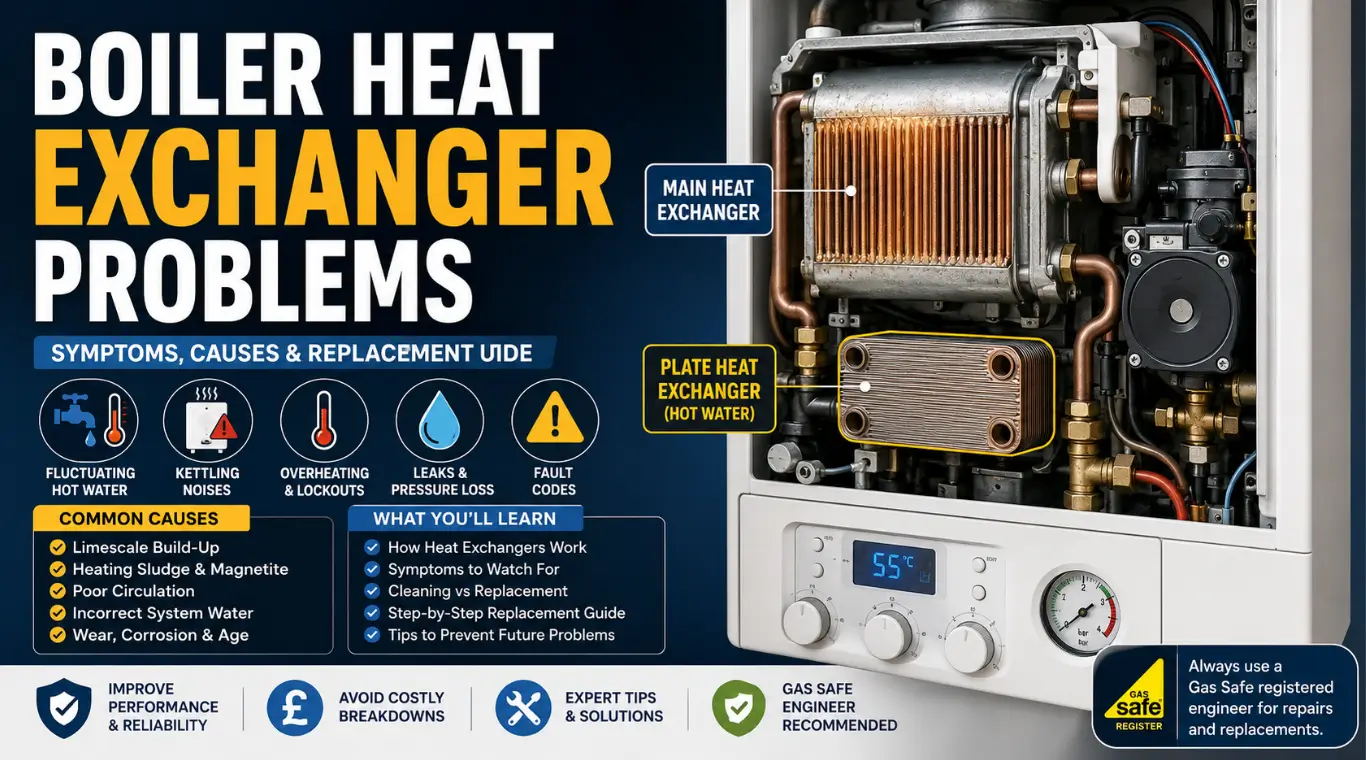
Boiler heat exchanger problems can cause fluctuating hot water, kettling noises, overheating, repeated fault codes, leaks or reduced heating performance. The exact symptoms depend on whether the problem affects the boiler’s main heat exchanger or, on many combi boilers, the separate domestic hot-water plate heat exchanger.
However, these symptoms do not prove that the heat exchanger is faulty. Pump problems, blocked filters, temperature sensors, flow sensors and diverter valves can create similar behaviour. A Gas Safe registered engineer should diagnose the boiler before a replacement part is ordered or fitted.
Table of contents
Quick Answer
The main heat exchanger transfers heat from the burner into the boiler’s primary water circuit. On many combi boilers, a second plate heat exchanger then transfers some of that heat into the mains water supplying the hot taps.
A restricted exchanger may cause poor heat transfer, noisy operation, overheating or inconsistent hot water. Cleaning may be possible where the problem is caused by removable scale or sludge. A leaking, cracked, badly corroded or permanently restricted exchanger will normally need replacing.
What Does a Boiler Heat Exchanger Do?
A heat exchanger allows thermal energy to pass from one medium to another without the two fluids mixing.
Inside a gas boiler, the main heat exchanger absorbs heat produced by combustion and transfers it into the water circulating through the boiler’s primary circuit. That heated water may then travel around the radiators, through a hot-water cylinder coil or towards another heat exchanger, depending on the boiler design.
The exchanger must repeatedly withstand high temperatures, cooling cycles, system pressure and constant water flow. Its internal waterways must also remain clear enough for water to circulate and carry heat away safely.
Although this article applies across boiler brands, the construction, materials and hydraulic layout vary considerably. An engineer must therefore use the correct manufacturer instructions and parts diagram for the exact boiler model.
Main Heat Exchanger vs Plate Heat Exchanger
These components are related, but they do different jobs.
| Component | What it does | Commonly found in |
| Main or primary heat exchanger | Transfers burner heat into the boiler’s primary water circuit | Combi, system and heat-only gas boilers |
| Domestic hot-water plate heat exchanger | Transfers heat from primary boiler water into mains water for the hot taps | Many combi boilers |
When a hot tap is opened on a typical combi boiler, the appliance detects hot-water demand. Heated primary water is directed through one side of the plate heat exchanger while cold mains water passes through the other side. Heat moves through the metal plates without the two water circuits mixing.
Not every combi boiler uses exactly the same arrangement. Some designs use alternative or combined exchanger layouts. In addition, certain manufacturers may use the term “secondary heat exchanger” for a condensing section rather than the domestic hot-water plate unit.
Always confirm the component through the boiler’s model, GC number and manufacturer parts information instead of relying only on its name.
Symptoms of a Blocked or Faulty Heat Exchanger
The following symptoms may point towards a heat exchanger problem. They can also be caused by other components, so they should be treated as diagnostic clues rather than confirmation.
| Symptom | What it may indicate |
| Hot water repeatedly changes from hot to cold | Restricted plate heat exchanger or another domestic hot-water control fault |
| Heating works but hot water is weak or lukewarm | Possible blocked plate heat exchanger |
| Boiler makes kettling, whistling or rumbling noises | Restricted circulation, scale or deposits creating localised overheating |
| Boiler overheats or frequently locks out | Heat is not being carried away correctly |
| Boiler starts and stops rapidly | Temperature may be rising too quickly because of poor flow |
| Heating and hot water both perform poorly | Main exchanger, circulation, pump or wider system issue |
| Water appears beneath the boiler | Leaking exchanger, seal, connection or another internal component |
| Boiler pressure keeps falling | A water leak may be present, although blockage alone does not usually reduce pressure |
| Temperature or circulation fault codes appear | The boiler is detecting abnormal readings, but the code may not identify the failed part |
Hot Water Changing Temperature
Fluctuating shower or tap temperature is commonly associated with a restricted plate heat exchanger on a combi boiler. Deposits inside the narrow waterways may reduce the rate at which heat passes into the tap water.
The boiler can then heat the primary circuit rapidly, reach a control limit and reduce or stop burner operation. As temperatures fall, it may fire again, producing a repeating hot-cold-hot pattern.
However, a flow sensor, thermistor, diverter valve or mixer shower can cause similar symptoms. An engineer should compare the boiler’s behaviour during heating and hot-water demand before blaming the plate heat exchanger.
Heating Works but There Is Little or No Hot Water
When the radiators heat normally but domestic hot-water performance is poor, the fault may be limited to the combi boiler’s hot-water circuit.
A restricted plate exchanger is one possibility, especially where hot-water flow is reasonable but the temperature remains low or unstable. Other possible causes include the diverter valve, flow turbine, temperature sensor or a restriction elsewhere in the water path.
Kettling and Unusual Boiler Noises
Kettling describes whistling, bubbling or rumbling sounds associated with water becoming excessively hot in a restricted area.
Limescale or other deposits can reduce flow and create local hot spots. The water around those deposits heats more quickly than expected, potentially causing noise and repeated overheating. Restricted circulation elsewhere in the system can produce a similar result, so kettling does not automatically mean the exchanger must be replaced.
Water Leaking from the Boiler
A damaged main heat exchanger may leak, but water under a boiler can also come from seals, hydraulic connections, the pressure relief valve, condensate components or other internal parts.
Homeowners should not remove the boiler casing to locate the source. Record when the leak appears, switch the appliance off if water is reaching electrical components, and arrange a professional inspection.
Carbon Monoxide Alarm or Suspected Combustion Problem
A sounding carbon monoxide alarm, unusual combustion smell or other gas-safety concern should not be treated as ordinary boiler troubleshooting.
Turn the appliance off when it is safe to do so, ventilate the property, leave the affected area and follow the emergency instructions supplied with the alarm. Do not remove the boiler casing to inspect the burner or heat exchanger.
These signs do not confirm a cracked exchanger, but the appliance must not be used until it has been checked by an appropriately qualified Gas Safe registered engineer.
Common Causes of Boiler Heat Exchanger Problems
Limescale Build-Up
Hard mains water contains minerals that can form deposits when heated. This is particularly relevant to the domestic-water side of a combi boiler’s plate heat exchanger because fresh mains water continually passes through it.
As deposits accumulate, they can narrow the waterways and reduce heat transfer. Hot-water temperature may become unstable, and the boiler may need to operate harder to meet demand.
Limescale can also contribute to boiler noise and localised overheating. The severity depends on the water conditions, boiler design, usage and any scale-protection measures fitted.
Heating Sludge and Magnetite
Corrosion inside radiators and heating pipework can produce magnetic debris that combines with other contamination to form dark heating sludge.
This material circulates through the primary circuit and may collect in pumps, filters, valves and heat-exchanger waterways. Restricted circulation reduces the system’s ability to carry heat away from the boiler.
A magnetic filter can capture circulating magnetic debris, but it will not automatically clear a component that is already heavily restricted. A contaminated system may require cleaning and investigation by a heating engineer.
Poor Primary Circulation
The exchanger itself may be clear while another problem limits water movement through it.
Possible causes include:
- A weak or sticking circulation pump
- Air trapped in the system
- Closed or restricted valves
- A blocked system filter
- Sludge elsewhere in the pipework
- Incorrectly balanced or modified heating circuits
Poor circulation can cause the main exchanger to overheat, even when the exchanger is not the original cause.
Incorrect or Poorly Maintained System Water
Dirty water, installation debris, inadequate inhibitor protection or contamination introduced during repairs can increase the risk of corrosion and blockage.
Manufacturer requirements commonly state that heating systems should be flushed and correctly treated. Poor system-water condition may also affect warranty coverage, depending on the manufacturer’s terms.
Age, Corrosion and Repeated Thermal Stress
A main heat exchanger repeatedly expands as it heats and contracts as it cools. Over time, corrosion, contamination and thermal cycling can weaken the material.
Age alone does not prove that an exchanger has failed. Some older exchangers remain serviceable, while relatively recent ones can be damaged by poor circulation or contaminated system water.
The decision should be based on its physical condition, test results, boiler history and whether the underlying cause can be corrected.
Can a Boiler Heat Exchanger Be Cleaned?
Yes, some heat exchangers can be cleaned successfully. It depends on the exchanger type, the cause of the restriction and whether the component remains structurally sound.
Cleaning a Plate Heat Exchanger
A plate heat exchanger affected by removable limescale or debris may sometimes be cleaned using an appropriate professional method.
Depending on the boiler and level of contamination, an engineer may:
- Confirm the restriction through temperature and flow checks
- Remove the plate exchanger where the manufacturer permits
- Flush or professionally descale the component
- Inspect the seals and waterways
- Refit and test it using the correct replacement seals
Cleaning will not repair split plates, corrosion damage, distorted connections or a component that fails pressure testing.
A general system flush should not be presented as a guaranteed cure for a heavily blocked plate exchanger. In some cases, removal, specialist cleaning or replacement is required.
Cleaning a Main Heat Exchanger
Main heat-exchanger cleaning must follow the boiler manufacturer’s servicing instructions.
Depending on the appliance, this may involve cleaning the water side, combustion side, condensate passages or accessible exchanger surfaces. These procedures require the boiler casing and combustion components to be disturbed and are not suitable for homeowners.
Manufacturer documentation for some boilers includes specific methods for accessing and cleaning exchanger surfaces. Using the wrong brush, chemical or procedure could damage the exchanger or seals.
When Cleaning Will Not Work
Replacement is usually more appropriate when:
- The exchanger body is cracked or leaking
- Corrosion has weakened the metal
- Internal waterways remain restricted after correct cleaning
- Plates or connections are damaged
- The exchanger fails the required tests
- Cleaning would not provide a reliable repair
- The manufacturer specifies replacement
The underlying cause must still be corrected. Installing another exchanger into a dirty or poorly circulating system can result in the replacement becoming restricted or damaged again.
Safe Checks for Homeowners
Homeowners can collect useful information without opening the boiler:
- Check which service is affected. Note whether the problem affects heating, hot water or both.
- Read the displayed fault code. Record the exact code and check the user manual for the boiler model.
- Check the pressure gauge. Compare the reading with the normal range stated in the boiler manual.
- Look for visible water. Check beneath the boiler and around accessible pipes without removing covers.
- Compare several hot-water outlets. A problem at one shower or mixer tap may be outside the boiler.
- Listen for unusual sounds. Note when kettling or rumbling starts and whether it occurs during heating or hot-water demand.
- Use only the permitted reset procedure. One reset may be reasonable where the manual allows it. Do not repeatedly reset a boiler that continues to overheat or lock out.
Do not add descaling chemicals, remove the casing, disconnect the exchanger or attempt an internal repair.
Checks for Heating and Gas Safe Engineers
A competent engineer may need to:
- Confirm the full model, variant, GC number and hydraulic arrangement
- Review stored and current fault codes
- Establish whether the problem occurs during heating, hot water or both
- Compare flow, return and domestic hot-water temperature behaviour
- Check circulation, pump operation, filters, valves and air removal
- Evaluate temperature-sensor readings against the manufacturer procedure
- Distinguish plate restriction from flow-sensor or diverter-valve faults
- Inspect system water for corrosion products and contamination
- Check the main exchanger for leaks, corrosion and deposits
- Follow the manufacturer’s combustion, safety and recommissioning procedures
- Confirm that the original cause has been corrected before fitting a replacement
Work on a gas boiler must be carried out by a Gas Safe registered engineer with the appropriate appliance qualifications.
When Does a Heat Exchanger Need Replacing?
Replacement should be based on evidence rather than symptoms alone.
A replacement may be justified when an engineer confirms physical leakage, structural damage, serious corrosion or a restriction that cannot be removed reliably. The condition of the rest of the boiler should also be considered.
On an older boiler, the engineer or owner may compare:
- Availability of the correct exchanger
- New and refurbished replacement options
- Required seals and service parts
- Labour and recommissioning requirements
- Condition of the pump, burner, controls and hydraulic components
- Previous repair history
- Expected reliability after repair
A costly main heat-exchanger repair does not automatically mean the entire boiler must be replaced. Where a suitable exchanger is available and the rest of the appliance is serviceable, repair may remain practical.
New vs Refurbished Main Heat Exchangers
A brand-new exchanger may be preferred for newer appliances, warranty repairs or situations where the manufacturer requires a new component.
However, the price of a new main exchanger can make some older-boiler repairs difficult to justify. A professionally refurbished original component may provide a more economical alternative where the correct part is available.
Selected refurbished main heat exchangers from Heating & Catering Parts may cost around 20% of the equivalent new-part price, depending on the boiler and stock availability. That can make an otherwise uneconomical repair more practical.
HCP states that its refurbished boiler parts are tested and supplied with a one-year warranty. Individual refurbished exchanger listings also describe cleaning, inspection or pressure testing, although customers should check the exact product condition and warranty information before ordering.
A refurbished part must still be:
- Correct for the exact boiler variant
- Inspected before fitting
- Installed with the required seals or service kit
- Fitted and tested by a suitably qualified engineer
How to Find the Correct Boiler Heat Exchanger
Do not order an exchanger based only on the boiler brand or visual appearance. Similar boilers can use different exchangers depending on output, production date and appliance revision.
Heating & Catering Parts provides three main search routes:
Filter by Brand and Part Type
Select the boiler manufacturer and choose the relevant part type. This is useful when the customer knows the brand but does not yet have the exchanger part number.
Search by Manufacturer Part Number
Enter the MPN printed on the original component, packaging or manufacturer parts documentation.
A matching manufacturer part number is usually the quickest way to narrow the search, but superseded numbers and revised components should still be checked.
Search by GC Number
The GC number identifies the appliance type and can help distinguish between similar boiler variants. It is normally found on the boiler data plate or relevant appliance documentation.
Before ordering, compare:
- Full boiler make and model
- GC number
- Manufacturer part number
- Boiler output
- Production or serial information where relevant
- Connection layout
- Included seals, clips and service parts
- New or refurbished condition
When the details are unclear, send HCP a clear photograph of the boiler data plate and the existing component. Do not remove an internal heat exchanger solely to obtain a photograph unless the work is already being undertaken by a qualified engineer.
How to Prevent Heat Exchanger Problems Returning
The repair should address both the failed component and the conditions that caused it.
Recommended measures include:
- Cleaning the heating system where contamination is present
- Maintaining the correct inhibitor concentration
- Checking system-water quality during servicing
- Cleaning magnetic filters regularly
- Correcting pump and circulation problems promptly
- Using suitable scale protection where required
- Following the boiler manufacturer’s servicing instructions
- Investigating repeated overheating rather than continually resetting the appliance
A magnetic filter can capture circulating magnetite, while correct flushing and inhibitor treatment help protect the wider system. These measures cannot reverse structural exchanger damage, but they can reduce the risk of another restriction developing.
Frequently Asked Questions
Common signs include kettling noises, fluctuating hot water, poor heating performance, rapid temperature increases, repeated overheating and fault codes relating to circulation or temperature. These symptoms can also come from pumps, sensors or valves.
Yes. On many combi boilers, the central heating can operate normally while hot-water performance becomes weak or unstable because the plate heat exchanger serves the domestic hot-water circuit.
A blockage by itself does not normally make sealed-system pressure disappear. Pressure may fall if the exchanger, its seals or another component is leaking. Expansion-vessel and pressure-relief-valve problems can also cause pressure loss.
No. Scale or contamination inside an exchanger is one possible cause, but poor circulation, a blocked filter, pump problems or restrictions elsewhere in the system can create similar noises.
Deposits may sometimes be removed through correct professional cleaning. Cracks, serious corrosion, split plates and structural leaks normally require replacement rather than cleaning.
It may be suitable when a new exchanger is disproportionately expensive but the boiler remains otherwise serviceable. Confirm the part number, condition, warranty and compatibility before ordering.
Normally, no. On a typical combi boiler, the main exchanger heats the primary water. The domestic plate exchanger then transfers heat from that primary water to the mains water supplying the taps.
Key Takeaways
- Boiler heat exchanger problems can cause fluctuating hot water, kettling noises, and leaks, but issues may arise from other components too.
- Symptoms like poor heating performance or fault codes hint at potential heat exchanger faults, requiring a Gas Safe engineer’s diagnosis.
- The main heat exchanger transfers heat from the burner to the primary water circuit, while the plate heat exchanger supplies hot water to taps.
- Common causes of problems include limescale build-up, heating sludge, and poor primary circulation, leading to inefficient operation.
- Replacement is often necessary for cracked, leaking, or severely corroded heat exchangers, while cleaning is possible in certain cases.