Boiler NTC Sensor Faults: Symptoms, Testing & Replacement
A boiler NTC sensor fault can cause incorrect water-temperature readings, short cycling, unreliable heating, no hot water or a boiler lockout. Also known as a thermistor, the NTC sensor helps the boiler’s printed circuit board understand how hot the water is. When the sensor, its wiring or its electrical connection develops a problem, the boiler may react to a temperature that is different from the actual water temperature. However, similar symptoms can also be caused by circulation problems, blocked heat exchangers, wiring faults or PCB issues, so the sensor should be tested before replacement.
Table of contents
- Quick Answer
- What Is a Boiler NTC Sensor?
- Common Symptoms of a Boiler Temperature Sensor Fault
- Does a Fault Code Confirm the Sensor Has Failed?
- What Causes an NTC Thermistor Fault?
- Safe Checks for Homeowners
- How Does an Engineer Test a Boiler NTC Sensor?
- When Is Boiler Sensor Replacement Needed?
- Finding the Correct Replacement Thermistor
- Shop Boiler Thermistors and Temperature Sensors
- Frequently Asked Questions
Quick Answer
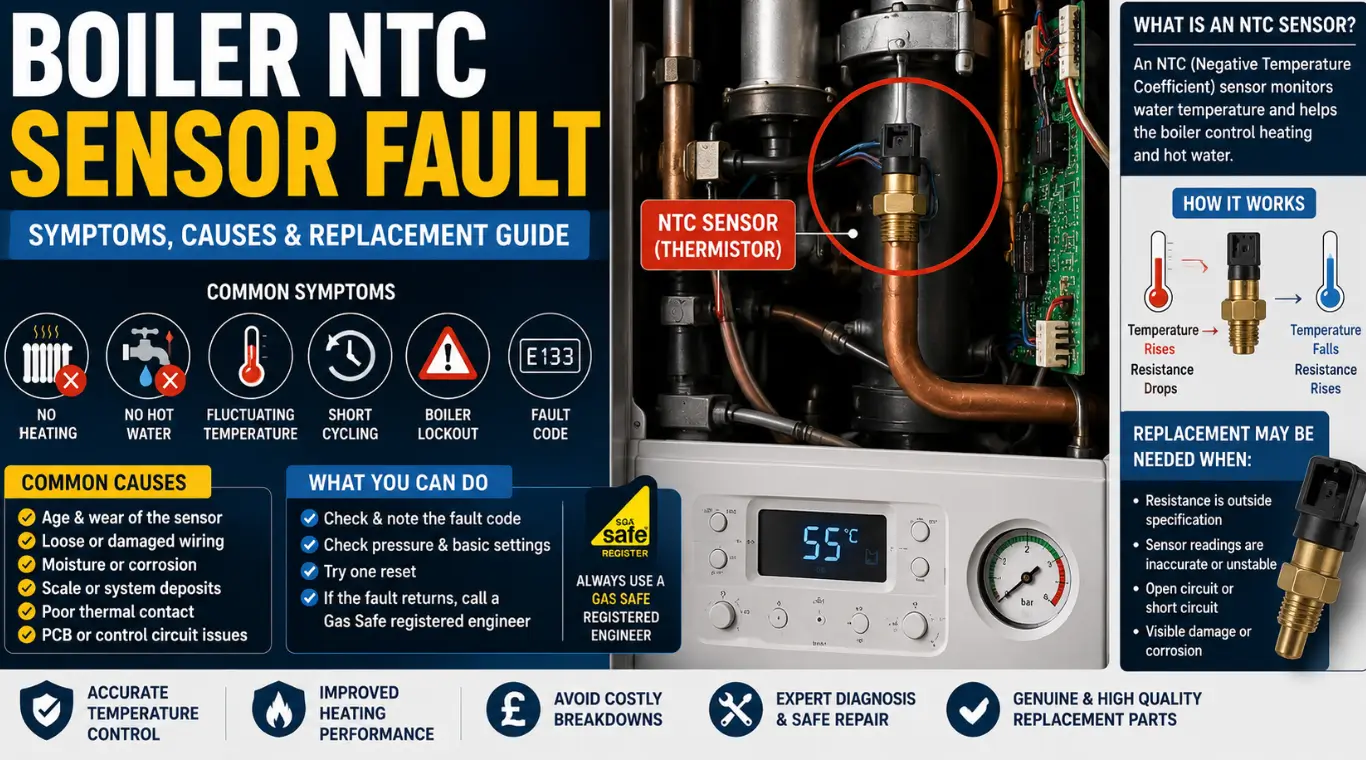
An NTC sensor is a temperature-sensitive electrical component inside a boiler. Its resistance decreases as the temperature rises, allowing the PCB to monitor water temperature and control boiler operation. If its readings become inaccurate, interrupted or unstable, the boiler may heat incorrectly, switch on and off repeatedly or display a fault code.
Homeowners should not remove the boiler casing or attempt to test the sensor. Internal inspection, electrical testing and replacement should be completed by a suitably qualified Gas Safe registered engineer.
What Is a Boiler NTC Sensor?
NTC stands for negative temperature coefficient.
An NTC thermistor is a resistor whose electrical resistance changes with temperature. As the sensor becomes warmer, its resistance falls. As it cools, its resistance rises.
The boiler’s PCB monitors this changing electrical value and uses it to estimate the temperature of the water passing through the appliance. This helps the boiler decide when to:
- Increase or reduce burner output
- Stop firing when the target temperature is reached
- Restart when the water cools
- Protect the boiler against excessive temperatures
- Control central heating or domestic hot water production
Depending on the boiler, separate sensors may monitor the flow temperature, return temperature or domestic hot water temperature. The number, position and specification of the sensors vary between boiler models.
Common Symptoms of a Boiler Temperature Sensor Fault
A boiler temperature sensor fault does not always produce one clear symptom. What happens depends on which sensor is affected and what reading the PCB receives.
| Symptom | How an NTC Sensor Fault May Be Involved |
| No heating | The PCB may incorrectly believe the heating water is already hot |
| No hot water | A domestic hot water sensor may fail to report the correct temperature |
| Water is only lukewarm | The boiler may reduce or stop firing before the water reaches the selected temperature |
| Water becomes excessively hot | The sensor may report a temperature lower than the actual water temperature |
| Short cycling | The boiler may repeatedly fire and stop because the reported temperature changes incorrectly |
| Erratic temperature display | The displayed temperature may jump, freeze or change unexpectedly |
| Boiler lockout | The PCB may detect an open circuit, short circuit or implausible temperature reading |
| Sensor-related fault code | The boiler may identify a flow, return or hot-water sensor problem |
| Heating works but hot water does not | A sensor used specifically for domestic hot water may be affected |
| Hot water works but heating does not | A flow or return temperature sensor may be giving an incorrect reading |
A sensor can also drift gradually rather than fail completely. In that situation, it may continue sending a believable but inaccurate reading, meaning a dedicated fault code might not appear immediately.
Does a Fault Code Confirm the Sensor Has Failed?
Not always.
Boiler manufacturers use different fault codes for sensor problems, and the meaning can vary between model ranges. A code referring to a flow, return or domestic hot water sensor may indicate:
- An open circuit
- A short circuit
- A disconnected plug
- Damaged wiring
- A poor electrical connection
- An NTC sensor outside its expected tolerance
- A fault within the PCB or sensor circuit
For example, manufacturer documentation may list a broken sensor, damaged cable, short circuit or defective electronic connection under related NTC fault codes. This shows why replacing the sensor solely because of a displayed code can lead to an incorrect repair. The boiler’s exact model and installation manual should therefore be checked before diagnosing the component.
What Causes an NTC Thermistor Fault?
Age and repeated heating cycles
Boiler sensors are exposed to regular changes in temperature. Over time, the sensor may deteriorate or move outside its expected resistance range.
Loose or damaged wiring
A sensor cannot communicate correctly with the PCB if its cable, connector or wiring harness is damaged. Loose plugs and corroded terminals can create intermittent readings that resemble a failed thermistor.
Moisture or corrosion
Water from a leak or previous repair may reach a sensor connection. Moisture can lead to corrosion, unstable readings or a short circuit.
Scale or system deposits
Deposits around a sensor may affect how quickly it responds to temperature changes. This does not always mean the electrical element itself has failed, but it can contribute to inaccurate or delayed readings.
Poor thermal contact
A sensor that is loose, incorrectly fitted or not making proper contact with the surface it monitors may report a temperature different from the actual water temperature.
PCB or control-circuit problems
The sensor may test correctly while the PCB receives or processes its signal incorrectly. Wiring and control-board checks are therefore important before ordering a replacement.
Safe Checks for Homeowners
There are only a few checks a homeowner should make.
Record the fault code
Write down the complete code before resetting the boiler. Take a photograph of the display where possible. The code should then be checked against the instructions for the exact boiler model rather than a general list for the manufacturer.
Check whether heating and hot water are both affected
Note whether:
- Heating works normally
- Hot water works normally
- Both services have stopped
- The problem happens only after the boiler warms up
- Water temperature changes unexpectedly
This information can help the engineer identify which sensor or circuit needs investigation.
Check the system pressure
Look at the boiler’s pressure gauge or digital display. Low pressure and poor circulation can sometimes cause temperature-related symptoms that may be mistaken for an NTC thermistor fault. Follow only the user instructions supplied with the boiler. Do not remove the casing or touch internal components.
Try one reset
A single reset may clear a temporary electronic interruption. However, repeated resetting should be avoided if the code returns or the boiler continues to lock out.
Contact a Gas Safe engineer
Stop using the boiler and arrange professional diagnosis if:
- The boiler repeatedly locks out
- Water becomes unusually hot
- The fault code returns after a reset
- Heating or hot water remains unreliable
- There is a leak from the boiler
- There are unusual noises or smells
Anyone employed to repair or service a domestic gas boiler must be Gas Safe registered and competent for the relevant type of work.
How Does an Engineer Test a Boiler NTC Sensor?
Testing should be completed using the instructions and technical information for the exact boiler.
A Gas Safe registered engineer may:
- Check the boiler’s fault history and live temperature readings.
- Inspect the sensor plug, terminals and wiring harness.
- Compare the displayed temperature with the actual temperature being measured.
- Electrically isolate the appliance before carrying out resistance testing.
- Measure the sensor’s resistance using a suitable multimeter.
- Compare the result with the manufacturer’s temperature-and-resistance chart.
- Repeat the comparison at different temperatures where necessary.
- Investigate the wiring or PCB if the sensor readings are correct.
The important point is that there is no single resistance value that applies to every boiler NTC sensor. Different thermistors can have very different resistance specifications. An engineer must compare the measured value with the correct chart for that boiler and sensor, rather than assuming every thermistor should produce the same reading.
A reading that does not change correctly as the temperature changes may indicate a faulty or drifting sensor. A completely open or shorted circuit may indicate a failed sensor, wiring fault or connection problem.
When Is Boiler Sensor Replacement Needed?
Boiler sensor replacement may be recommended when testing confirms that the thermistor:
- Has an open or short circuit
- Is outside the manufacturer’s expected resistance range
- Produces unstable readings
- Does not respond correctly to temperature changes
- Has visible damage or corrosion
- Has failed alongside a confirmed sensor-specific fault code
The sensor should not be replaced until the wiring and connections have also been checked. Fitting a new thermistor will not solve the problem if the actual cause is a damaged cable, loose plug or PCB fault.
Replacement should be completed by a Gas Safe registered engineer. Accessing the component may require the boiler casing to be removed, the appliance to be electrically isolated and part of the water circuit to be drained. The engineer must also check for leaks and confirm safe operation after the repair.
Finding the Correct Replacement Thermistor
NTC sensors that appear similar may have different electrical characteristics, connectors, seals or temperature ranges. Using the wrong sensor could produce inaccurate readings or another fault code.
Before ordering, check:
- Boiler manufacturer
- Exact boiler model
- Boiler GC number
- Manufacturer part number
- Number and shape of electrical connections
- Position or function of the original sensor
The safest approach is to compare the number printed on the existing component with the replacement listing. Where the part number is unavailable, the boiler’s GC number and full model details can help identify the correct option.
Shop Boiler Thermistors and Temperature Sensors
Heating & Catering Parts supplies replacement thermistors and boiler temperature sensors for a wide range of boiler brands and models. Browse our Thermistors category to find suitable flow, return and domestic hot water sensors. Customers can search using the boiler brand, model, GC number or manufacturer part number. Always confirm compatibility before ordering. A fault code should be professionally diagnosed before a replacement sensor is fitted.
Frequently Asked Questions
Yes. If the boiler uses a separate sensor to monitor domestic hot water, an incorrect reading may cause the boiler to stop firing too early, produce lukewarm water or fail to respond correctly to hot-water demand. Other components can produce the same symptoms, so testing is required.
Yes. If the sensor incorrectly reports that the water has reached its target temperature, the PCB may stop the burner. When the reported temperature falls again, the boiler restarts, creating repeated short firing cycles.
Yes. A completely disconnected or shorted sensor is more likely to trigger a code. A sensor that has drifted slightly may still send a plausible reading, even though the reading is inaccurate.
Homeowners should not remove the boiler casing or disconnect internal wiring. Testing requires electrical isolation, a multimeter, the correct manufacturer chart and an understanding of the boiler’s control system. Arrange diagnosis by a Gas Safe registered engineer.
No. The problem may be caused by wiring, a loose connection, moisture, poor thermal contact or the PCB. These should be checked before replacing the sensor.
No. Their resistance characteristics, connectors, dimensions and intended positions can differ. Order using the exact boiler model, GC number or manufacturer part number.
Key Takeaways
- A boiler NTC sensor fault can lead to incorrect temperature readings, short cycling, and boiler lockout, affecting heating and hot water.
- NTC stands for negative temperature coefficient, and these sensors monitor water temperature by changing resistance with temperature changes.
- Common symptoms of a fault include no heating, lukewarm water, and erratic temperature displays, but other issues may also cause similar problems.
- Boiler sensor replacement may be necessary if testing confirms issues like open circuits, unstable readings, or visible damage.
- Always consult a Gas Safe registered engineer for diagnosis and repairs, as improper handling can cause further issues.