Boiler Electrodes Explained: Ignition & Flame Detection Problems
A boiler ignition electrode fault can prevent the burner from lighting, cause repeated ignition attempts or make the boiler light briefly before shutting down. However, these symptoms do not always mean the electrode itself needs replacing.
The ignition system includes the spark electrode, flame-sensing electrode or ionisation probe, connecting leads, burner, gas valve, appliance earth and boiler PCB. A Gas Safe engineer must test the complete ignition sequence before deciding which part has failed. This guide explains how boiler electrodes work, common fault symptoms, possible causes and how the correct replacement should be identified.
Table of contents
- Quick Answer
- What Are Boiler Electrodes?
- What Does an Ignition Electrode Do?
- What Does a Flame-Sensing Electrode Do?
- Ignition Electrode vs Flame-Sensing Electrode
- Symptoms of a Boiler Ignition Electrode Fault
- Boiler Ignites but Then Cuts Out
- Common Boiler Electrode Problems
- What Causes Boiler Electrodes to Deteriorate?
- Why a Boiler May Not Ignite Even When the Electrode Is Working
- Safe Checks for Homeowners
- Do Not Clean or Adjust Boiler Electrodes Yourself
- What Will a Gas Safe Engineer Check?
- Fault Codes That May Involve the Ignition System
- Does a Faulty Electrode Always Need Replacing?
- How to Identify the Correct Boiler Electrode
- Can Electrode Problems Be Prevented?
- Find the Correct Boiler Electrode
- Frequently Asked Questions
Quick Answer
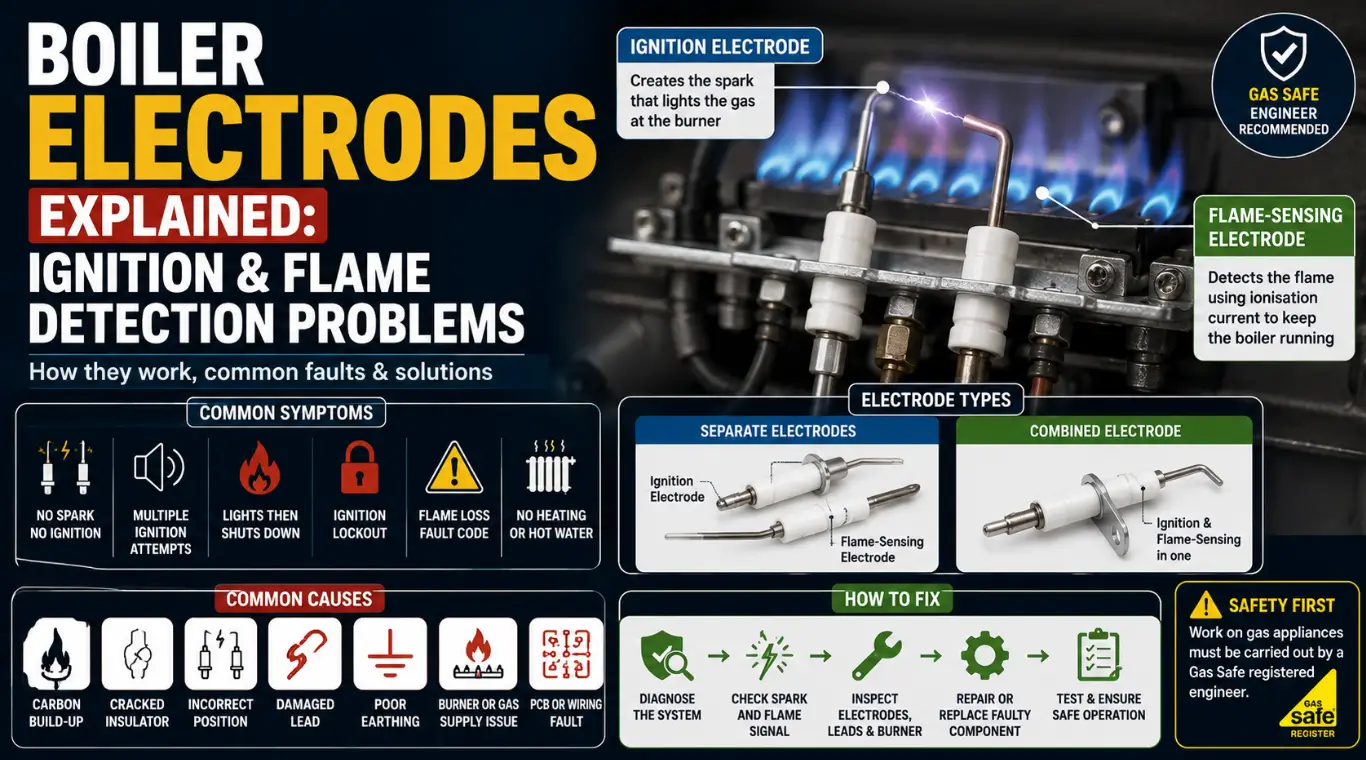
The ignition electrode creates the spark used to light the gas at the burner. Once the flame is established, a flame-sensing electrode confirms its presence so the PCB can allow the boiler to continue operating.
If the burner does not light, or if it lights but the flame cannot be confirmed, the boiler normally stops the gas supply and enters a safety lockout. Worn electrodes are one possible cause, but gas supply, combustion, wiring, gas-valve and PCB faults can produce similar symptoms. Manufacturer fault-finding information therefore treats electrodes as one part of a wider ignition system.
What Are Boiler Electrodes?
Boiler electrodes are normally positioned near the burner inside the combustion area. Depending on the boiler design, there may be separate electrodes for ignition and flame detection or a combined assembly that performs both functions.
The original servicing material supplied for this article distinguishes between the spark electrode, which lights the burner, and the rectification probe, which proves that a flame is present.
Because these components are inside or connected to the combustion system, they are not suitable for homeowner inspection, cleaning or adjustment.
What Does an Ignition Electrode Do?
When the boiler receives a demand for heating or hot water, it begins a controlled startup sequence. Once the required safety conditions have been confirmed, the ignition system supplies a high voltage to the spark electrode.
The spark jumps between the electrode and the designated burner or earth point. This should ignite the gas-and-air mixture at the burner.
If the spark is weak, occurs in the wrong position or does not happen at all, the burner may fail to light. The boiler will normally stop the ignition attempt and may try again before displaying a fault code or entering lockout.
An ignition problem may be associated with:
- A worn or contaminated spark electrode
- Cracked electrode insulation
- Incorrect electrode position
- A damaged ignition lead
- An ignition transformer or generator problem
- A wiring or connection fault
- A PCB problem
It can also occur when the electrode produces a suitable spark but there is no correct gas supply to ignite.
What Does a Flame-Sensing Electrode Do?
Lighting the burner is only the first stage. The boiler must also confirm that a stable flame exists.
A flame-sensing electrode—also called an ionisation electrode, flame-detection electrode or rectification probe—sits within the burner flame. The flame allows a very small electrical current to pass in a way that can be detected by the boiler’s control system.
The PCB uses this flame signal to confirm successful ignition. If the signal is absent, too weak or considered unreliable, the boiler closes the gas valve and stops operation.
This is an important safety function. It prevents unburnt gas from continuing to enter the combustion chamber when a flame has not been safely established.
Ignition Electrode vs Flame-Sensing Electrode
| Component | Main Function | Possible Symptoms When There Is a Problem |
| Ignition or spark electrode | Creates the spark that lights the burner | No spark, delayed ignition, repeated clicking, failed ignition or lockout |
| Flame-sensing or ionisation electrode | Confirms that a flame has been established | Burner lights and then stops, flame-loss fault, repeated startup attempts or lockout |
| Combined electrode assembly | Provides ignition and flame detection in one assembly | Either ignition failure, flame-detection failure or both |
Not every boiler uses the same arrangement. Some models have separate ignition and sensing electrodes, while others use a combined ignition and monitoring component. The correct design must be confirmed from the exact boiler model and manufacturer documentation. Vaillant documentation, for example, refers to both ignition and monitoring electrodes within its diagnostic information.
Symptoms of a Boiler Ignition Electrode Fault
A possible boiler ignition electrode fault may produce one or more of the following symptoms:
- The boiler clicks or attempts to spark but does not ignite
- There is no normal ignition sound
- The boiler makes several startup attempts
- Heating and hot water stop working
- The burner starts intermittently
- The boiler enters ignition lockout
- The fault returns soon after a reset
- Ignition takes longer than normal
- The boiler lights but switches off within a few seconds
- A flame-loss or flame-detection code appears
These symptoms should not be treated as confirmation that the electrode is faulty.
For example, Worcester fault-finding information for an EA flame-not-detected fault also directs engineers to investigate the gas supply, power supply, ignition leads, ionisation circuit, flue and combustion conditions. Baxi similarly lists the gas supply, sensing electrode, spark electrode and cable as possible areas connected with an E133 fault.
Boiler Ignites but Then Cuts Out
A boiler that lights and then shuts down shortly afterwards may have a flame-detection problem rather than a spark problem.
In this situation, the spark has apparently performed its initial function and the burner has lit. However, the PCB may not be receiving an acceptable flame signal.
Possible causes include:
- A dirty, damaged or incorrectly positioned sensing electrode
- A damaged ionisation lead
- A loose electrical connection
- Poor appliance earthing
- Moisture affecting the electrode or electronics
- An unstable burner flame
- Incorrect combustion conditions
- A gas-pressure or gas-valve fault
- A PCB flame-monitoring fault
An engineer should confirm that a genuine flame is being established and then test why the boiler is not recognising or maintaining it.
Common Boiler Electrode Problems
| Possible Cause | How It May Affect the Boiler | Who Should Investigate |
| Carbon or combustion deposits | Deposits may interfere with the spark or weaken flame detection | Gas Safe engineer |
| Cracked ceramic insulation | Electrical energy may track away from the intended spark point | Gas Safe engineer |
| Worn or damaged electrode tip | May produce an unreliable spark or flame signal | Gas Safe engineer |
| Incorrect electrode position or gap | The spark may occur in the wrong place, or the sensing probe may not sit correctly in the flame | Gas Safe engineer |
| Damaged ignition lead | High-voltage energy may not reach the electrode correctly | Gas Safe engineer |
| Damaged sensing lead | The flame signal may not reach the PCB reliably | Gas Safe engineer |
| Loose connection | May produce intermittent ignition or detection faults | Gas Safe engineer |
| Poor appliance earth | Can interfere with ignition and flame rectification | Gas Safe engineer |
| Moisture or water ingress | May cause corrosion, electrical tracking or intermittent signals | Gas Safe engineer |
| Burner contamination or damage | The flame may not establish correctly around the electrode | Gas Safe engineer |
| Gas supply or gas-valve fault | A spark may be present without sufficient gas reaching the burner | Gas Safe engineer or gas supplier |
| PCB or ignition-control fault | The electrode may not receive the correct ignition supply, or the flame signal may not be processed correctly | Gas Safe engineer |
What Causes Boiler Electrodes to Deteriorate?
Boiler electrodes operate close to the burner and are exposed to repeated heating and cooling cycles. Over time, this environment can affect the metal tips, ceramic insulation and connecting leads.
Heat and normal wear
Repeated operation can gradually wear or distort an electrode. The tip may become eroded, and the ceramic insulator can become brittle.
Combustion deposits
Deposits around the burner and electrode can affect both the spark route and flame signal. Deposits may also indicate that the burner or combustion system requires wider investigation rather than simple electrode cleaning.
Cracked ceramic
The ceramic section electrically insulates the electrode. If it cracks, electricity may track to the boiler casing or another metal surface instead of reaching the correct spark point.
Incorrect positioning
Electrodes must be positioned according to the boiler manufacturer’s specification. A small change in the spark gap, angle or location can affect ignition reliability.
A replacement electrode should therefore not be bent or positioned by guesswork. The engineer must follow the instructions for that particular boiler.
Moisture or condensate
Water ingress, condensate leakage or moisture around electrical components can cause corrosion and unreliable ignition signals. The source of the moisture must be found rather than only replacing the affected electrode.
Damaged cables and connectors
The electrode may be serviceable, but a damaged lead or loose connector can interrupt the ignition voltage or flame-sensing circuit.
Why a Boiler May Not Ignite Even When the Electrode Is Working
“Boiler not igniting” is a broad symptom. Replacing the electrode without testing the wider system can result in an unnecessary repair.
Other possible causes include:
- No gas supply to the property
- A prepayment meter without sufficient credit
- Low gas pressure
- Air within the gas supply after interruption
- A frozen or blocked condensate pipe
- A gas-valve fault
- A contaminated or damaged burner
- A fan, flue or air-pressure problem
- An ignition transformer fault
- Damaged internal wiring
- Incorrect appliance earthing
- A PCB fault
Official fault guidance illustrates this wider diagnostic requirement. Vaillant lists several potential causes for unsuccessful ignition under F.28, while Ideal describes L2 as a flame-loss or ignition-lockout condition rather than a specific electrode failure.
Safe Checks for Homeowners
Homeowners should not remove the boiler casing, enter the combustion chamber or touch electrodes, burners, ignition leads or gas components.
However, a few external checks may help before arranging a repair.
1. Record the fault code
Write down the full code shown on the display. Do not assume that a code has the same meaning across every model from the same manufacturer.
Check the boiler’s user instructions for the model-specific description.
2. Check whether there is a general gas-supply problem
Where another gas appliance is available, check whether it is operating normally. If no gas appliance works, the problem may affect the property’s gas supply rather than only the boiler. For a prepayment meter, confirm that credit is available.
3. Check the boiler has electrical power
Confirm that the display and normal controls are operating. Do not remove electrical covers or investigate internal wiring.
4. Check the heating controls
Make sure the programmer, room thermostat or smart control is requesting heating. For a combi boiler, check whether opening a hot tap creates a hot-water demand on the display.
5. Look for an external condensate problem
During freezing weather, an external condensate pipe may freeze and contribute to an ignition lockout on certain boilers. Only carry out checks permitted by the manufacturer’s user instructions.
6. Reset the boiler once
Follow the exact reset procedure in the user manual. A single reset may clear a temporary interruption.
If the boiler fails again or the fault immediately returns, stop resetting it and arrange an engineer visit. Manufacturer guidance commonly recommends professional assistance when an ignition fault remains after an approved reset.
Do Not Clean or Adjust Boiler Electrodes Yourself
Electrodes are not externally accessible user controls. Access may involve removing a case that forms part of the room-sealed combustion system.
Do not attempt to:
- Remove the boiler casing
- Clean an electrode with abrasive material
- Bend or realign electrode pins
- Adjust the spark gap
- Disconnect ignition leads
- Test the electrode with a multimeter
- Run the boiler with covers removed
- Replace an electrode without the correct qualifications
Gas Safe Register states that anyone fixing, fitting or servicing a gas boiler must be appropriately Gas Safe registered. Its guidance also explains that work involving an integral combustion-chamber case, gas-carrying parts or combustion controls falls within the relevant gas-work safety boundary.
What Will a Gas Safe Engineer Check?
An engineer should diagnose the ignition sequence rather than assuming that a visible fault code identifies one failed part.
Depending on the boiler and fault, checks may include:
- Confirming the manufacturer’s fault description
- Observing where the ignition sequence stops
- Checking whether a spark is present
- Confirming the spark occurs at the correct location
- Inspecting the electrode tips and ceramic insulation
- Checking electrode position against the service manual
- Inspecting seals and mounting arrangements
- Checking ignition and sensing leads
- Testing relevant connections, polarity and appliance earth
- Assessing the flame signal using the manufacturer’s procedure
- Inspecting burner condition
- Checking gas inlet and operating conditions
- Checking gas-valve operation
- Examining wiring and PCB outputs
- Testing combustion and safe operation after repair
There is no universal spark gap, resistance value or flame-current figure suitable for every boiler. The engineer must use the technical data for the specific make, model and electrode arrangement.
Fault Codes That May Involve the Ignition System
The following are examples of codes that may lead an engineer to inspect ignition or flame-detection components. They do not automatically mean that an electrode is faulty.
| Boiler Brand | Example Fault Code | General Meaning on Relevant Models |
| Worcester Bosch | EA | Flame not detected |
| Baxi | E133 | Gas-supply or ignition-related fault |
| Vaillant | F.29 | Ignition unsuccessful during startup |
| Vaillant | F.28 | Flame lost during operation on relevant models |
| Ideal | L2 or F2 | Flame loss or ignition lockout |
Fault meanings and numbering can differ between boiler ranges and generations. Always check the exact model manual before diagnosing the fault or ordering a part.
Does a Faulty Electrode Always Need Replacing?
Not automatically.
An engineer may find that the electrode is serviceable and that the real problem is a damaged cable, poor connection, burner condition, gas-valve fault, earthing problem or PCB issue.
Where an electrode is worn, cracked, distorted, heavily deteriorated or unable to meet the manufacturer’s requirements, replacement may be the appropriate repair.
The engineer should also inspect related seals and gaskets. Some electrode assemblies require a new combustion seal when removed, while others are supplied as part of a complete kit.
How to Identify the Correct Boiler Electrode
Boiler electrodes can look very similar while having different dimensions, connectors, brackets, spark gaps and applications. Ordering by appearance alone is unreliable.
Before purchasing a replacement,
Boiler manufacturer
Confirm the correct brand.
Complete boiler model
Include output, range and generation where shown.
GC number
The Gas Council number can help separate similar models.
Manufacturer part number
Compare the number from the original part, packaging or technical documentation.
Electrode type
Confirm whether it is an ignition electrode, flame-sensing electrode or combined assembly.
Required kit contents
Check whether the replacement includes the bracket, lead, seal or gasket required for the repair.
Heating & Catering Parts supplies ignition electrodes, flame-sensing electrodes, ionisation probes and combined assemblies for a range of boiler brands. Products can be checked using boiler compatibility, GC numbers and manufacturer part numbers.
Can Electrode Problems Be Prevented?
Normal wear cannot be eliminated, but correct servicing can help identify deterioration before it becomes a recurring ignition fault.
A boiler should be serviced according to the manufacturer’s instructions by a Gas Safe registered engineer. During servicing, the engineer may inspect relevant ignition components, burner condition, seals and combustion performance where required by the appliance procedure.
Gas Safe Register advises that boiler servicing should include checks and tests in line with the appliance manufacturer’s instructions.
Early investigation is especially important where the boiler:
- Has started taking longer to ignite
- Makes repeated ignition attempts
- Develops intermittent flame-loss faults
- Locks out more than once
- Shows signs of water or condensate leakage
- Produces unusual ignition noises
Find the Correct Boiler Electrode
Heating & Catering Parts stocks boiler ignition electrodes, flame-sensing electrodes, ionisation probes, leads and combined electrode kits for a wide range of manufacturers.
Before ordering, ask a Gas Safe engineer to confirm the diagnosis. Then use the boiler model, GC number or manufacturer part number to check compatibility.
Browse boiler electrodes and ignition parts.
When requesting help identifying a component, provide:
- The boiler make
- Complete model name
- GC number
- Existing part number
- A clear image of the boiler data plate
- A clear image of the existing component, where safely available from the engineer
Frequently Asked Questions
Yes. A damaged or incorrectly positioned ignition electrode may prevent the burner from lighting. However, gas-supply, gas-valve, burner, wiring and PCB faults can cause the same symptom.
The boiler may be producing a spark without receiving the correct gas flow, or the spark may be weak or occurring in the wrong place. A Gas Safe engineer must assess the complete ignition sequence.
The flame may not be detected reliably by the sensing electrode and PCB. The cause could also be an unstable flame, poor earthing, damaged wiring, incorrect combustion, a gas-valve problem or a PCB fault.
No. The electrode is normally inside the boiler’s combustion area. Do not remove the boiler casing or attempt to clean, adjust or test internal ignition components.
You can perform one reset if the boiler’s user manual instructs you to do so. If the fault returns, do not continue resetting the boiler. Arrange diagnosis by a Gas Safe registered engineer.
There is no reliable fixed replacement interval for every boiler. Service life depends on the appliance design, operating conditions, burner condition, servicing and normal wear.
No. Ignition and flame-loss codes normally cover several possible causes. The electrode must be tested as part of the complete ignition and combustion system.
Sometimes. Some boilers use separate electrodes, while others use a combined assembly. Check the exact boiler model and part number before ordering.
Key Takeaways
- Boiler electrodes ignite the gas and confirm flame presence; faults can cause ignition failure or lockout.
- Common causes of electrode issues include wear, incorrect positioning, and dirt accumulation.
- Homeowners should avoid inspecting or cleaning electrodes and should record fault codes for engineers.
- An engineer must check the entire ignition system, as symptoms may point to broader issues beyond just electrodes.
- Replacement requires attention to specific boiler models, parts, and specifications to ensure compatibility.