How Often Should a Boiler Be Serviced in the UK?
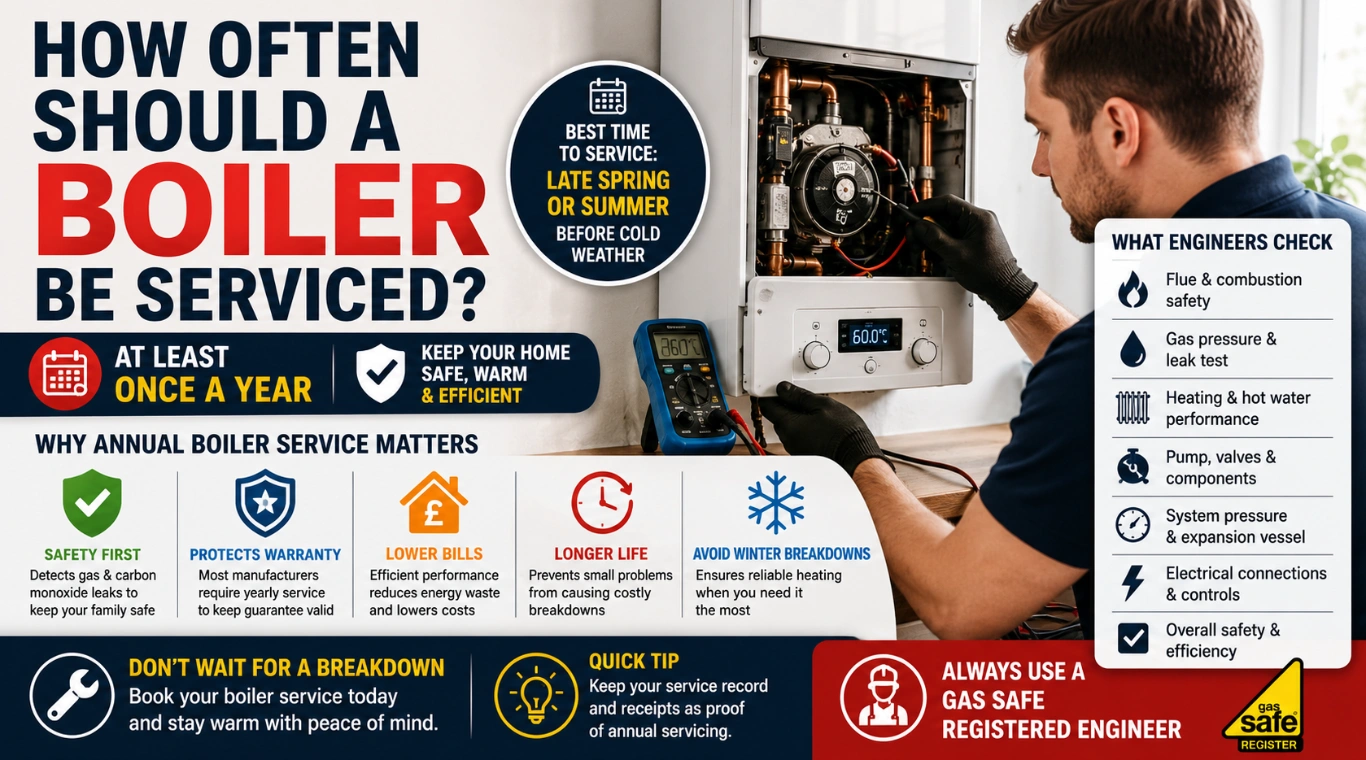
A boiler should generally be serviced once every year by a suitably qualified heating professional. Annual servicing helps identify safety issues, maintain efficient operation and detect developing faults before they become expensive breakdowns.
For homeowners, the best time to arrange a boiler service is usually during spring or summer, before the heating system is heavily used in autumn and winter. However, the exact servicing requirements can depend on the boiler manufacturer, warranty conditions and installation.
A boiler service is more than simply checking whether the appliance still works. A qualified engineer should inspect the appliance, assess its operation and carry out the relevant safety and performance checks for that boiler.
Table of contents
- Quick Answer: How Often Should a Boiler Be Serviced?
- Why Does a Boiler Need Servicing Every Year?
- What Happens During a Boiler Service?
- What Boiler Parts Are Checked During Servicing?
- Does Boiler Servicing Improve Efficiency?
- Can Annual Servicing Prevent Boiler Breakdowns?
- Does Boiler Servicing Keep the Warranty Valid?
- What Happens If You Do Not Service Your Boiler?
- When Is the Best Time to Service a Boiler?
- What Are the Warning Signs That a Boiler Needs Attention?
- Step-by-Step: What Should You Do Before a Boiler Service?
- What Can Homeowners Safely Check?
- Boiler Service vs Boiler Repair: What Is the Difference?
- How Often Should a New Boiler Be Serviced?
- What Replacement Parts Might Be Needed After a Boiler Service?
- What You Should Ask the Engineer After the Service
- Conclusion
- Frequently Asked Questions
Quick Answer: How Often Should a Boiler Be Serviced?
For most domestic gas boilers, annual servicing is recommended.
A yearly service can help:
- Check the boiler is operating safely.
- Identify potential combustion or flue problems.
- Detect developing component faults.
- Check the appliance and heating system.
- Maintain efficient operation.
- Provide evidence of servicing where required by the manufacturer.
- Reduce the likelihood of unexpected breakdowns.
If your boiler is covered by a manufacturer’s warranty, check the warranty conditions carefully. Some manufacturers require annual servicing and other conditions to maintain warranty cover.
Important: Boiler servicing and repairs should be carried out by an appropriately qualified professional. Gas work on domestic boilers must be completed by a Gas Safe registered engineer.
Why Does a Boiler Need Servicing Every Year?
A boiler operates for thousands of hours over its lifetime. Components are repeatedly exposed to heat, pressure, water and electrical operation.
Small problems can therefore develop gradually.
For example, an engineer may identify:
- Deteriorating seals.
- Faulty sensors.
- Poor combustion.
- Flue problems.
- Water-pressure issues.
- Pump problems.
- Expansion vessel issues.
- Electrical faults.
- Blockages or contamination.
- Unusual operating conditions.
Finding a developing fault during routine maintenance can be preferable to discovering it when the boiler stops working during freezing weather.
What Happens During a Boiler Service?
The exact procedure varies according to the boiler and manufacturer instructions.
A qualified engineer will typically assess several areas of the appliance and heating system.
1. Visual Inspection
The engineer may inspect the boiler and surrounding installation for obvious issues.
This can include checking:
- Boiler condition.
- Flue arrangement.
- Pipework.
- Connections.
- Signs of water leakage.
- Signs of corrosion.
- Condensate arrangements.
- Ventilation requirements where applicable.
The engineer should follow the manufacturer’s servicing instructions for the specific appliance.
2. Flue and Combustion Checks
The flue safely removes combustion products from the boiler.
A problem with the flue or combustion process can create a serious safety risk.
The engineer may therefore check the appliance’s combustion performance using appropriate equipment and procedures.
This is particularly important because carbon monoxide cannot be seen, smelled or tasted.
A carbon monoxide alarm should also be installed in accordance with current requirements and manufacturer guidance.
3. Boiler Operation
The engineer will check that the boiler operates correctly.
They may assess:
- Ignition.
- Burner operation.
- Heating response.
- Hot-water operation on a combi boiler.
- Temperature control.
- Pressure.
- Fault history.
- Unusual noises.
- General operating performance.
If the boiler displays an error code, the engineer can investigate the underlying cause rather than simply resetting it.
What Boiler Parts Are Checked During Servicing?
A service may involve inspection of several components depending on the boiler.
Common components include:
Burner
The burner is responsible for combustion. Its condition and operation can affect efficiency and safe combustion.
Heat Exchanger
The heat exchanger transfers heat from combustion to the heating or hot-water circuit.
Deposits, corrosion or restricted circulation can affect performance.
Pump
The circulation pump moves heating water around the system.
A developing pump fault can cause:
- Cold radiators.
- Overheating.
- Boiler lockouts.
- Unusual humming or grinding noises.
- Poor heating circulation.
- Expansion Vessel
The expansion vessel accommodates the increase in water volume as the heating system warms.
A problem with the vessel can contribute to abnormal pressure increases and subsequent pressure loss.
Pressure Relief Valve
The PRV protects the heating system from excessive pressure.
A leaking or repeatedly discharging PRV can contribute to falling boiler pressure.
Sensors and Thermistors
NTC thermistors monitor temperature and send information to the boiler’s PCB.
An inaccurate sensor can cause incorrect temperature control, cycling or fault codes.
Condensate System
The condensate pipe and trap should be checked where applicable.
A blocked condensate system can prevent a condensing boiler from operating correctly.
Does Boiler Servicing Improve Efficiency?
It can help maintain efficient operation, particularly where servicing identifies combustion, control, circulation or component problems.
However, servicing should not be presented as a guarantee of lower energy bills.
Energy consumption also depends on:
- Boiler size.
- Boiler efficiency.
- Heating controls.
- Thermostat settings.
- Property insulation.
- System design.
- Hot-water demand.
- Heating habits.
- Boiler condition.
A properly maintained appliance can operate closer to its intended performance than one with unresolved faults.
Can Annual Servicing Prevent Boiler Breakdowns?
Annual servicing cannot prevent every breakdown.
Boiler components can fail unexpectedly, even when an appliance has been maintained correctly.
However, servicing provides an opportunity to identify problems before they develop into complete failures.
For example:
Small pump problem → poor circulation → overheating → boiler lockout
An engineer may identify abnormal pump operation before the boiler eventually stops working.
Similarly:
Pressure problem → repeated pressure loss → low-pressure lockout
Finding the cause early can prevent repeated emergency call-outs.
Does Boiler Servicing Keep the Warranty Valid?
It can be an important requirement.
Many boiler manufacturers specify servicing conditions within their warranty terms. These conditions can include:
- Annual servicing.
- Registration within a specified period.
- Correct installation.
- Completion of commissioning documentation.
- Use of approved installation procedures.
- Servicing by an appropriately qualified engineer.
However, warranty conditions differ between manufacturers and boiler ranges.
Therefore, homeowners should check the exact warranty documentation for their appliance.
Do not assume that every boiler has identical servicing requirements.
What Happens If You Do Not Service Your Boiler?
Skipping one service does not automatically mean the boiler will fail.
However, long gaps between services can increase the likelihood that developing problems remain undetected.
Potential consequences include:
- Undetected component deterioration.
- Reduced reliability.
- Poor combustion.
- Heating problems.
- Increased risk of unexpected breakdown.
- Potential warranty issues.
- Higher repair costs when a small problem becomes a larger one.
A boiler that appears to be working normally can still require inspection.
When Is the Best Time to Service a Boiler?
Spring and Summer
Spring and summer are often convenient times because the central heating system is used less frequently.
Advantages include:
- Engineers may have greater availability.
- Faults can be addressed before winter.
- Replacement parts can be sourced before heating demand increases.
- Homeowners can avoid discovering a problem during a cold spell.
Autumn
Autumn is also a sensible time if the boiler has not yet been serviced.
The important point is not to wait until the boiler develops a fault.
Winter
A boiler can still be serviced during winter.
However, if the appliance develops a problem during cold weather, engineer availability can become more limited because demand for heating repairs increases.
What Are the Warning Signs That a Boiler Needs Attention?
You should arrange professional investigation if you notice:
1. Repeated Fault Codes
A recurring fault code should not simply be reset repeatedly.
2. Unusual Boiler Noises
Examples include:
- Banging.
- Kettling.
- Grinding.
- Humming.
- Whistling.
3. Repeated Pressure Loss
If you repeatedly need to top up the system, there may be an underlying leak or component fault.
4. Radiators Not Heating Properly
Poor circulation can indicate pump, valve, air, sludge or control problems.
5. Hot Water Going Hot and Cold
On a combi boiler, fluctuating hot water can have several causes, including flow, sensor, diverter-valve or heat-exchanger problems.
6. Boiler Lockouts
Repeated lockouts require diagnosis rather than continuous resetting.
7. Water Leaks
Visible water around the boiler or heating system requires investigation.
Step-by-Step: What Should You Do Before a Boiler Service?
Time needed: 5 minutes
You can prepare useful information for the engineer without opening the boiler.
- Find the Boiler Model
Record the:
Manufacturer.
Boiler model.
Serial number if available.
GC number where applicable. - Record Any Fault Codes
Take a photograph of the display if a code appears.
- Note Any Symptoms
Record whether you have noticed:
No heating.
No hot water.
Low pressure.
Pressure increases.
Unusual noises.
Radiators staying cold.
Repeated lockouts. - Check Your Warranty Documents
Look for the manufacturer’s servicing requirements.
- Arrange a Qualified Engineer
For a domestic gas boiler, use a suitably qualified Gas Safe registered engineer.
What Can Homeowners Safely Check?
There are several basic checks homeowners can make without opening the boiler.
You can normally:
- Check the boiler display.
- Check the system pressure against the manufacturer’s instructions.
- Check the thermostat.
- Check whether heating controls are operating.
- Look for visible leaks.
- Check for unusual noises.
- Check whether radiators are heating normally.
- Check whether fault codes are displayed.
Do not remove the boiler casing or attempt internal gas, combustion or electrical repairs.
Boiler Service vs Boiler Repair: What Is the Difference?
A boiler service is planned preventative maintenance and safety inspection.
A boiler repair is performed when a specific fault has already been identified.
For example:
Service:
Engineer identifies an abnormal component during routine inspection.
Repair:
Engineer replaces the faulty component after diagnosis.
A service does not necessarily mean replacing parts.
Likewise, a boiler that requires a repair should not automatically be condemned simply because it has developed a fault.
How Often Should a New Boiler Be Serviced?
A new boiler should normally be serviced according to the manufacturer’s requirements.
Do not assume that a new boiler does not need servicing.
A new appliance can still require annual maintenance, and warranty conditions may specify servicing intervals.
Always check the specific manufacturer’s warranty documentation.
What Replacement Parts Might Be Needed After a Boiler Service?
A service does not automatically require replacement parts.
If a fault is diagnosed, common boiler components that may require replacement include:
- Boiler pumps.
- PCBs.
- Fans.
- Gas valves.
- Diverter valves.
- Expansion vessels.
- Pressure relief valves.
- Thermistors.
- NTC sensors.
- Electrodes.
- Heat exchangers.
- Seals and service kits.
- Condensate components.
Always identify the exact boiler before ordering a replacement part.
Useful information includes:
- Boiler manufacturer.
- Full model.
- GC number.
- Serial number.
- Manufacturer part number.
- Number printed on the existing component.
Heating & Catering Parts supplies replacement boiler components for a wide range of UK boiler brands.
What You Should Ask the Engineer After the Service
Before the engineer leaves, ask:
- Did the boiler pass its service checks?
- Were any faults identified?
- Is the boiler operating safely?
- Does anything need replacing?
- Is the heating system pressure normal?
- Are there any signs of circulation problems?
- Is the condensate system satisfactory?
- Is anything required to maintain my warranty?
- When should the next service be carried out?
- Do you recommend any additional heating-system maintenance?
This can help distinguish essential repairs from optional improvements.
Conclusion
A boiler should generally be serviced annually by a suitably qualified heating professional. Regular servicing provides an opportunity to check the appliance’s safety, operation and condition before small problems become major breakdowns.
The best time to arrange a service is often spring or summer, before the heating season begins. However, servicing should not be delayed simply because winter has already arrived.
Annual servicing also matters for warranty compliance, but requirements vary between manufacturers and boiler ranges. Always check the exact warranty conditions for your appliance.
If your boiler is showing a fault code, repeatedly losing pressure, making unusual noises, producing inconsistent hot water or frequently locking out, do not wait for the next routine service. Arrange professional diagnosis.
Frequently Asked Questions
Most domestic gas boilers should be serviced once a year. Always check the manufacturer’s instructions and warranty conditions because requirements can vary.
A boiler may continue working without annual servicing, but developing safety, combustion or component problems may remain undetected. Some manufacturer warranties may also require evidence of regular servicing.
Summer is often a convenient time because heating demand is lower and engineers may have better availability. It also allows faults to be addressed before winter.
No service can guarantee that a boiler will never break down. However, routine maintenance can identify developing faults and help maintain reliable operation.
Yes. A new boiler should still be serviced according to the manufacturer’s requirements. Warranty conditions may specifically require annual servicing.
Key Takeaways
- A boiler should generally be serviced annually by a qualified professional to ensure safety and efficiency.
- The best times for boiler servicing are during spring or summer, prior to heavy usage in autumn and winter.
- Annual servicing can identify potential problems and maintain reliable operation, but it doesn’t guarantee to prevent all breakdowns.
- Homeowners should monitor for warning signs like repeated fault codes, unusual noises, or pressure drops and seek professional help.
- Service requirements can vary by manufacturer; always check warranty conditions to maintain validity.